
Uncategorized
UNREMEMBERED FRUIT: The Rise and Fall of the ‘Woodpecker Apple’
By Ken Zurski
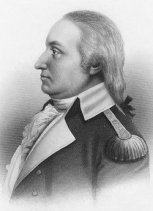
Meet Loammi Baldwin.
He was a colonel in the Revolutionary War.
He commanded several regiments during the battles of Concord and Lexington and accompanied General George Washington when the future president famously crossed the Delaware River to surprise the Hessian’s in Trenton, New Jersey.
But that’s not all. Baldwin was also a member of the Academy of Arts and Sciences who like Benjamin Franklin conducted experiments in electricity. He was elected to the Massachusetts General Assembly and as an engineer was instrumental in pioneering a waterway that connected Boston Harbor to the Merrimac River, known as the Middlesex Canal.
Yes, Col. Baldwin is certainly a man who held many distinguished titles and honors. For some, he is considered to be the “Father of Civil Engineering.” But today he is best remembered – or unremembered, if you will – for one thing: an apple.
Let’s backtrack.
While building the Middlesex Canal, Baldwin visited the farm of a man named William Butters. It was on a recommendation from a friend that Butters had grown the sweetest apple in all of New England. Butters told Baldwin that the tree was frequented by woodpeckers who in addition to the apples would eat tree grubs and other damaging insects. Butters called the apple a “Woodpecker” after the bird, or ‘Pecker for short. Others had dubbed it “Butters Apple.”
Baldwin was so impressed that he planted a row of ‘Pecker trees near his plantation home in Woburn, Massachusetts.”The tree was a seedling,” a historian wrote of Baldwin’s interest, “but the apple had so fine a flavor that he returned at another season to cut some scions, and these being grafted into his own trees, produced an abundant crop.”
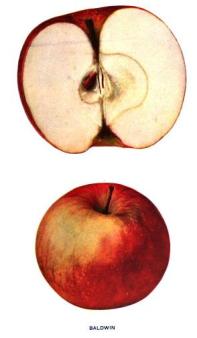 After Baldwin’s death in 1807, the ‘Pecker Apple was officially named in his honor and the Baldwin Apple quickly became the most popular fruit in New England. It’s easy to see why. The Baldwin was smaller than most red apples are today, but its skin was mostly free of blights. Farmers loved the Baldwin because they could harvest large crops and transport them readily with little or no deterioration. The Baldwin’s were also a good apple to make into a rich, sweet cider. The hard texture was perfect for making pies. “What the Concord is to the grapes, what the Bartlett has been among pears, the Baldwin is among apples,” the New England Farmer described in 1885.
Unfortunately, the Baldwin’s dominance wouldn’t last. Too many severe winters took its toll.
In fact, in one particularly harsh year, 1934, nearly two-thirds of all apple trees in the northeast were destroyed. The next year the state of Maine helped growers replenish their decimated orchards, but only Macintosh and Red Delicious seeds were offered. The Baldwins were just too delicate to replant in large numbers. Still some farmers grew small crops to maintain the rich cider.
So Baldwin’s survive today in small numbers.
But there’s one more interesting note about Loammi Baldwin. Besides the name, the “Father of Civil Enginerring,” has another connection to apple folklore. Baldwin it turns out is the second cousin of Johnny Chapman, another Massachusetts man and traveling missionary whose work included the planting of apple trees throughout the expanding frontier.
We know him today not as Johnny Chapman, but Johnny Appleseed.

The Two-Week, Two-Weight Olympic Boxer
By Ken Zurski
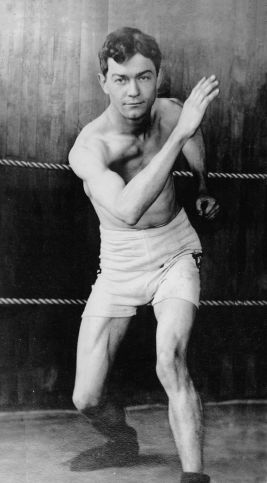
Oliver Leonard Kirk has two gold medals from one Olympic Games. That’s not unusual in today’s Olympic climate. Many athletes have done it especially in swimming and track and field events.
But Kirk was a boxer.
In the slipshod third Olympiad held at the St Louis World’s Fair in 1904, due to a limited amount of competitors, especially in boxing, Kirk was allowed to compete in two weight classes.
So as a featherweight Kirk faced a slightly larger opponent in Frank Bee Haller, another American. Kirk was a brawler and won. But was it a fair fight? Haller was a tough competitor, but many felt he was taxed from an earlier bout, while Kirk had the advantage of a bye in the first round.
Regardless, Kirk took the gold.
Kirk than spent a week losing 10 pounds and as a bantamweight faced the slighter smaller George Finnegan. A week before, Finnegan had beat Miles Burke to win the flyweight gold medal.
Finnegan quickly added 10 pounds to battle Kirk.
Finnegan may have been pressured to move up and fight Kirk. That’s because there were no other competitors in the bantamweight division. Kirk had made the weight, but no one to fight. So Finnegan put the extra load on his frame.
It showed.
Kirk landed more punches and won his second gold medal.
The Unlikely and Unconventional Winner of the 1960 Olympic Marathon
 By Ken Zurski
At the 1960 Summer Olympic Games in Rome, Gordon McKenzie was one of three U.S runners entered in the prestigious marathon, a race the Americans were given only an outside chance to win.
Before the start of the race, however, McKenzie noticed a “skinny little African guy” in the field. “There’s one guy we don’t have to worry about,” he said to another entrant. The guy he was referring too was Abele Bikila from Ethiopia.
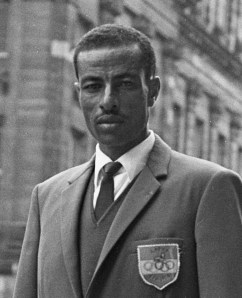 McKenzie knew that in the past African runners didn’t fare so well in long distance races. But Africa, the continent, was changing. New nations were forming and more athletes were competing like Bikila, who was a soccer player and soldier before becoming a runner. Bikila was also used to training in the extreme heat, something many of the other runners were not.
On the day of the race, September 10, temperatures were expected to be near 90 degrees. So a change was made to start the race at twilight and end in “torch-lit” darkness by the Arch of Constantine and not in the Olympic stadium, a first for the games.
By the time it was over, Bikila had stunned the crowd and won the race convincingly – shattering an Olympic record in the process. A fitting end to the Games which had already introduced a track star named Wilma Rudolph and an unknown young boxer at the time named Cassius Clay.
Bikila became the first runner from Africa to win an Olympic marathon and in hindsight set the stage for the dominance of African marathoner’s to come.
But it’s how he won that most impressed.
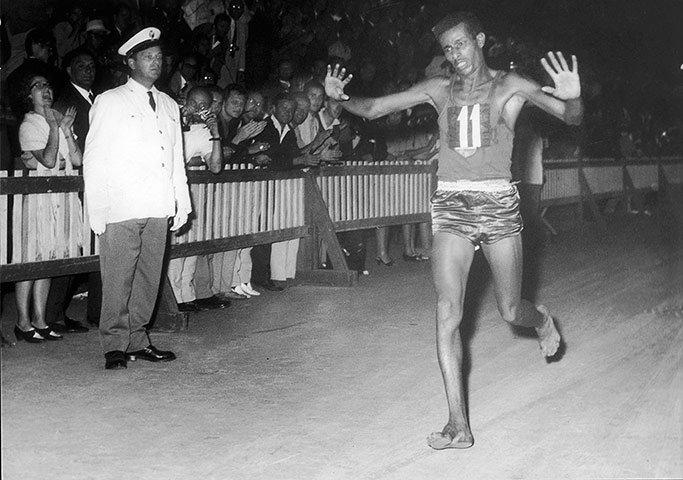
Bikila had to throw out the badly frayed sneakers he arrived with and dismissed a last minute replacement pair because it didn’t fit properly.
He had nothing left to wear.
So like he had done many times in training, Bikila started and completed the race in his bare feet.
That’s Not George Washington on the First Dollar Bill
By Ken Zurski
In the summer of 1861, after the Battle of Bull Run disproved the theory that the Civil War would end quickly, U.S. Treasury Secretary at the time Salmon P. Chase turned to the option of paper money to help pay the Union soldiers. This included the first government-issued dollar bill.
A bill which looked much different than it does today.
The man on the front of the original dollar bill was Chase himself who did the honors of appointing his own likeness to the first “greenbacks” (named for the green ink used on the back, with black ink in front).
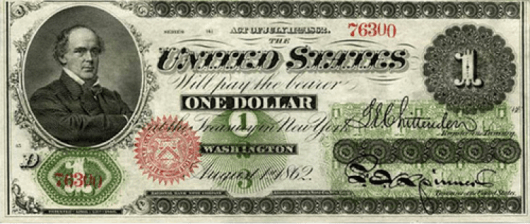
Chase was a political rival of Lincoln who became part of his cabinet, oftentimes disagreeing with the president and threatening to quit on numerous occasions until Lincoln diffused the matter – usually with a joke.
Gold and silver coins were popular, but at the onset of the Civil War, to help fund it, Congress authorized the issue of demand notes worth $5, $10 & $20. The notes could be redeemable by coin. The $1 bill soon followed.
Chase contributed to the design of the new dollar bill and having presidential aspirations himself thought his image on its face would help the cause. The fact that he ran the Treasury Department was a strong argument for inclusion.
Eventually, Chase was replaced by George Washington on the dollar bill.
But in 1928, more than 50 years after his death, Chase was honored again with his picture on the newly minted $10,000 bill. The big bills, like the $1,000 (Cleveland), $5,000 (Madison), and $10,000, were used mainly for transfers between banks. Even a $100,000 bill (Wilson), the largest single denomination ever, was printed in 1934 for this same purpose.

Although it went out of circulation, the $10,000 bill is still considered legal tender and banks would be glad to exchange it if collectors were crazy enough to pass on the market price which is ten times or more its face value.
The original $1 dollar bill, with Chase’s likeness, while not as rare, is still collectible. Mint condition bills can fetch up to $1000. Most are worth between $100 and $300.
Chase is also remembered to this day by a large bank, now a merged institution, with his name still in its title.
When the ‘Stache Ruled the Pool
By Ken Zurski
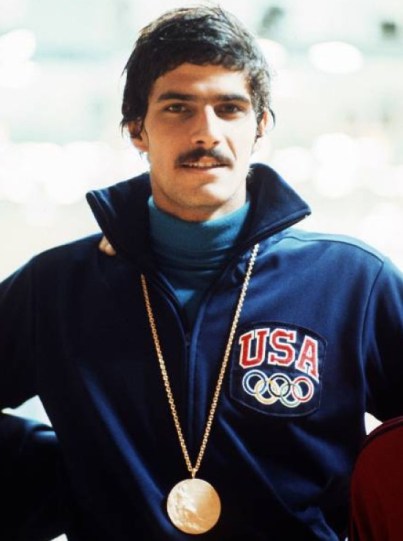
In August and September of 1972, at the Summer Olympics in Munich, West Germany, American swimmer Mark Spitz did what no other Olympian had ever done up to that point, win more consecutive gold medals in a single games.
In this case, it was a “golden” seven.
It could have been only six.
Spitz was satisfied with his unprecedented six-for-six gold medal streak and considered bowing out of his last scheduled race, the 100m freestyle, after being edged by rival and current world record holder in the event Michael Wenden of Australia in both the prelims and the semis.
Sptiz thought a loss would tarnish his previous accomplishments. But his coach convinced him that since the 100m freestyle was the premier swimming event of the games, Wenden would be crowned the fastest swimmer in the world.
Spitz raced, won, and beat Wenden’s world record by nearly a second.

“There is no money in swimming like there are in other sports,” Spitz said about his record making accomplishments. “The medals don’t have much monetary value. I’ll hang them on the wall someplace.”
But Spitz’s fortunes would change.
After the games, Spitz became an instant celebrity and one of the first Olympians to profit off his success by picking up major product endorsements from swim trunk maker Speedo and razor king, Schick.
The latter thanks to that famous mustache, Spitz’s trademark.
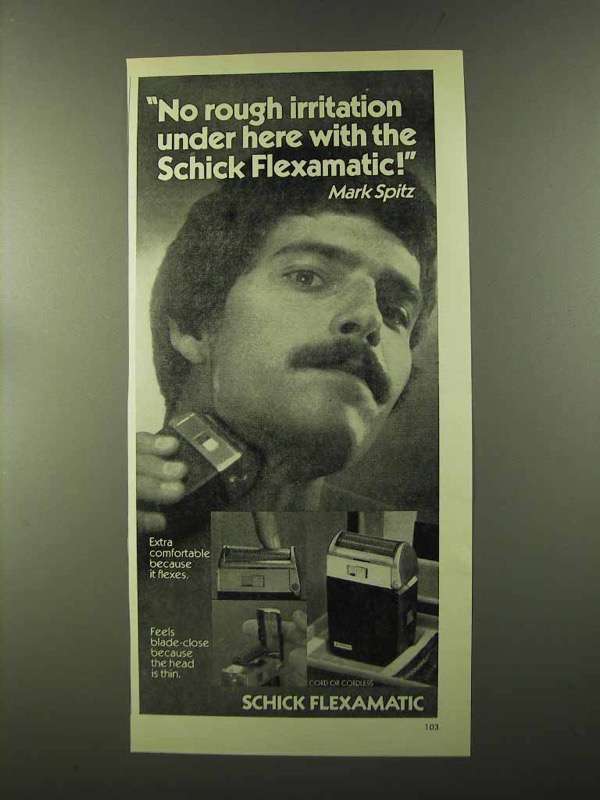
Spitz grew up in Honolulu Hawaii and became a competitive swimmer at an early age. He sported the mustache in college on a bet from a coach that he couldn’t grow one.
After the games, which were marred internationally by the Israeli hostage tragedy, the poster of Spitz sporting his mustache and seven gold medals around his neck became a best seller.
The ‘stache, however, was a source of curiosity and contention for other competitors.
Even the coach of the Russian team went so far as to ask Spitz if he thought his facial hair slowed him down. Spitz told him it actually streamlined water around his mouth, making him swim faster. Today’s competitive swimmers would disagree, since they prefer no facial or body hair in general except perhaps on their heads which is usually covered by smooth swim caps. In Spitz’s era, swimmers didn’t wear caps on their heads.
Sptiz amount of gold won at a single games was finally broken by Michael Phelps at the Beijing Games in 2008.
But Phelps, who won 8 gold medals without breaking a world record in one event, gives Spitz a lasting distinction of besting the world record in every event he entered, even the seventh and final race of his swimming career, the 100m freestyle, the event he considered skipping.
“You can bet your ‘omph-pah’ horn or your last stein of Munich beer, or both, that it will be seven gold medals before the sun sets,” wrote UPI sports writer John G. Griffin on the day of that last race.
He was right.

The Marathon Runner, Long Pants and Rotten Apples
By Ken Zurski
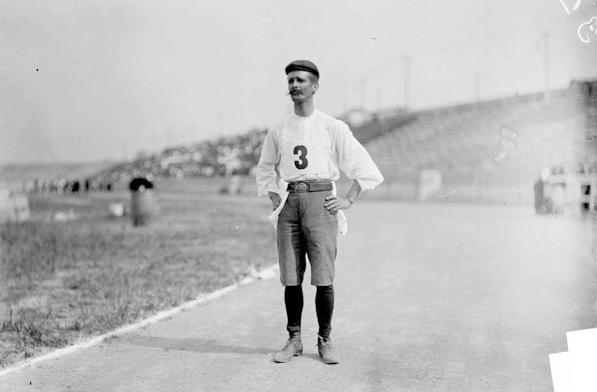
 In 1904, Cuban postman and aspiring runner Felix Carvajal heard a marathon would be held that August at the Summer Olympic games in St. Louis.Without a sponsor, he decided to make the trip alone.
It began poorly. After arriving by steamer in New Orleans, Carahjal lost all his travel money in a craps game. He hitchhiked or walked the rest of the way.
On race day, Carvajal went to the starting line with just the shirt on his back and long wool trousers that he cut off at the knee.
As colorful as it is skeptical, the rest of Carajval’s story continues during the race.
Tired and hungry from the long journey, Carajval reportedly took a brief nap and stopped for a snack at a nearby orchard. He resumed running, but soon cramped from eating rotten apples. Despite this, he did manage to complete the course.
Other runners weren’t so lucky.
It was brutally hot that day, the dirt roads were dry, and dust clouds from lead automobiles and horses choked the participants.
Out of 32 entrants, only 14 made it to the finish line.
The Cuban postman came in fourth.
Well, She Was An Americanized Girl…
by Ken Zurski
 Before the iconic Rosie the Riveter urged women to join the work force in World War II, another strong woman figure was used by the U.S government, this time by the Treasury Department, to sell war bonds.
Her name was Joan of Arc.
Joan was certainly not American. But her story and image gained footing in the U.S. during the first world war.
 Called to serve God in the form of angel’s voices, the teenage Joan takes up the sword, disguises herself as a man, and goes to battle to save the French from evil in the early 15th century. After her capture, she was burned alive at the stake.
In France, even today, she is celebrated as a symbol of nationalism and unity. However, American sensibilities about the mythical Joan are more romanticized.
 In 1946, actress Ingrid Bergman played Joan in a play within a play titled Joan of Lorraine. (Lorraine loosely refers to Joan’s birthplace with the surname Arc.) The play is about a company of actors who stage a dramatization of Joan’s story. Bergman who won a Tony Award for her role, played two parts, Joan and Mary Grey the fictional actress who portrays Joan in the play.
Two years later, Bergman starred in a modified movie version of Joan of Lorraine. The film, renamed Joan of Arc, was a more straightforward retelling of Joan’s story, but still gave Americans a stylized portrayal of the French martyr. By this time, Joan’s image had already been on war posters. “Joan of Arc Saved France,” the ad reads. “Women of America. Save Your Country, Buy War Savings Stamps.”
The ads, which appeared for the first time in 1917, were colorful and attractive, especially the image of Joan.
 In it, Joan is sporting long autumn hair, red lips, and a suit of armor that not only shows a tapered waistline, but a womanly figure as well. “Two orbs of light at the level of her hidden breasts suggest a female bosom that cannot be obscured by the trappings of war,” biographer Kathryn Harrison wrote about the poster’s likeness.
This was not the cross dressing savoir of France, Harrison points out, but a 20th century version, pretty and determined, ready to fight like a man, but remain an empowered woman.
“Oh if I could speak large and round like a boy,” Bergman’s Joan wonders in the play. “But my voice is a girl’s voice and my ways are a girl’s ways.”
Ben Franklin, the Bald Eagle, and the Grudge

By Ken Zurski
Thanks to the sight of its majestic flight, broad 8-foot wing span, and contrasting white head, the bald eagle became the symbol of America when it first appeared on the Great Seal adopted by Congress in 1782.
A year and a half later it had a major dissenter in Benjamin Franklin.
Franklin saw the image of the bird on the badge of the Society of the Cincinnati of America, a military fraternity of revolutionary war officers, and thought the drawing of the bald eagle on the badge looked more like a turkey, a fair and reasonable complaint considering the image looked like, well, a turkey.
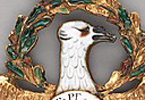
But it was the use of the bald eagle as the symbol of America that most infuriated Franklin. “[The bald eagle] is a bird of bad moral character,” he wrote to his daughter in a complaint letter, “he does not get his Living honestly.” Franklin had a point. The bald eagle was a notorious thief. A good glider and observer, the bald eagle will often watch the more agile Osprey, appropriately called a fish hawk, dive into water to seize its prey. The bald eagle then assaults the Osprey and forces it to release the catch so the scavenging bird can grab it in mid-air and return to its nest with the stolen goods. “With all this injustice,” Franklin wrote as only he could, “[The bald eagle] is a rank coward.”
Franklin then expounded on the turkey comparison: “For the truth, the turkey is a much more respectable bird…a true original Native of America who would not hesitate to attack a grenadier of the British Guards who should presume to invade his farmyard with a red coat on.”
 Franklin’s suggestion of the turkey as the nation’s symbol, however, is a myth. He never suggested such a thing. He only compared the bald eagle to a turkey because the drawing reminded him of a turkey. Franklin’s argument was the choice of bald eagle not in support of the turkey he called “vain and silly.” Some even claim his comments and comparisons were slyly referring to members of the Society, of whom he thought was an elitist group comprised of “brave and honest” men but on a chivalric order, similar to the ruling country to which they helped defeat. This might explain why Franklin’s assessment of the bald eagle in the letter is based solely on human behavior, not a bird’s.
But was it a fair assessment?
Ornithologists today provide a more scientific and sensible explanation. In the”Book of North American Birds” the bald eagle gets its just due, for as a bird, it’s actions are justifiable. “Nature has her own yardstick, and in nature’s eyes the bald eagle is blameless. What we perceive as laziness is actually competence.” Being able to catch a “waterfowl in flight and rabbits on the run,” the book suggests is a noble and rewarded skill.
 Perhaps, a better choice for the nation’s top bird, might have been the golden eagle, who unlike the bald eagle captures its own prey, mostly small rodents, but is powerful enough to attack larger animals like deer or antelope on rare occasions. (Its reputation today is tainted somewhat by rumors that it snatches unsuspecting domestic animals, like goats or small dogs.) But golden eagles don’t want attention. They shy away from more populated areas and appear to be “lazy” only because they can hunt with such precision and ease they don’t really have to ruffle their feathers. Plus, golden eagles were already symbolic. History finds them “perched on banners of leading armies, the fists of emperors and figuring in religious cultures.”
The bald eagle, by comparison, would be truly American.
Perhaps when Franklin made the disparaging comments against the bald eagle he was also harboring a nearly decade old grudge.
In 1775, a year before America’s independence, Franklin wrote the Pennsylvania Journal and suggested an animal to be used as a symbol of a new country, one that had the “temper and conduct of America,” he explained. “She never begins an attack, nor, when once engaged, ever surrenders. She is therefore an emblem of magnanimity and true courage”
Eventually the image Franklin suggested did appear on a $20 bill issued in 1778, adopted for use as the official seal of the War Office, and may have been the inspiration for the Gadsden flag with the inscription, “Don’t Tread On Me.”
But it never officially became the preferred symbol.
Franklin’s choice: the rattlesnake.

P.T. Barnum’s “To-Do” List Blunder
By Ken Zurski
 In addition to his celebrated showy attributes and unabashed self-promotion, P.T. Barnum kept a meticulous daily schedule.
Every day before leaving his lavish home in Fairfield Connecticut, Barnum made a “to-do” list right down to where and what he would eat that day and when he would take a stroll in the garden.
One day, Barnum wrote on his “to-do” list: “drop Charity [his wife] off at the dress maker.”
When Barnum returned home that day, his daughter asked, “Where is mother?”
Barnum thought for a moment then realized he had dropped his wife off as scheduled, but did not return to pick her up because he had not put it on the list.
He immediately called for a carriage to retrieve her.
She was “exceedingly angry,” Barnum explained.
Her Voice Was Out of This World and You Don’t Know Her
By Ken Zurski
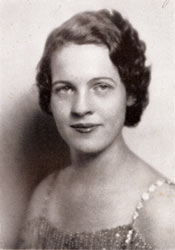
Singer Louille Jean Norman is certainly not a household name, but her voice is an unmistakable part of television history. More on that in a moment. First a little background.
Norman was a coloratura soprano, a vocal range most commonly suited for the opera stage. Unlike counterparts like Maria Callas, however, Norman took her gift to radio instead. It was the 1930’s, and radio was just starting to emerge as an entertainment force. Louille Jean was in her twenties at the time. Her voice and beauty were being noticed. She moved from her native Birmingham, Alabama to New York City to jump start her career. Modeling jobs paid the bills at first, but singing was her passion.
She eventually got bit parts in singing ensembles on several musical variety shows including one with Bing Crosby who would signal her out several times for her solo passages. Norman provided studio background vocals to hitmakers like Sam Cooke, Frank Sinatra, Mel Torme and Elvis Presley. On TV, she appeared on the Dinah Shore Show. with Dean Martin, and back-up on Carol Burnett’s popular variety program. “When you sang,” a colleague once told Norman, “it was the angels.”
But perhaps her most unaccredited and influential contribution is the reason why Norman is unremembered today. It’s why science fiction fans may know her soaring voice, but not her name.
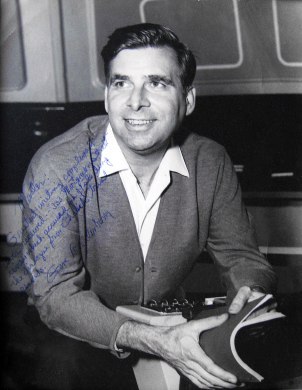
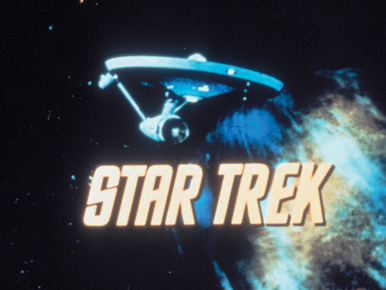
In 1964, when television producer Gene Roddenberry introduced a new space serial titled Star Trek he asked a friend Jerry Goldsmith to write the theme music. Goldsmith was too busy but enlisted fellow composer and collaborator Alexander Courage, who was said to be no fan of the science fiction genre, but drew inspiration from a song he heard on the radio titled “Beyond the Blue Horizon, ” which was featured in the 1930 movie “Monte Carlo” and sung by actress Jeannette McDonald, a soprano.
Courage wrote the theme for the TV series in about a week. Roddenberry heard the music and for reasons some explain were financially motivated, wrote lyrics for the tune. Courage, surprised – and perhaps, a bit offended – by Roddenberry’s contribution, had included a voice in his recording, but no words. The lyric version of the song was never used.
The singer Courage chose for his work was similar to MacDonald, who ironically died the year the theme was written. Norman was another soprano and known for her studio work. Plus she wasn’t a big enough star to turn down such an offer. Norman had the range Courage needed to make the tune work.
Star Trek: The Original Series ran for only three seasons and 79 episodes. In the third and final year, the theme was re-recording without the vocals.
Despite a growing fan base, Roddenberry was hopelessly fighting low ratings, high production costs, and threats from the network to cancel.
He reportedly couldn’t pay Norman her royalty cut that year.
 UNREMEMBERED