
Roosevelt vs. Supreme Court: A Battle for Power

By Ken Zurski
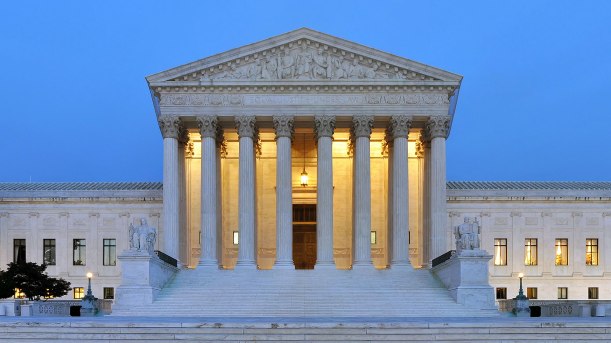
On February 5, 1937, President Franklin Delano Roosevelt announced his intention to expand the Supreme Court to as many as 15 justices. The move was clearly a political one. Roosevelt was trying to “pack” the court and in turn make the nation’s highest court a completely liberal entity. Republicans cried foul.
Roosevelt didn’t care what his opponents thought. He embraced the criticism and mostly ignored it. Although politically it was still a hot button issue, his New Deal policies had earned public acceptance, even praise. The high court, however, was another matter. They had previously struck down several key pieces of his legislation on the grounds that the laws delegated an unconstitutional amount of authority in government, specifically the executive branch, but especially the office of the president.
Roosevelt won the 1936 election in a landslide and was feeling a bit emboldened. If he could pack the court, he could win a majority every time. By constitutional law, Roosevelt couldn’t force any justice out, but he could offer an incentive to leave. So the president proposed legislation which in essence asked current Supreme Court justices to retire at age 70 with full pay or be appointed an “assistant” with full voting rights, effectively adding a new justice each time.

This initiative would directly affect 75-year-old Chief Justice, Charles Evan Hughes, a Republican from New York and a former nominee for president in 1916 who narrowly lost to incumbent Woodrow Wilson. Hughes resigned his post as a Supreme Court Justice to run for president, then served as Secretary of State under the Harding administration. In 1930, he was nominated by Herbert Hoover to return to the high court as Chief Justice. Hughes had sworn in Roosevelt twice. Now he was being asked by the president to give up his post or, under Roosevelt’s plan, give the president the power to appoint another justice.

In May of 1937, however, Roosevelt realized his “court packing” idea was wholly unnecessary. In an unexpected role of reversal, two justices, including Hughes, jumped over to the liberal side of the argument and by a narrow majority upheld as constitutional the National Labor Relations Act and the Social Security Act, two of the administration’s coveted policies. Roosevelt never brought up the issue of court size again.
But his power move didn’t sit well with the press.
Newspaper editorials criticized him for it and the public’s favor he had enjoyed after two big electoral victories was waning. He was a lame duck president finishing out his second term. Then Germany invaded Poland. Roosevelt’s steady leadership was lauded in a world at war.
In 1940, he ran for an unprecedented third term and won easily.
The following year, Japan attacked Pearl Harbor.
The Man Who Gave ‘Google’ Its Name
By Ken Zurski
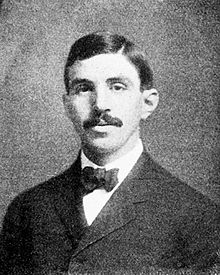
In the early half of the 20th century, shortly after World War I ended, mathematician Edward Kasner, a professor at Columbia University, devised the concept of showing the common features of whole numbers, no matter how large. As an example, he came up with the number one followed by a hundred zeros.
Writing out such a large number was ridiculous of course, and at the time formal names didn’t exist for numbers larger than a trillion.
But he needed a name.
So he asked his nine-year-old nephew Milton to intervene. During a causal stroll in New Jersey’s Palisades Woods, Edward wondered if Milton could come up with one. “Googol” was the boy’s answer. So Milton’s silly sounding recommendation became “Googolplex,” or one followed by a googol zeros. Kasner began using the name in his classes.
Flash forward more than 70 years in 1995 when two Stanford University students Larry Page and Sergey Brin began collaborating on a search engine they originally called BackRub. The project began to attract investors and bandwidth grew. But they needed a new name, something catchier, something they could easily register online.
Google was chosen as the common spelling of Googol which, thanks to Kasner, was as close to an infinite number as possible.
“We picked the name “Google” because our goal is to make huge quantities of information available to everyone,” Page later recalled.

When they presented the name however, math traditionalists balked. “You idiots, you spelled it [Googol] wrong!” one chastised. But Google.com was available and Googol.com was not. Besides, Page said, “It sounds cool and [still] has only six letters.”
According to an official statement Google’s corporate website (yes, there is one): “The name “Google” reflects Larry and Sergey’s mission to organize a seemingly infinite amount of information on the web.”
Simple enough. But what about young Milton? How did the word “Googol” pop into his head? Speculation runs rampant here. A great niece of Dr. Kasner, Denise Sirotta, claims her father Edwin, Milton’s younger brother, should get some credit since he claimed the siblings came up with the name together. “He was asked for a word with a sound that had lots of O’s in it,” she said.
Another observation seems to make more sense especially in the imaginative mind of a toddler. Caroline Birenbaum, another great-niece of Dr. Kasner’s, speculates the word was inspired by a comic-strip character named Barney Google, who debuted in 1919. She says Dr. Kasner, liked cartoons.
“He may have tweaked the spelling to avoid any trademark issues,” she claims.

Barney Google was an American comic strip created by Billy DeBeck, that originally appeared on the sports pages. Google had big “banjo” eyes, a mustache, a large bulbous nose, and wore a tuxedo-type suit. He was an “avid sportsman and N’er do well” involved with some of the more contentious contests like poker, prize fights and horse racing. Google’s bow-legged horse “Spark Plug” was introduced in 1922, and nicknamed “Sparky.” The horse was a nag who rarely raced, but when he did it became a big media event. Millions of readers bought in.
A popular song was introduced, a foxtrot, titled “Barney Google and Spark Plug”
Barney Google—with the goo, goo, googly eyes,
Barney Google—bet his horse would win the prize;
When the horses ran that day,
Spark Plug ran the other way!
Barney Google—with the goo-goo-googly eyes!
In 1934, another character named Snuffy Smith joined the fray and Barney Google and Spark Plug were phased out.
So Google, the word itself, was in the public consciousnesses long before the giant search engine came along. Still, Kasner had no idea that it would become so popular in the next century.
So where did his inspiration for the seemingly infinite number come from?
Kasner, who never married, cited a description of unrequited love. In a divorce case, he explained, a woman called the commitment she had for her husband as “a million billion billion times and eight times around the world.” Kaisner was struck by the expansive description. “It was the largest number ever conceived of,” he said. So he set out to immortalize it.
And his little nephew inspired a name.
Googolplex!

The American-Made Safe That Survived Hiroshima
By Ken Zurski
In 1946, a U.S. Army Lieutenant surveying damage left by the massive explosion of the first atomic bomb in Hiroshima a year earlier, sent a letter to a safe-making company back in America. “I found in one of three structures standing, four large vaults built by the Mosler Safe Co. of Hamilton, Ohio,” he explained. “The vaults were entirely intact and except for the exterior being burned and rusted there was no damage.”
Two other vaults he added, made by a Toyko, Japan company, were completely destroyed.
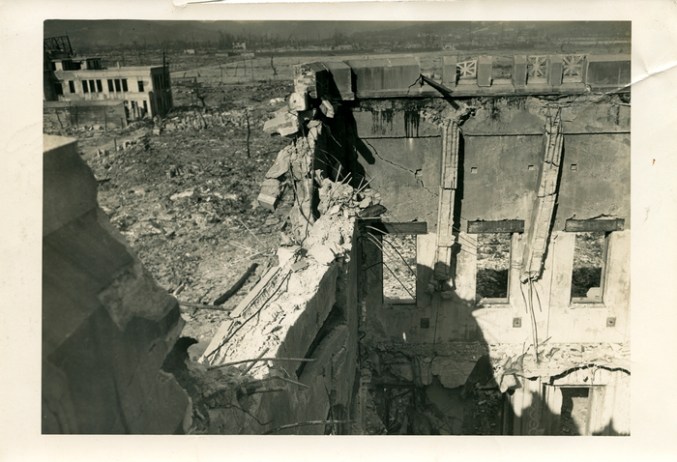
The two-story Teikou Bank built in 1925 was close to the hypocenter of the blast. Made of steel and concrete, the building crumpled from the inside, cracking the exterior and tearing the cement floor to bits. Nearly two dozen employees were in side at the time. None survived.
But the bank vaults did.
This was reassuring news at least to bank executives back in the States.
At the time there was a heightened sense of security against attacks on American soil. Many banks advertised that valuables were better protected because they used Mosler safes.
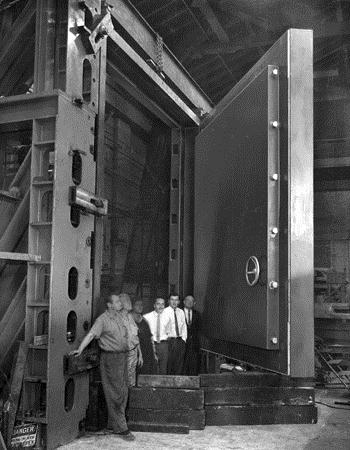
Even the U.S government chimed in. Mosler was awarded a lucrative contract and eventually built a 25-ton blast door vault in West Virginia mountainside bunker used to hide classified and historical documents.
Then five years after the attack, Mosler received another letter.
This time it was from the manager of the newly rebuilt Teikou bank in Hiroshima. “Your products are admired,” he praised, “for being stronger than the atomic bomb.
“As you know in 1945 the Atomic bomb fell on Hiroshima, and the whole city was destroyed and thousands of citizens lost their precious lives. And our building, the best artistic one in Hiroshima, was also destroyed. However it was our great luck to find that though the surface of the vault doors was heavily damaged, its contents were not affected at all and the cash and important documents were perfectly saved.”
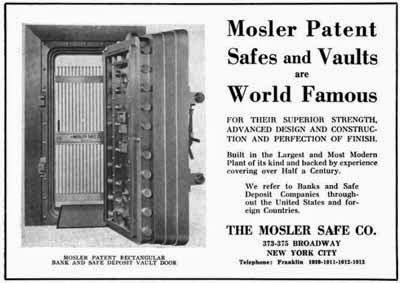
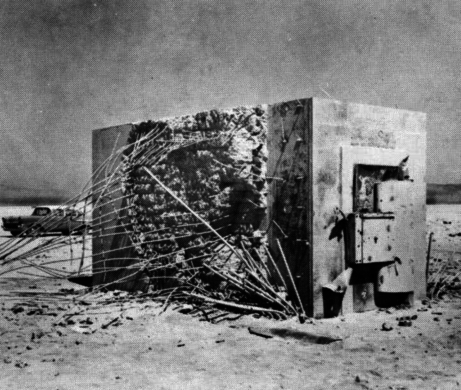
In the late 1950’s, to recreate the same show of strength displayed in Hiroshima, Mosler took their products to the Yucca Flats nuclear testing grounds in the Nevada desert. They placed a Century steel door and concrete vault with various contents in the blast zone.
Once again the vault survived intact.
How an Infinite Number Idea Became the World’s Most Recognizable Word

By Ken Zurski
In the early half of the 20th century, shortly after World War I ended, mathematician Edward Kasner, a professor at Columbia University, devised the concept of showing the common features of whole numbers, no matter how large.
As an example, he came up with the number one followed by a hundred zeros. Writing out such a large number was ridiculous of course, and at the time formal names didn’t exist for numbers larger than a trillion. But he needed a name.
So he asked his nine-year-old nephew Milton to intervene. During a causal stroll in New Jersey’s Palisades Woods, Edward wondered if Milton could come up with a name. “Googol” was the boy’s answer. Milton also came up with the term “Googolplex,” or one followed by a googol zeros.
In lectures, Kasner began referring to the seemingly infinite number as “Googolplex.”
Flash forward more than 70 years in 1995 when two Stanford University students Larry Page and Sergey Brin began collaborating on a search engine they originally called BackRub. The project began to attract investors and bandwidth grew. But they needed a new name, something catchier, something they could easily register online.
Google was chosen as the common spelling of Googol which, thanks to Kasner, was as close to an infinite number as possible.
“We picked the name “Google” because our goal is to make huge quantities of information available to everyone,” Page later recalled.
When they presented the name however, math traditionalists balked. “You idiots, you spelled it [Googol] wrong!” one chastised. But Google.com was available and Googol.com was not. Besides, Page said, “It sounds cool and has only six letters.” According to Google’s official corporate website (yes, there is one): “The name “Google” reflects Larry and Sergey’s mission to organize a seemingly infinite amount of information on the web.”
Simple enough. But what about young Milton? Why did the word “Googol” pop into his head? Speculation runs rampant here. A great niece of Dr. Kasner, Denise Sirotta, claims her father Edwin, Milton’s younger brother, should get some credit since he claimed the siblings came up with the name together. “He was asked for a word with a sound that had lots of O’s in it,” she said.
Another observation seems to make more sense especially in the imaginative mind of a toddler. Caroline Birenbaum, another great-niece of Dr. Kasner’s, speculates the word was inspired by a comic-strip character named Barney Google, who debuted in 1919. She says Dr. Kasner, liked cartoons. “He may have tweaked the spelling to avoid any trademark issues,” she claims.
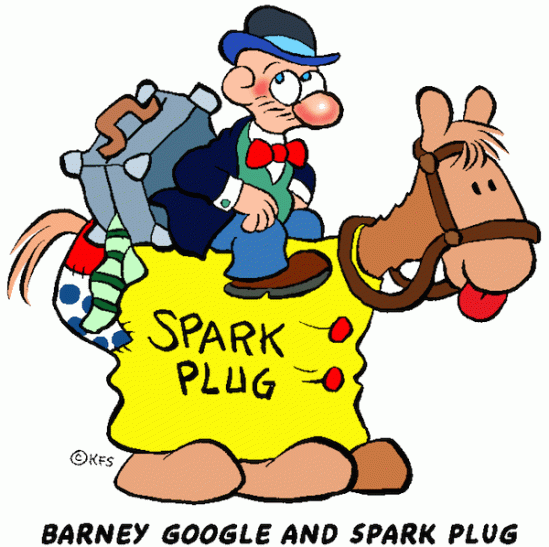
Barney Google was an American comic strip created by Billy DeBeck, that originally appeared on the sports pages. Google had big “banjo” eyes, a mustache, a large bulbous nose, and wore a tuxedo-type suit. He was an “avid sportsman and N’er do well” involved with some of the more contentious contests like poker, prize fights and horse racing. Google’s bow-legged horse “Spark Plug” was introduced in 1922, and nicknamed “Sparky.” The horse was a nag who rarely raced, but when he did it became a big media event. Millions of readers bought in.
A popular song was introduced, a foxtrot, titled Barney Google and Spark Plug:
Barney Google—with the goo, goo, googly eyes,
Barney Google—bet his horse would win the prize;
When the horses ran that day,
Spark Plug ran the other way!
Barney Google—with the goo-goo-googly eyes!
In 1934, another character named Snuffy Smith joined the fray and Barney Google and Spark Plug were phased out.
So Google, the word itself, was in the public consciousnesses long before the giant search engine came along. Still, Kasner had no idea that the chosen name for his boundless number would become so popular in the next century. So where did his inspiration come from?
Kasner, who never married, cited a description of unrequited love. In a divorce case, he explained, a woman called the commitment she had for her husband as “a million billion billion times and eight times around the world.” Kaisner was struck by the expansive description. “It was the largest number ever conceived of,” he said. So he set out to immortalize it.
And his little nephew gave it a name.
Googolplex

 UNREMEMBERED