
The Unlikely and Unliked 13th President of the United States
By Ken Zurski
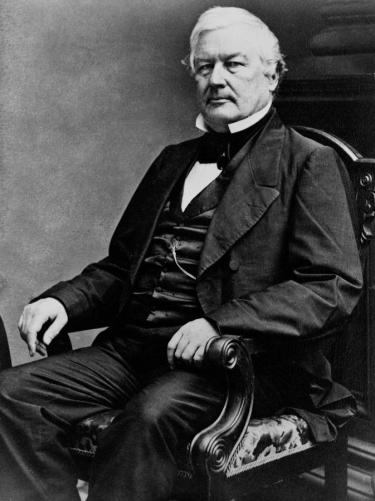
On July 10, 1850, Millard Fillmore became the 13th President of the United States.
It didn’t go so well.
The unsuspecting Fillmore, a lawyer and former congressman from New York, had been vice president to Zachery Taylor at the time, a job he sought but ultimately didn’t think he would get. Even Taylor, a popular military general, had reservations about running for the office of president. But duty called. “If my friends deem it good for the country that I be a candidate,” Taylor obliged. “so be it.”
Fillmore, who was not known as politically savvy or ambitious, tagged along.
Once in the White House, however, Fillmore had little to do. The job held no great power or influence and only one vice president, John Tyler, had ever assumed the presidency unexpectedly. That changed when only sixteen months after being elected, Taylor was dead. A bad stomachache and poor medical care did him in. A stunned Fillmore took the oath of office and set the stage for what is considered one of the worst presidencies in history.
Here’s why it began so poorly…
Almost immediately after Taylor’s death, the members of his cabinet, in ceremonial unity and respect to the late president, turned in resignation letters. They fully expected Fillmore to deny their requests. Fillmore was unproven and needed their help. Plus, Fillmore and Taylor were teammates, not adversaries. Whether they personally liked the vice president or not, and most did not, a nation’s stability and Taylor’s legacy was at stake.
Clearly, they thought, Fillmore could grasp that.
They were wrong.
Fillmore was either intimidated by the experience of others, stubborn, or didn’t care. He accepted their resignation letters and basically told them all to leave. Then in an unexpected and clearly brazen move, he asked them all to stay on another month. So he could appoint a new team, Fillmore told them.
Each one refused.
How the Dilemma of the Fourth Dimension and a Progressive Teacher Taught Children How To Play
By Ken Zurski
Mathematician Charles Howard Hinton was both equally fascinated and frustrated by the concept of the fourth dimension, also known as the “other dimension,” or the one dimension of time and space that no one had been able to verify or explain. Albert Einstein tried. He deduced in his Theory of Special Relativity that the fourth dimension is “time” and that “time is inseparable from space.” Since then science fiction writers have used the space-time continuum to great dramatic effect in their stories.
But in 1884, while Einstein was still a toddler, it was Hinton who wrote the definitive article on the subject. In “What is the Fourth Dimension?” Hinton explained that the theory behind a fourth dimension was firmly established, but there was no physical evidence to support it. That was the dilemma, he inferred: “If we think of a man as existing in four dimensions, it is hard to prevent ourselves from conceiving him prolonged in an already known dimension.” Hinton used a four-cornered room, or cube, for example, to explain how one can only reach three dimensions. “Space as we know it, is subject to limitation,” he conceded.
However, to teach his children math skills, Hinton built a three-dimensional bamboo dome with evenly spaced geometric shapes. His son, Sebastian, remembers climbing and hanging from the dome while his father called out intersections for the children to identify.
“X2, Y4, Z3, Go!” Hinton would command.

Hinton died unexpectedly in 1907 from a cerebral hemorrhage. While he is mostly remembered for his work on the fourth dimension, in stark contrast, he is also credited with introducing the first pitching machine (for baseball) – more like a gun – called the “mechanical pitcher,” and designed for the Princeton University team. The machine used gunpowder to fire the ball.
But the geometric dome he created for his children also had a lasting effect. Especially on his youngest son Sebastian.
Here’s why:
Sebastian ended up marrying a teacher, Carmelita Chase, who grew up in Omaha, Nebraska and moved to Chicago in 1912 to become Jane Adams’ secretary at Hull House. That’s when she met Sebastian, a patent lawyer in town.
Carmelita was pretty, smart, and multi-talented. In college, she excelled in tennis (among other sports), acted in plays and sang in the choir. “She has distinguished herself in athletics as well her studies,” the Chicago Daily Tribune described in announcing the couple’s engagement in 1916. She and Sebastian would eventually have three children.

Shortly after getting married, however, Carmelita put most of her time and efforts into her work. She opened a kindergarten and nursery school at her Chicago apartment which was directly across from a park.
“Frustrated by her own ‘dreary’ school experience, she was determined to create learning environments for her school children and others that would be joyfully experimental,” author Susan Ware wrote about Carmelita in Notable American Women.
The type of teaching she endorsed already had a name: progressive education. For Carmelita, this included incorporating more outdoor activities like hiking, camping, farming and the care of animals to daily activities. “She would come into a room and it would be an explosion,” a former student recalled in the book Founding Mothers and Others, “But it was a happy occasion. She could sweep people up and carry them to Mars.”
In 1920, while watching his wife’s school children playing outside their Winnetka, Illinois home, Sebastian had a revelation. Why not build something they could climb on?
He envisioned a three-dimensional structure similar to his father’s geometric dome, but for play rather than instruction. He reportedly jotted down the idea on a napkin and perfected the plan for a patent submission. Then he built it.
Hinton called it a Jungle Gym.
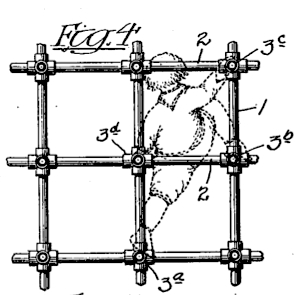
At the time of its conception, however, the Jungle Gym was never heralded as the important contribution to the children’s playground as it is today. In fact, Hinton’s only recorded words about his invention are attributed to his detailed patent filings: “Children seem to like to climb through the structure and swing their head downward by the knees, calling back and forth to each other. A trick which can only be explained of course by a monkey’s instinct.” While the name Jungle Gym never officially changed, many people began seeing the correlation with the primate’s distinctive behavior and started calling it “monkey bars” instead. The moniker stuck.
Unfortunately, Sebastian Hinton is a figure lost to time. Although he married a socialite in Carmelita, Hinton preferred to stay out of the spotlight. Tragically, just a few years after creating the Jungle Gym, he committed suicide in a clinic after reportedly being treated for depression.
Caremilta chose not to publicly disclose her husband’s illness and cause of death (he hung himself). She packed up the family and moved east. Today, she is best remembered for founding Putney School, an independent progress education institution in Vermont that is still in existence today.
Hinton’s original Jungle Gym is permanently on display in the backyard of the Winnetka Historical Society Museum.

As Many as 15 Supreme Court Justices? That Was the Plan
By Ken Zurski
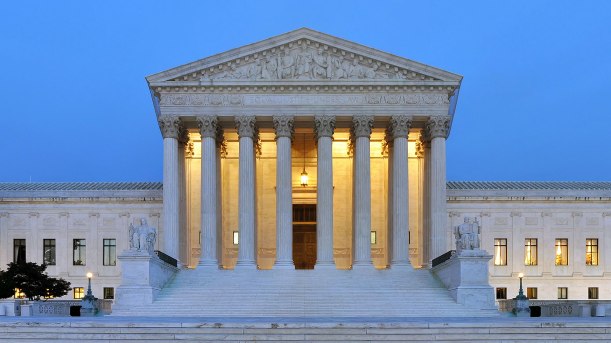
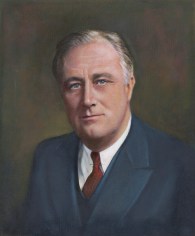 On February 5, 1937, President Franklin Delano Roosevelt announced his intention to expand the Supreme Court to as many as 15 justices. The plan was clearly political. Roosevelt was trying to “pack” the court, Republicans argued, and in turn make the nation’s highest court a completely liberal entity.
Roosevelt embraced the criticism and mostly ignored it. Although politically it was still a hot button issue, his New Deal policies had earned public acceptance, even praise. As president, he reached for the stars.
Here’s why it mattered to Roosevelt. The high court had previously struck down several key pieces of his New Deal legislation on the grounds that the laws delegated an unconstitutional amount of authority in government, specifically the executive branch, but especially the office of the president.
Roosevelt won the 1936 election in a landslide and was feeling a bit emboldened. If he could pack the court, he could win a majority every time. The president proposed legislation which in essence asked current Supreme Court justices to retire at age 70 with full pay or be appointed an “assistant” with full voting rights, effectively adding a new justice each time.
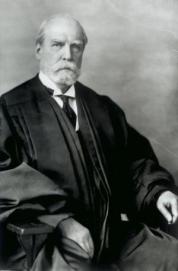
This initiative would directly affect the 75-year-old Chief Justice, Charles Evan Hughes, a Republican from New York and a former nominee for president in 1916 who narrowly lost to incumbent Woodrow Wilson. Hughes resigned his post as a Supreme Court Justice to run for president, then served as Secretary of State under the Harding administration. In 1930, he was nominated by Herbert Hoover to return to the high court as Chief Justice. Hughes had sworn in Roosevelt twice. Now he was being asked by the president to give up his post.
In May of 1937, however, Roosevelt realized his “court packing” idea was wholly unnecessary. Two justices, including Hughes, jumped over to the liberal side of the argument and by a narrow majority upheld as constitutional the National Labor Relations Act and the Social Security Act, two of the administration’s coveted policies. Roosevelt never brought up the issue of the court size again.
But his power move didn’t sit well with the press.
Newspaper editorials criticized him for it and the public’s favor he had enjoyed after two big electoral victories was waning. He was a lame duck president finishing out his second term. Then Germany invaded Poland. Roosevelt’s steady leadership was lauded in a world at war. In 1940, he ran for an unprecedented third term and won easily.
The following year, Japan attacked Pearl Harbor.
Truth Be Told: The Landmark Libel Case That Nearly Stopped the Press
By Ken Zurski
On November 17, 1734, a German immigrant and printer named John Peter Zenger, known for his influential newspaper, the New York Weekly Journal, was thrown in jail for seditious libel.
Zenger was accused of printing unflattering and damaging stories about William S. Cosby, the 24th colonel governor of the Province of New York. Among other things, the Journal claimed Cosby rigged elections, stole collected taxes, misappropriated Indian lands, and allowed enemy ships, like the French, to dock in New York harbor. This was tantamount to treason, the article implied.

The article provoked an already dubious reputation. As a public servant, Cosby was known as a notoriously giving man, but only for the benefit of his fellow Royalists. He tried and often failed to secure higher salaries for his friends and officers. The Journal finally unleashed an onslaught of charges against him.
Cosby fired back, ordering his men to burn up the remaining editions of the Journal, claiming libel laws, and demanding justice. In the early 18th century, under British rule, any information published that was opposed to the monarchy was considered a violation of the law. The truth, as it was understood, was irrelevant. Cosby had a case.
But who to blame?
Zenger was the printer of the article and claimed not to have written it. But when asked to reveal the name of the writer – or writers – listed as anonymous in the paper, he refused. Zenger was arrested, incarcerated and left to await trail. Nearly a year later, in August of 1735, when the jury was finally seated, the Chief Justice in the case, James DeLancey, thought the proceedings would end quickly.
He was right, to a point.
A lawyer from Philadelphia named Andrew Hamilton was called upon to serve as Zenger’s counsel . The Scotland born Hamilton practiced law in Maryland and Pennsylvania and oftentimes traveled between the two provinces to accept cases and appointments. He mostly avoided New York. But when Zenger’s lawyers, a couple of locals, were stricken from the case because they had objected to DeLancey’s commission, Hamilton, a friend and an outsider, stepped in.

Hamilton went to work. He demanded the prosecution prove the allegations were false or the jury must free Zenger immediately. “It is not the cause of one poor printer,” Hamilton insisted, “but the cause of liberty.”
Hamilton’s words were prophetic and Zenger’s case would begin a contentious debate that would last until 1791 when under a new constitution of laws, the expression known as “Freedom of Press,” was included in the very first amendment of the Bill of Rights.
But that precedent would be set only if Hamilton was persuasive enough to exonerate Zenger. Libel only exists when falsehoods are perpetrated, not the truth, he argued.
It took the jury less than ten minutes to come back with a verdict.
“Not guilty” was their response.

Dying for King, Country and Spices and Spices and Spices and Spices
By Ken Zurski
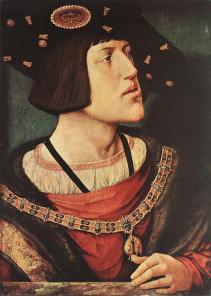 In 1517, King Charles I of Spain, who had just assumed the throne at the tender age of eighteen, was approached by a Portuguese explorer named Ferdinand Magellan.
Rejected by his own country, Magellan made the young King an offer: Let him sail around the world and find a direct route to Indonesia, once successfully navigated by Christopher Columbus.
Columbus’s four voyages for Spain, among other revelations, claimed new lands, including one which was named after another Italian explorer Amerigo Vesspucci.
Charles found Magellan’s plan intriguing. After all, great riches awaited any King who could bring back the precious spices like cinnamon, nutmeg and cloves which grew in abundance on the elusive islands.
If Magellan could find a way to get the spices back to Charles, Spain would reap the rewards and rule the spice trade. Charles wholeheartedly approved the voyage and ordered five ships and a crew of nearly 300 men.
In 1519, Magellan set sail from Seville.
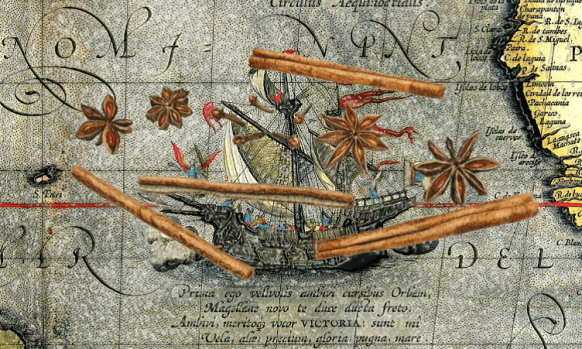
Four years later, limping back to port, only one ship named Victoria returned. Every other ship was lost including most of the men. Even Magellan was gone, hacked to death in a fierce battle with a native tribe.
Despite this, the King was pleased.
 The tragic news of the lost ships and crew was irrelevant. The Victoria had returned with a cargo of 381 sacks of cloves, the most coveted of all spices.“No cloves are grown in the world except the five mountains of those five islands,” explained the ships diarist.
Charles questioned the returning men on mutiny claims and other charges of debauchery, but it didn’t matter.
He paid the royal stipends to survivors, basked in his clove treasure, and set in motion plans to put another crew back in route to the islands.
The First Multi-Book Reader Dates Back to the 16th Century
By Ken Zurski

Agostino Ramelli was a military engineer which meant he wore an armored suit and carried a sword like the rest of his fellow combatants, but used his brain rather than brawn on the battlefield.
This came in handy during the 16th century French Wars of Religion when the Italian born Ramelli went to France, took up arms with the Catholic League, and was captured by the Protestants (Huguenots).
While incarcerated, Ramelli not only found a way to break out, but in as well. After he escaped – or was exchanged – Ramelli returned and breached the fortification by mining under a bastion. From that point on, he called himself “Capitano” and dedicated his life to, well, figuring things out.
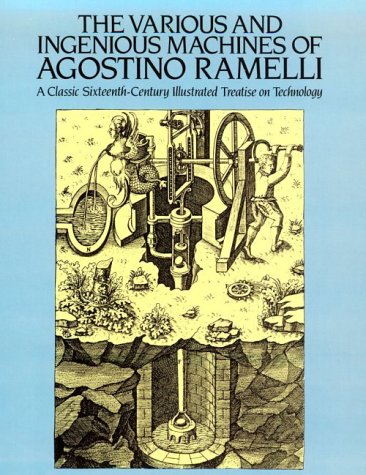
In 1588, he released a book titled, Various and Ingenious Machines of Capitano Ramelli. The expertly illustrated book was a compilation of 195 machines that made laborious tasks more practical. Many of the machines lifted things in crafty ways, like water, or solid objects, like doors off their hinges. One machine milled flour using rollers rather than stones.
Then there was the Book Wheel.
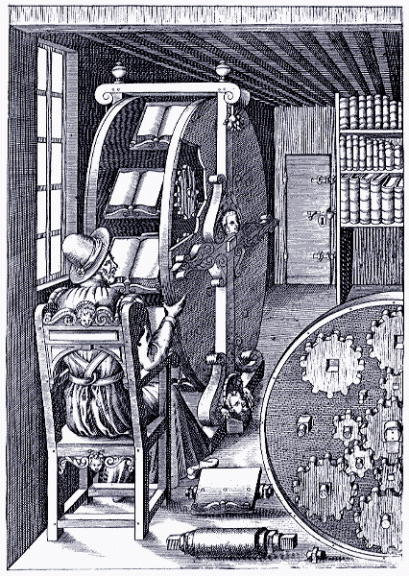
“This is a beautiful and ingenious machine, very useful and convenient,” Ramelli bragged about the large contraption which allowed a person to sit and read several different books without actually picking them up.
By convenient, he meant for those suffering from gout, a painful joint disease which made walking or standing difficult. A noble gesture, for sure, but the wheel itself, while complex, was also bulky and cumbersome. So it is doubtful Ramelli designed it strictly for its practicality.
Nevertheless, its usefulness is left up to the user to decide. The operator remains seated while the books, eight in all, each come to the front by turning the wheel.
Ramelli was especially proud of the gearing system that kept the books constantly level to the ground. He built an intricate gear for each slot and prominently featured a diagram in his book to explain the complicated design. The impressive technology was similar to that used in an astronomical clock.
It was also wholly unnecessary.
A simple swivel pivot and gravity could do the trick just as engineer George Ferris would prove many centuries later in a similar design that carried people rather than books.
Speculation is Ramelli knew this application applied to his Book Wheel, but as a mathematician, and a bit of a swank, he couldn’t help himself.
The English Boxing Champion Who Gets His Bell Rung Everyday
By Ken Zurski
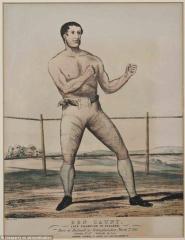
On July 21, 1835 Benjamin Caunt and William Thompson, two of England’s best known boxers and biggest rivals, faced off in a test of strength, will and endurance, typical of a boxing match at the time.
Thompson, considerably lighter and shorter than the 6-foot, 2-inch, 250-pound Caunt, was known as much for his relentless taunting as he was for his fighting. During the bout, Thompson would chant clever but insulting sing-song rhymes directed at his opponent’s wife or mother. Usually the submissive jeers worked to Thompson’s advantage, but Caunt was different – or was he?
For twenty-two rounds, Caunt endured Thompson’s verbal assaults until he finally had enough. During a short break, Caunt walked over to the opposing corner and blindsided Thompson in the head while he sat, ending the fight on a foul and sending the unsuspecting winner slumping to the ground in a heap.
A rematch would take place three years later.

In that contest, Caunt had the advantage early on, but in the 13th round lost his cool again. He began to strangle his opponent with both hands until Thompson nearly passed out. Thompson’s corner crew stormed the ring to help the struggling boxer and subdue Caunt. In defense, Caunt pulled a rope spike out of the ground and began waving it in front of him. Caunt eventually backed off and Thompson was revived with a few sips of brandy. The bout continued until the 75th round when Thompson finally hit the ground from exhaustion. Caunt was declared the winner and returned to his hometown of Nottingham City where he was treated to a hero’s welcome and crowned the new heavyweight champion of England.
The two rivals third and final match in 1845 was mostly Thompson’s to lose. Caunt was hit so hard and bleeding so profusely near the eye that in the 93rd round he retired to his corner to sit. The referee, however, never called for the break and Caunt was ordered to continue. He didn’t. Thompson won by a deliberate foul. Following the embarrassing defeat, Caunt went into a semi-retirement, but his legacy did not.
Despite his even record of wins and loses, Caunt was a giant of a figure in England. Not only due to his a physical attributes, tall and solidly built, but his affectionately playful manner and “booming” laugh too. “A huge, slow-witted, beef-raised pugilist of tremendous powers,” a newspaper recounted in 1910, “who gained prominence through sheer muscle and pluck.” Caunt earned the nicknames “Tokard Giant” referring to his English birthplace, “the bare-knuckled boxer” (there were no gloves used), and the moniker that seemed to stick more than others: “Big Ben.”
“Big Ben” was lured back into the ring one more time in 1857 at the age of 42 to settle a dispute involving the two combatants wives. After 60 rounds both men were too exhausted to continue and declared it a draw.
Four years later, Caunt died from pneumonia.
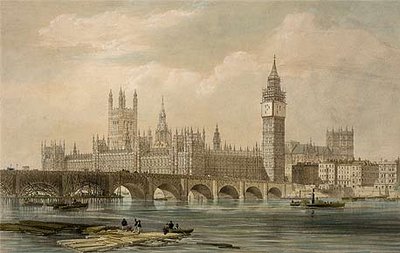
But his story doesn’t end there. In fact, it goes back 20 years to 1834, when a fire ripped through Westminster Palace. Ten years later, the rebuilding committee decided to add a massive clock tower to the new design, including a tolling bell. In May of 1859, after several construction delays and a few broken casts, the bell rang out for the first time.
Shortly after its unveiling, a Parliamentary committee was formed to come up with a name for the bell, similar to York Minister’s “Great Peter” named for the saint, of course, and the church which bears it’s name.

One man on the committee towered above the rest, not only in size but in stature as well. His name was Sir Benjamin Hall. He was the Chief Lord of Woods and Forrests and he stood a whopping 6-foot-4 inches tall.
Hall would typically send the room into a frenzy with his confrontational debates and fiery speeches. During one raucous session dominated by Hall, an exasperated colleague stood up and said: “Why not call him ‘Big Ben’ and be done with it.” No one knows for sure if the acknowledgement was in reference to Hall’s larger-than-life demeanor or the bell. The nickname stuck and Hall apparently sold the idea that the bell was named after him. He died in 1867. The story, however, comes with a mix of skepticism and doubt. Not a word of it was documented. It’s hearsay and most of it was Hall’s doing, not much more.
The more plausible explanation, and the one supported today, is that the bell in London’s iconic Elizabethan Tower is named after the boxer, Benjamin Caunt. That’s because Caunt, like his size, was associated with heavy things, often the heaviest or biggest of things, or in this case, the nearly 14-ton bell. It must be a “Big Ben,” like the famous boxer, many surmised.
But being bigger was not always better.
In October 1859, several months after the great bell was installed, it cracked. The striking hammer was to blame. Either it was too strong or the bell was hung too rigidly, no one was quite sure. Whatever the reason, it was ridiculed in the press for being a mammoth failure, at least initially. “There is no more melancholy looking object than a large public clock which wont go.” the London Times sarcastically reported. Criticism of the time and expense it took to put up the bell was replaced by even harsher objections to how much more time and expense it would take to fix it. “An old adage tells us the fate of the best broth with too many cooks to prepare it,” the Times reported, openly blaming poor management and craftsmanship for the bell’s initial failure.
“In the name of common prudence,” the Times continued, “let the contract for the next bell be given to some of our eminent bell founders who have passed their lives and realized fortunes in the manufacture of bells of all kinds.”
Whether Caunt knew the bell was named after him is not known. Perhaps based on its ineffectiveness at first, he wanted nothing to do with it. When “Big Ben” tolled for the first time, Caunt, who was likely in Nottingham City – a distance of 175 kilometers to London – would have never heard it.
By the time the recasted bell rang again, nearly two years later, he was dead.
How the Civil War Changed Baseball Forever
By Ken Zurski
Conventional wisdom would suggest that the start of the Civil War in 1861 slowed down the progress of a game like baseball, a sport that was gaining popularity in the years before the conflict began.
And that is true, to a point.
Inevitably as men heeded the call to serve, there just weren’t as many players to take the field. But there were reserves to take their place, especially in the well populated state like New York, which holds the distinction of introducing the world to Base Ball (then written as two words).
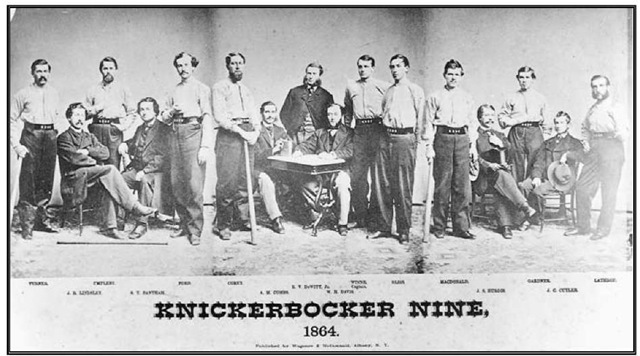
While bat-and-ball type games were popping up throughout the country, in New York, an actual team called the Knickerbockers emerged in the 1840’s. While not trailblazers in creating the game, they can be considered pioneers when it comes to the sport. The Knickerbockers actually made and followed rules.
Other teams formed and crowds grew.
Then came the war.
Although pick-up games continued, the sport shifted to the battlefront instead. “Each regiment had its share of disease and desertion; each had it’s ball-players turned soldiers,” remembered George T Stevens, of the 77th Regiment, New York Volunteers.
Union soldiers would play a good “game of nines” to help pass the time.
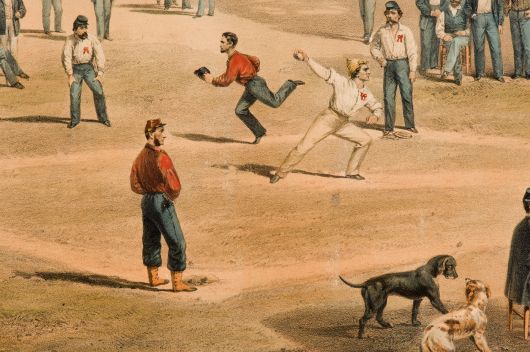
Otto Boetticher was a Union prisoner at Salisbury, North Carolina. In 1861, at the age of 45, he enlisted in the 68th New York Volunteers and left his job as a commercial artist. The following year he was captured and ended up in Salisbury before a prisoner swap set him free a few months later. Before leaving, Boetticher did a drawing of a prisoner game of baseball.
Boetticher’s drawing, released in 1864, was hardly representative of prison camp descriptions at the time. “Despite the bleak realities of imprisonment,there is a sense of ease and contentment in the image, conveyed in part by pleasures of the game, the glowing sky and sunlight, and the well-ordered composition,” one assessment of the drawing goes.
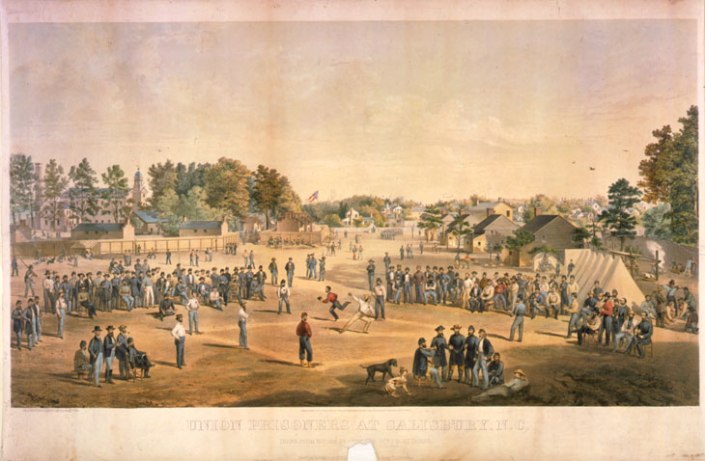
Boettchler’s lighthearted look at prisoner life wasn’t his fault. The harsh reality of the POW camps would come later with the woeful Libby and Andersonville among others where the prisoner population grew by thousands and unsanitary and overcrowded conditions led to widespread starvation and sickness. Early on, however, the captured soldiers waited for their name to be called.
Why not play a spirited game of baseball?
Boetticher’s print may have been from a July 4th game, when prisoners were allowed to celebrate the nation’s holiday, as one prisoner described, with “music, sack and foot races and baseball.” But if weather permitted and “for those who like it and are able,” baseball was played everyday.

Some might think Boetticher’s depiction of prison life is more deception than reality. But prisoner recollections support the claim that despite the animosity between them, a game of baseball was good fun for both sides.
“I have never seen more smiles today on their oblong faces,” William Crosley a Union sergeant in Company C wrote describing Confederate captors watching a match at Salisbury. “For they have been the most doleful looking set of men I ever saw.”
Once the conflict was over, the game itself was in for an overhaul. Many of the older players who went off to war, were either injured, weary, or worse. That’s when younger players joined in. Skills improved, rules were implemented and the game became more about the playing and the winning rather than just a friendly “game of nines”
Base ball became Baseball – a legitimate competitive sport.
Play ball!
‘Is There a Santa Claus?’: History’s Most Enduring Christmas Related Editorial Was Published in September.
By Ken Zurski

As brothers growing up in Rochester, New York, William and Francis Church were raised in a strict but loving household. Their father, Pharcellus Church, was a newspaper publisher and Baptist minister. He demanded nothing but the best from his boys, who in return, each earned a college degree and joined their father in the newspaper business.
In 1862, however, at the onset of the Civil War, the two brothers followed separate paths. William resigned his post at the New York Times to become a full-time soldier while Francis continued on as a civilian war correspondent.
William earned the rank of Lieutenant Colonel, but left after a year. His superior at the time, General Silas Casey, suggested he start up a newspaper and devote it strictly to the war. William liked the idea so he mustered out and asked his brother to join him. Together they published The Army and Navy Journal and Gazette of the Regular and Volunteer Forces, a weekly filled with articles on everyday applications of the war, soldier’s viewpoints, and a critical eye.
“There is not a shadow of a doubt that Fort Sumter lies a heap of ruins,” the first sentence of the first volume read on August 29, 1863.

While the two brothers continued to edit the Journal, and eventually collaborated on a monthly literary magazine, The Galaxy, their legacies are vastly different.
William would go on to become the founder and first president of the National Rifle Association (NRA), while Francis became posthumously known for an editorial he wrote in response to a little girl’s inquisitive letter and inquiry. “I am 8 years old…,” the letter began and ended with an ages old question, “Please tell me the truth. Is there a Santa Claus?”
It was signed: Virginia O’Hanlon 115 W. 95th Street

The editorial appeared without a byline and was buried deep in New York’s The Sun on September 21, 1897.
Only after Francis’ death in 1906 was it revealed that the former war correspondent penned the famous line:
“Yes Virginia, there is a Santa Claus.”

Before There Was Reality TV There Was ‘Real People’

By Ken Zurski
In April of 1979, NBC rolled out a new one-hour weekly TV show called “Real People” that was unlike anything anyone had ever seen before. At first no one was quite sure what to make of “Real People.” Was it a news show or an entertainment show? Quickly they discovered while the program loosely incorporated a “60 Minutes” type format, it was done mostly for laughs. The struggling NBC network was desperately in need of a hit and they got one in the unlikely “Real People.” The next day people would be talking about what they had seen on the show.
“Real People’ of course stood for, well, real people. The program aired short videotaped segment highlights of real people doing real, but often oddball and hilarious things. In between the segments, mostly unknown hosts at the time, like local LA talk show host Sarah Purcell and comedian Skip Stephenson, would engage in humorous banter about the segments. (John Barbour, Mark Rafferty and Byron Allen rounded out the original cast.)
The show was filled with fast-cut editing, silly sound effects, and just enough cheesy commentary to get in an out of each segment and commercial breaks.
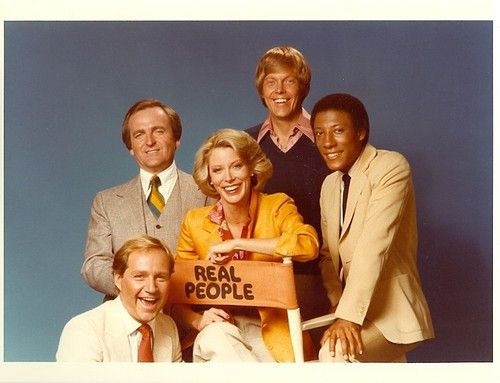
Comedy variety shows were popular on television, like the hillbilly-themed “Hee–Haw” and the trippy “Rowan and Martin’s Laugh-In,” but “Real People” was different. There were no staged skits, not technically at least. The taped segments took up most of the hour, but there were also “in-studio bits” that featured funny newspaper headlines and bizarre photos. Many of these features would later become staples in late-night television programs such as “Jay Leno’s Tonight Show.”
Some of the taped segments were just downright weird. Like the man who could run up a 20-ft brick wall or an elderly woman who could put the tip of her nose in her mouth. Naked skydivers, a beauty pageant for pigs, a married couple who both wanted sex change operations, and a cat that uses the “commode” instead of the liter box were some of the more curious and interesting pieces.
In one episode, two car enthusiasts showed off their “push me-pull me” vehicle that fused together the front of two Packard’s so an engine was on both ends. You get get in the any side and go, they would explain. In a Halloween-themed episode that aired in October of 1980, a medium was featured who tried to reach Elvis Presley
The opening of the show would be a teaser of each segment: “Meet a modern day King Kong,” an excited announcer would describe under jumpy theme music, “who enters the Empire State Building and goes completely ape!” While on the screen a man in a gorilla suit is seen doing a dance in front of actual visitors to the iconic New York skyscraper. Although the show was filmed in front of a live studio audience a laugh track helped accentuate the hilarious response.
While the sillier segments highlighted the show, more serious topics were also explored. They included a Canadian man, an amputee, who ran cross-country and called it the Marathon of Hope; and the reunion of WW II American POW’s who were held captive and bunched up their clothing to make an American flag. Several of the men broke down while recalling the story. So did the audience.

“‘Real People’ focuses on weirdos, eccentrics and unusually admirable Americans,” syndicated TV critic Gary Deeb wrote in November 1979.”Particularity the unsung types who never make the local paper or the 6 o’clock news.”
“Real People” was a really big hit, often topping the Nielsen ratings for the week and leading to several mildly successful imitators like “That’s Incredible” and “Games People Play.” It was a hit, many agreed, because it served as an alternative to the other top-rated shows at the time or “cheescake programs” as Deeb called them. They included “Three’s Company,” “Mork and Mindy” and “Charlies Angel’s.”
“It’s a welcome antidote to the glitter and tackiness that characterize so many TV variety shows,” Deeb wrote.
Deeb also gave credit to the show’s creator, producer and co-host Jon Barbour, calling him “the guardian angel and most eloquent spokesman” of the show. Going even further, Deeb dubbed Barbour, “The Godfather of Reality TV.”
After the success of “Real People,” several spin-offs,”Speak Up America” and “Real Kids,” were launched but failed to ignite like its predecessor. Even Barbour, who left the show over a creative dispute in 1982, returned with “John Barbour’s World” on cable’s Showtime the following year. The original “Real People” eventually signed off in July of 1984.
But despite the failures of the network spin-offs, the concept did not die. Nearly a decade later, in 1989, when Americans could videotape their own silly segments of pratfalls and embarrassing blunders, “America’s Funniest Home Videos,” debuted on the ABC network.
Although its inception was attributed to a Japanese television show, the influence of “Real People” is evident. A host or hosts introduce each segment in front of a live audience, a music and laugh track amp up the silliness, and the videos – albeit shorter – are still real people doing really funny things.
Only this time, the audience is encouraged to laugh at them, not with them.
Like “Real People,” AFV as it was called, became an unexpected hit.
 UNREMEMBERED