
unrememebred history
“Shoot a horse,” they said. Good thing he didn’t take that literally
By Ken Zurski
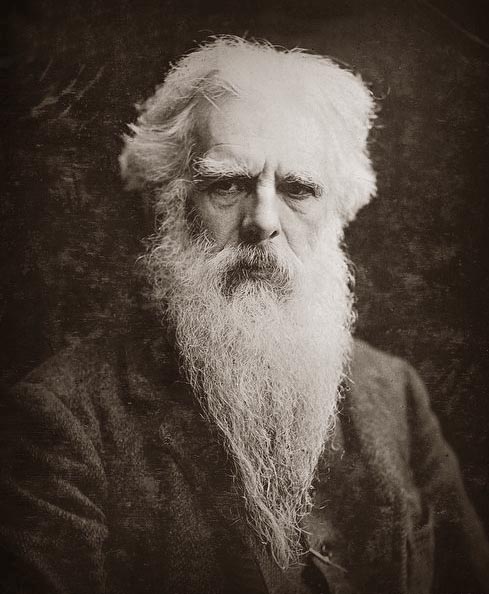
In 1860, while traveling by stagecoach across the Texas plains, capitalist Eadweard Muybridge fell and suffered a serious head injury. Some say he never fully recovered.
His doctor however suggested more fresh air.
So Muybridge took up photography and began shooting landscapes.
Then in 1872, railroad magnate Leland Stanford hired Muybridge to shoot a horse. Not literally, of course, but with a camera. Stanford wanted to know if a horse lifts all four feet off the ground simultaneously during a gait.
Muybridge managed to show a horse seemingly suspended in midair. But the shot, published as a line drawing at first, drew jeers from a skeptical public.

Muybridge found a way to convince them. He invented a machine called the Zoopraxiscope, where a silhouette image of a picture is painted on a revolving glass plate.
When the light is shown through the cylinder the drawings seem to move.
“A magic lantern gone mad,” raved the Illustrated London News.

Vindicated, Muybridge sought to improve his design. He went to see a man he thought might be able to put actual photographs on the cylinder.
After all, he had done the same thing with sound.
That man was Thomas Edison.
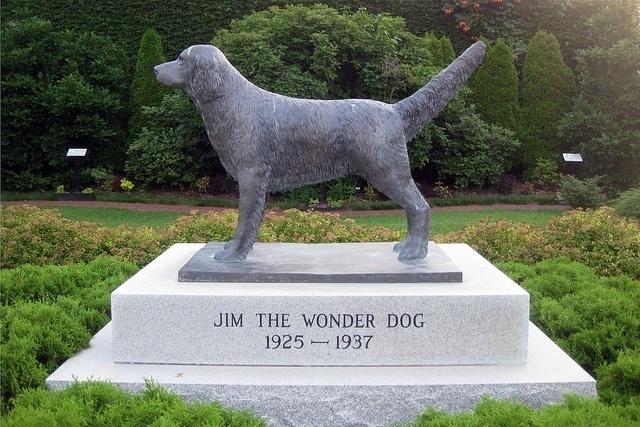
Meet Jim: The ‘Wonder Dog’ Who Correctly Picked Kentucky Derby Winners
By Ken Zurski

In the 1930’s, the Llewellyn setter known as “Jim the Wonder Dog” correctly picked the winner of seven Kentucky Derby’s in a row. An improbable feat even for the most adapt handicapper, but Jim’s owner Sam Van Arsdale insisted there was nothing deceitful about his dog’s apparent ability to predict the outcome of the prestigious race year after year.
Here’s how it worked: Van Arsdale would set down sealed envelopes each containing the name of a horse in the race. Jim would walk up to one and put his paw on it. The envelope was then stored in a locked safe. After the race, the envelope was reopened revealing the winning horse each time. The soft spoken Van Arsdale never wanted to profit off his prized pooch so he turned down all offers to reveal the contents of the envelopes before the race.

Jim is also credited with accurately guessing the gender of unborn children and in 1936 correctly picked the New York Yankees to win the World Series.
Skeptics and doubters were aplenty, but Van Arsdale insisted it was no trick
Jim died in 1937 at the age of 12.
UNREMEMBERED Preview: New Book Explores History’s Connections and Coincidences
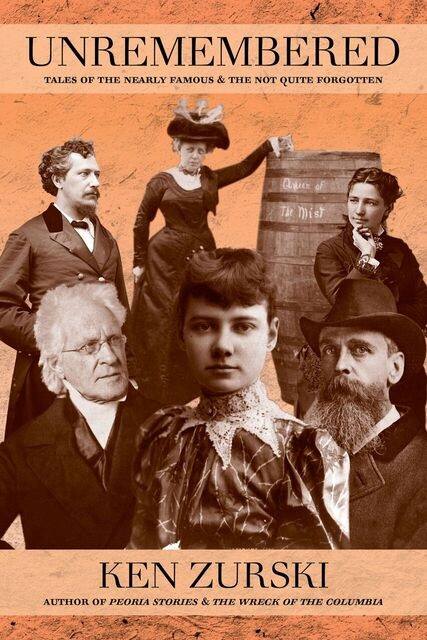
Author Ken Zurski (Peoria Stories & The Wreck of the Columbia) answers questions about his new book “UNREMEMBERED: Tales of the Nearly Famous and the Not Quite Forgotten:”
Unremembered is an interesting word. Why did you choose it?
I really liked it for one. It’s not used very often, but I saw it once and immediately knew it fit what I was trying to do.
And that would be a blog of forgotten history stories?
Well, yea, sort of. I was thinking a book first and thought it would make a terrific title. I had stories but wasn’t sure of the direction. I had a list of people and events I’d read about and wanted to write so I started the blog first and now here we are two years later and finally a book.
The book is different from the blog in that it tells multiple stories but within the context of a flowing or entwined narrative. Was that planned?
Mostly, yes. I didn’t want to do a bathroom book with just a bunch of articles. The stories on the blog are short so there would have to be a hundred or more in the book. I began thinking of stories intertwining and that sparked my interest in telling stories of people and events and their connections to each other, something I did in an abbreviated way with my book Peoria Stories. Some of the connections are more obvious than others and there are four parts to Unremembered so there are different themes, but with a thread that connects them all.
Some people seem to pop up and leave and others reemerge. Is this because of their connections?
Oh, Yes. There are probably 70 people featured in the book all under the same guise of being nearly famous or not quite forgotten. Some appear briefly others more prominently.
George Francis Train is one character that seems to have his hand in everything. Did you know that going in?
Oh, of course. Train was probably the person that best exemplifies what I was trying to convey in Unremembered. He was a resourceful figure and had some pretty amazing accomplishments in his lifetime, but he tried too hard to be important. Eventually his antics led many to believe he was insane. Others greatly admired him. In the end though, hardly anyone remembers him.
So he fits under the category of “nearly famous”?
Yes, I suppose, in how time treated his story. Today, he’s certainly not famous when compared to others, but in the later half of the 19th century he was a very famous figure, prominently in the news and influential and controversial too.
And Nellie Bly, the journalist, where does she fit in?
She is sort of like Train but never seemed to push herself into the spotlight like Train did. Certainly traveling around the world is a heady stuff for a woman at the time, but she did it to further her status as a journalist, not become a celebrity. That she became famous was a bonus.
So she is not quite forgotten?
Exactly her name comes up in books about the early history of journalism. But most people don’t know all of her amazing story.
Train and Bly seems to be main characters but don’t enter the book until the third part, especially Bly. Was this by design?
Sort of. Train has a connection to a man we meet in the first part Cornelius Vanderbilt, who has a connection to a steamboat disaster in New York whose tragic events has a connection to a young printer, it just follows along. Train is actually in every part in some way.
Niagara Falls is an interesting subject? How did you choose that to continue the narrative in Part Two?
Beyond the nature part of the beast, there’s a human story to the Falls which really interested me. Why did people risk their life to challenge it? So many stories emerged I had to tell it.
And yet, somehow it ties into balloon travel which ties into the birth of transportation
Yes, Part Three is about reaching new limits and new heights in transportation both by water and air. Some interesting and forgotten stories can be found here beyond the more familiar names like the Wright Brothers, Charles Lindbergh and even the Titanic.
So there is an “unremembered” ship?
There is. Again famous for it’s time, but mostly forgotten now.
And then we’re back to a tragedy in Part Four?
Yes, the Great Chicago Fire.
And a familiar face emerges?
Yes, Train has a history there as well.
It’s all very fascinating stuff and the book covers a lot of ground. Were you ever surprised by the connections?
Most everything in the book is included because of the connections, but there were a few that were unexpected and came about while during research.
They call that writer’s luck, right?
Exactly

3/2/18
“Unremembered: Tales of the Nearly Famous and the Not Quite Forgotten” is scheduled for release in August 2018 by Amika Press, Chicago.
A Legacy in One Book, Never Seen by it’s Author
By Ken Zurski
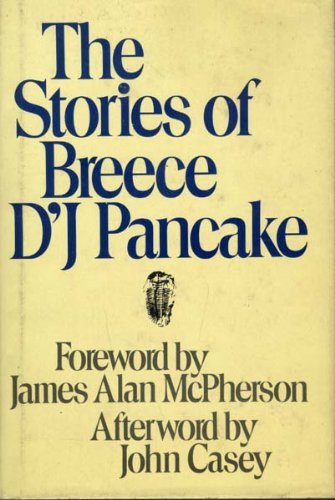
Breece D’J Pancake never had a book published in his lifetime. He died at the official age of 26, just shy of his 27th birthday. But four years after his death, The Stories of Breece D’J Pancake was released to critical acclaim. In fact, it was nominated for a Pulitzer Prize.
“A young writer of such extraordinary gifts that one is tempted to compare his debut to Hemingway,” praised a fellow author, Joyce Carol Oates.

Born in 1952, the name Pancake is a surname of German origin. The odd apostrophe in D’J was a printer’s error, which stuck.
Pancake wrote about hardships of rural life in the Appalachian Territories where he grew up and rarely strayed. Most of his stories fly by in time, examining just hours of a character’s life, but packed with personal and social struggles both past and present.
When I was a young punk, I tried to run away from home. I was walking through the meadow on the other side of the Hill, and this shadow passed over me. I honest to god thought it was a pterodactyl. It was a dammed airplane. I was so damn mad. I came home. (“Trilobytes” Breece D’J Pancake)
The stories appeared in Atlantic magazine and Pancake submitted them only after he composed four long-hand drafts and ten more on the typewriter.
Ultimately, he struggled with alcoholism, but his untimely death by self-inflicted gunshot in 1979 may have been a tragic accident, some believe, due to a bout of sleepwalking.
It all adds to his lore.
One book, however, remains.
The /rel·e·van·cy/ of a Dictionary Maker
By Ken Zurski

In 1858, Herbert Coleridge, a British philologist, took on the daunting task of compiling and completing a new English dictionary.
It was not an easy undertaking. Wordbooks as they were known had dated back to the early 17th century, and by the 19th century, an American lexicographer named Noah Webster made dictionaries that were based mostly on personal assessments of the English language, which in Webster’s opinion was too closely identified with the British.
Coleridge’s dictionary would be different and involve hundred of volunteers who would find unlisted words in books and write them down on note cards along with the word’s source.
The note idea was not Coleridge’s but rather that of Richard Chenevix Trench, a British professor and lexicographer, who proposed using everyday readers to participate in the dictionary’s creation. “It would be necessary to recruit a team moreover, a huge one comprising hundreds of unpaid amateurs,” Trench proposed.

Trench’s vision took hold and Coleridge was called upon to make it happen.
Coleridge went to work designing a system of collecting the reader’s notes and organizing them. He also grossly underestimated that it would take only two years to complete the work. In reality, near the two year mark, the dictionary was far from finished, and Coleridge, unfortunately, was dead.
Officially Coleridge died of consumption, or a bout of tuberculosis, which makes sense. However, biographers paint a more fanciful ending. While walking to a lecture hall in London’s St. James Square, Coleridge got caught in a downpour and sat soaking wet in an unheated upstairs room for several hours listening to the speaker. His chills turned to a debilitating fever and eventual death.

Despite his untimely demise, the dictionary idea did not go with him. Several enthusiastic wordsmith’s picked up the slack. Soon they learned what a formidable task Coleridge faced. In just a few years of work, Coleridge had only gotten halfway through the first letter. Undeterred the vision carried on and in 1878, nearly a quarter century after Coleridge began. A New English Dictionary on Historical Principles was released. Today, the book is cited as the basis for the inaugural Oxford English Dictionary which was released in 1895.
Coleridge is often listed as its first editor.

The Brutal Reality of Caesar’s Death
By Ken Zurski
The Death of Caesar is an 1867 painting by Jean-Léon Gérôme’, a 19th century artist and sculptor known for the French inspired “academism” artistic style. Among the many portraits and works inspired by Greek mythology, Gérôme’’s portfolio also includes historical recreations.
So here, as the title not so subtly suggests, he recreates the assassination of Julius Casear on the Ides of March, 44 B.C.

Gérôme’ paints the tale of Ceasar’s death in stark clarity. He shows the moment immediately following Ceasar’s murder as the unfortunate victim is seen in the foreground crumpled on the floor. The throne chair is overturned signifying a struggle and those not part of the killing are seen fleeing the room in terror. The conspirators celebrate by raising their weapons in victory.
The only man not holding a weapon above his head is Brutus.
His back is turned. He is walking toward the other celebrants and dragging his weapon behind. Perhaps, as history suggests, this signifies Brutus dealt the final blow. He also carries what appears to be a sword, not a dagger. This would seem appropriate for the time, since swords were commonly used by Roman soldiers in battle. But as history books explain, the weapon of choice to kill Casear was a dagger, not a sword.
Brutus all but confirms it in a coin he commissioned after Caesar’s death. On the coin are two daggers with different shaped hilts. Presumably, the first dagger belongs to Brutus. The second likely belongs to another assassin.
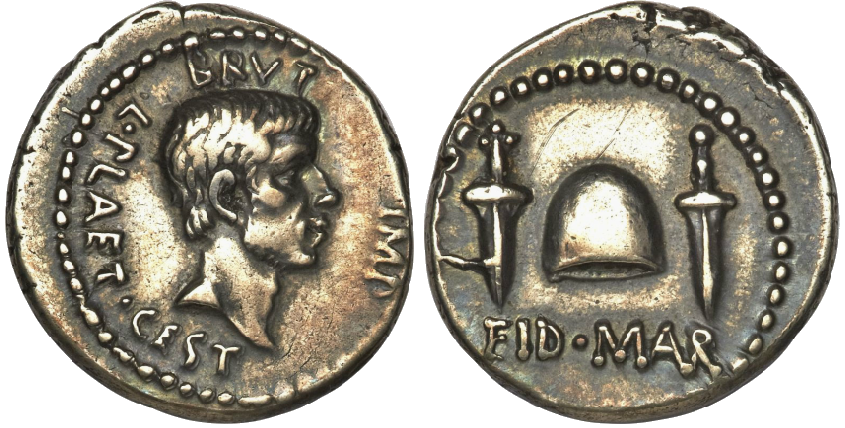
The shorter daggers make more sense in the killing of Caesar.
Daggers were as martial arts experts explain today, “streamlined and remarkably light.” They were also very effective, especially at close range. Plus, a dagger could easily be hidden in a toga and retrieved quickly. The only advantage a sword would have over a dagger is the distance between the striker and the intended target.
But that was in combat. Caesar was ambushed, presumably unarmed, and received blow after excruciating blow. A task, while effective, that took stamina and strength. Instead of celebrating with weapons held high (as Gérôme’s painting suggests) more realistically, the band of conspirators would be hunched over from exhaustion. Their hands and white garments covered in blood.
Author Barry Strauss in his book The Death of Caesar says this about the use of daggers in warfare: “Few felt comfortable talking about it and fewer still doing it.”
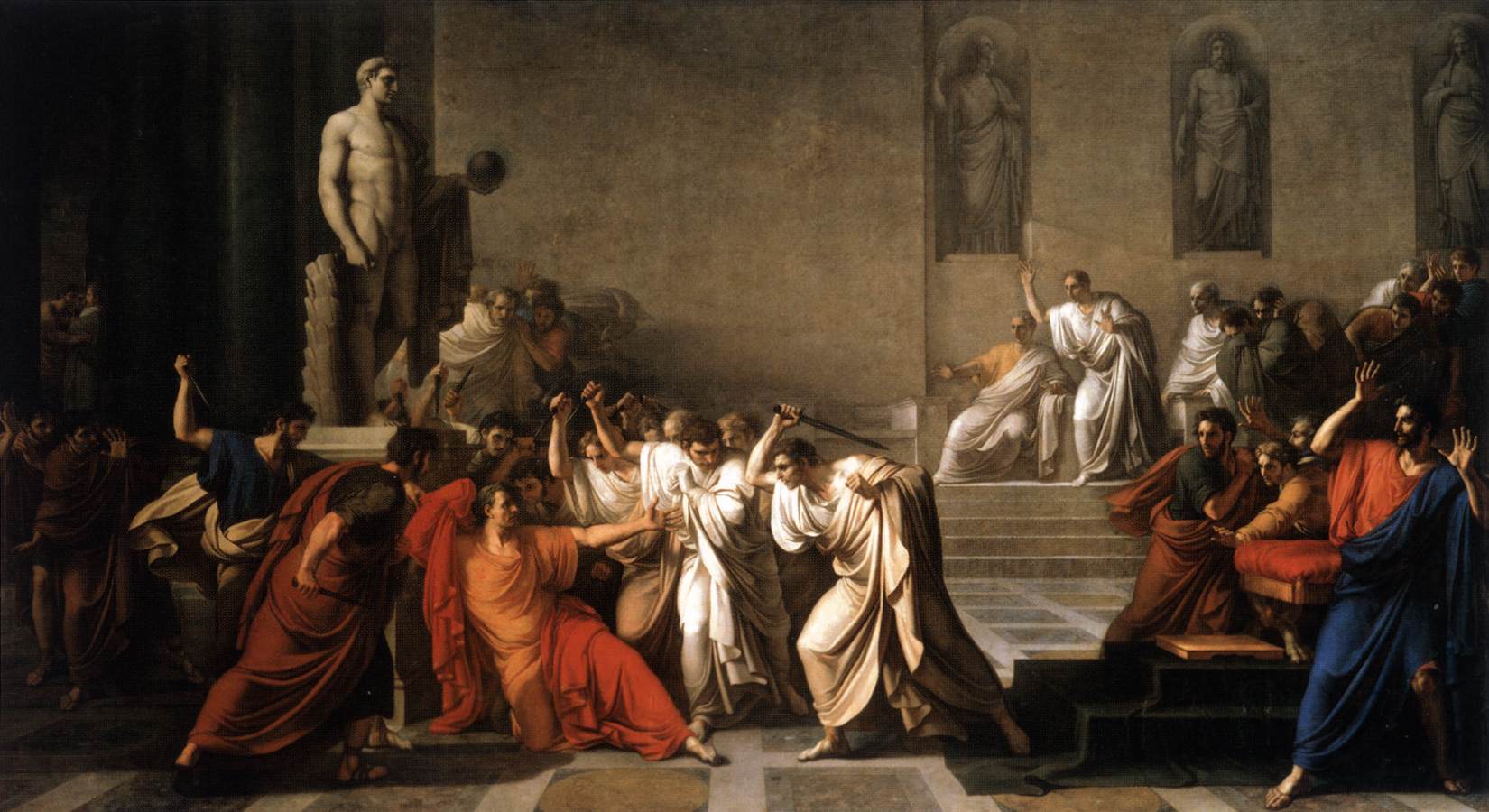
In another painting of Ceaser’s frantic death titled The Death of Caesar (1798), artist Vincenzo Camuccini seems to show a more accurate portrayal of the weapons used in the murder. The depiction portrays most of the mob carrying the shorter daggers, except for a few who still sport a longer blade.
Is one of them Brutus?
One might debate, and likely get few detractors, that Brutus used a sword for the final blow, thus marking Ceasar’s end for all eternity: Et tu, Brute
Yet, despite the graphic detail, there’s still no bloody mess.
That’s because the representation shown in Camuccini’s painting is the moment before Ceasar is struck not after like Gérôme’s and therefore spares the viewer the gory aftermath.
Churchill’s Gift from the U.S. Was a Literary Surprise
By Ken Zurski

On June 25, 1954, British Prime Minister Winston Churchill visited Washington D.C. to talk policy with then U.S. President Dwight D. Eisenhower.
At the time of his visit, the 79-year-old Churchill was showing his age and associates were urging him to retire. “His head was bent and his eyes, with their pale lashes were downcast, lest he stumble,” one biographer wrote of his appearance that day.
Despite Churchill’s weary appearance, Eisenhower greeted the Prime Minister warmly and the two got down to business.
History records a significant meeting which resulted in Churchill’s insistence that Eisenhower attend the tri-lateral talks with the Soviet Union. But history buffs, especially those who love literature, celebrate the trip for another reason.
During the visit, Churchill was presented with a gift from the Library of Congress and the U.S Copyright Office. The “handsomely bound, gold lettered” 35-page bibliography was the result of a massive undertaking to catalog all copyrighted works pertaining to Churchill, including books, periodicals, and his own writing. In the end, they found 565 contributions about or attributed to Churchill between the years of 1898 and 1953.
In a letter, the Library of Congress Reference Division Chief Richard MacCarteney wrote: “The bibliography was not the result of any special request. … It grew out of a realization of the tremendous effect Sir Winston Churchill’s utterances have had upon world history and thus our obligation to develop as nearly complete a copyright record of them as possible. ”
Churchill was obviously pleased, but explained that one book was still missing. “A modest work,” he implied.
Two years later, A History of the English Speaking People’s, an 800,000 word, 1,760 page four volume set, was released. Churchill had finally appeased his wife and close advisers by resigning from office and finishing the book. “It opens like an angel’s wings,” Churchill gushed about its stately design.
Shortly after it was published, a spokesman for the U.S. Copyright Office, who had made a promise to Churchill during his visit, “eagerly anticipated” the book and subsequently added it to the bibliography list.

The Greatest Showman’s Home Was Everything You Might Imagine It To Be And More

By Ken Zurski
In 1848 a mansion went up in the scenic countryside of Connecticut that looked oddly out of place for its location. Not only was it very large, occupying 17 acres of land, but the building itself with its exotic Indian influenced architecture looked like something you might spot in far off Mumbai or New Dehli, not Fairfield, near Bridgeport, Connecticut’s largest city.
All this was the creation of one man who commissioned the building of the mansion as a “permanent residence” for his family. His name was Phineas Taylor Barnum, better known as P.T. Barnum.
Barnum called his new home the Iranistan.
Barnum’s inspiration for Iranistan was the Royal Pavilion in Brighton, England, a place he visited while doing a tour of Europe with his star attraction at the time, the 25-inch tall man known as Tom Thumb. Unlike others, Barnum was greatly pleased by what he saw. “It was the only specimen of oriental architecture in England, and had not been introduced into America,” he wrote.
Barnum hired a New York architect named Leopold Eidlitz to design it with the stipulation that he hold nothing back in terms of style and decorative elements. “The whole was finally completed to my satisfaction,” Barnum expressed, and on November 14, 1848, he held a house warming party for “a thousand guests.”
The invitees found a casual but garish palace to explore. Outside there was a circular carriage way , a fountain, urns and a decorative facade that was filled with symmetrically placed arched openings and numerous decks and porches. Topping the building were onion-shaped domes and minarets.
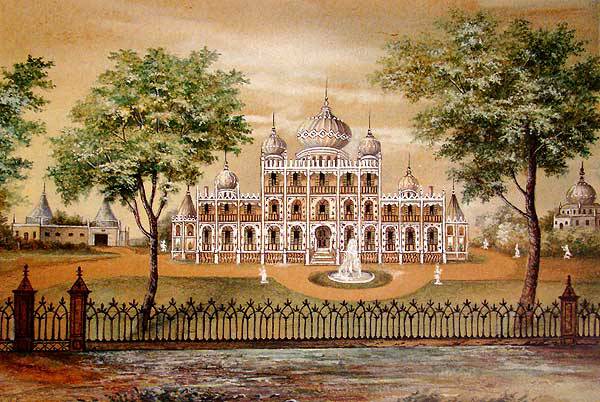
Inside, there was a circular divan under the dome, a large library adorned in Asian landscapes on its walls and elaborate stained glass windows that filled the rooms with colorful light. The grand ballroom sported a shiny wood floor with an inscription, “Love God and be Merry,” words Barnum used often.
“Elegant and appropriate furniture was made expressly for every room in the house,” Barnum would later write. “The stables, conservatories and out-buildings were perfect in their kind. There was a profusion of trees set out on the grounds. The whole was built and established literally ‘regardless of expense,’ for I had no desire even to ascertain the entire cost.”
In addition to the design, Barnum filled his home with animals of all kinds, as he did at his popular American Museum in New York City. Roaming the grounds of Iranistan were mandarin ducks, silver peasants, a cow named Bessie, and a pig named Prince Albert.
The biggest attraction was Iranistan’s largest resident, an unnamed bull elephant. This, of course, was all by design. Barnum felt the addition of the animals, especially the elephant was good promotion for the museum. “When entertaining the public, it is best to have an elephant,” Barnum would later explain. It all started at his home.
But it wouldn’t last.
Late on December 17, 1857, only nine years after it was built, the Iranistan was gone. Barnum, who was refurnishing the mansion at the time got the news the next morning by telegram while staying at the Astor House in New York. The building caught fire, he was told. It was a total loss.
The papers were consoling, but skeptical. Barnum’s good fortunes had recently taken a turn for the worse. It all started when Barnum sought to create a “perfect”town in Connecticut that he would call East Bridgeport. He convinced a large business, the Jerome Clock Company, to move their factory there in the hopes of bringing more people and jobs. The clock company agreed to relocate but first needed help to pay down a debt of $100,000 . Barnum loaned them the money, but was tricked into signing more cash notes. Soon he was responsible for a half million dollars in debt. Barnum was forced to go into bankruptcy and lost a fortune.
Many of his friends supported his plight with sympathy, loans and gifts, but others reveled in his misfortune. To his detractors, Barnum’s latest predicament – more like a humiliation – was subject to ridicule. “Here is a terrible illustration of where the practice of humbug will lead,” proclaimed the New York Herald.
The Chicago Tribune’s headline was even more biting.: “The deceiver is duped,” it read.
In the midst of all this turmoil, Barnum lost his beloved Iranistan.

Initially, no cause of the fire was given. “It is supposed to have been set on fire,” was one newspaper dispatch, not mincing words, but refusing to elaborate. Later, it was suspected a construction worker dropped a lighted pipe. Barnum had recently moved some of the more expense furniture out of the Iransitan during the renovation and claimed he would soon return. His insurance money was far less then the initial cost of $150,000. “My beautiful Iranistan is gone,” Barnum would write in his autobiography.
Barnum recovered financially after going on another successful tour of Europe with Tom Thumb. Upon his return he set out to build another home, again in Fairfield, called Lindencroft, that in its design was spacious, but far less extravagant than the Iranistan. “All the taste that money can could do was fairly lavished upon Lindencroft so that when all was finished it was not only a complete house in all respects, but a perfect home.” Barnum wrote his memoirs.
The biggest disappointment, however, was for the riders on a train line that would pass by the Iranistan grounds everyday. Not only was the impressive building gone, but they missed seeing the elephant, roaming the yard, helping plow the fields, and giving them all a thrill by raising its trunk and bobbing its head in a friendly gesture.

(Sources” The Great and Only Barnum by Candace Fleming; P.T. Barnum: The Legend and the Man by A.H. Saxon; various internet sites)
The Spirit of Giving: When The Winter Warlock’s Heart Was Warmed
By Ken Zurski
One day, quite a long time ago, a tiny baby was left on the doorstep of Burgermeister Mesiterburger, the fun-loathing mayor of Sombertown.
Now, this Burgermeister Meisterburger didn’t like babies.
Not one bit, in fact.
So the grumpy Burgerneister ordered his guards to take the baby away.

But something unexpected happened.
While the guard was pulling the baby through the snowy forest on a sled, the rope broke. Suddenly, the sled and baby went uncontrollably down the mountainside and straight into the home of the Kringle family.
Well, the Kringles were quite surprised by their new visitor. They took the baby in and called him “Kris.” This they explained was because the meaning of KRISTKINDL is the Christ Child.
They raised the boy as their own.
Meanwhile, Burgermeister Meisterburger continued to be a very irritable mayor. One day he tripped on a toy and hurt his leg. So, he outlawed toys! The children of Sombertown were very sad.
What would life be like with no toys?
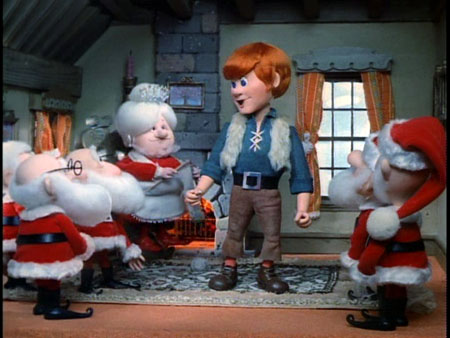
Kris Kringle, now all grown up, sought to bring the joy back to the children. He decided to drop off toys that his family had made to the children of Sombertown. But to get to Sombertown, Kris had to pass through the Land of the Winter Warlock.
Talk about grumpy!

The Winter Warlock was a very mean and bitter man. But Kris knew there was good in the heart of all men. When he gave Winter a gift of a toy train it warmed the Warlock’s cold heart.
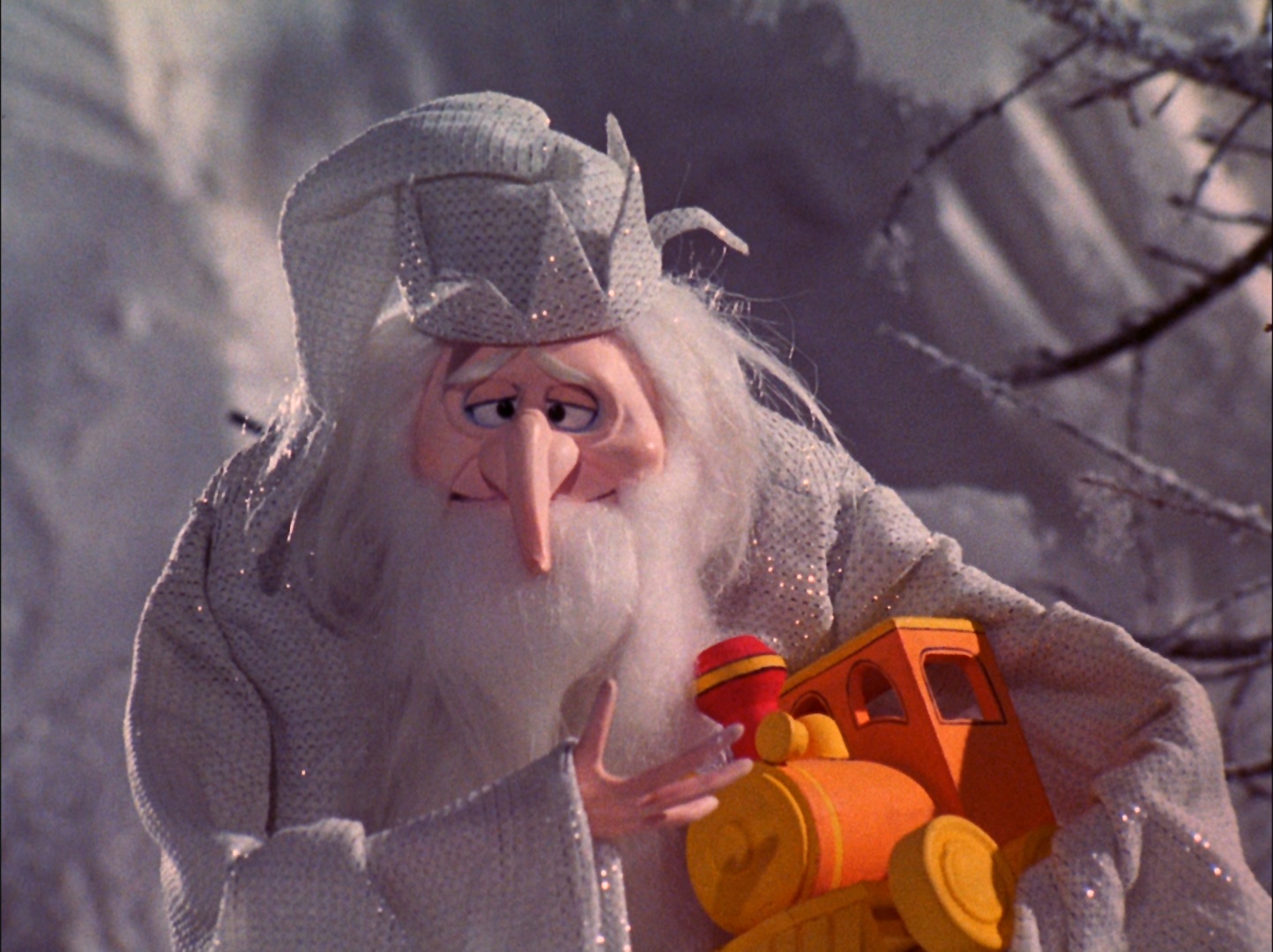
All this didn’t sit well with Burgermeister Meisterburger
He ordered Kris arrested for smuggling toys into Sombertown. The Winter Warlock was also arrested along with the other members of the Kringle family. Although all his powers might disappear, the Warlock uses his magic feed corn to make Kris’s reindeer fly.
Together, they all escape.
Finally, thinking his powers will disappear forever, on December 24, the Warlock uses one final bit of magic to create Christmas trees at the wedding of Kris and his girlfriend Jessica, the future Mr and Mrs Santa Claus.
Thanks to the spirit of giving, the Warlock’s powers have magically returned…along with a snowy, white Christmas.

‘The Greatest Gift’ is a Story You Know Well

By Ken Zurski
In November 1939 Philip Van Doren Stern, an American author, editor and Civil War historian wrote an original story titled “The Greatest Gift,” a heartwarming Christmas tale about a man named George Pratt who gets a dying wish granted by a guardian angel that literally changes his life.
Stern’s story begins at an iron bridge as a despondent George leans over the rail:
“I wouldn’t do that if I were you,” a quiet voice beside him
said.George turned resentfully to a little man he had never seen
before. He was stout, well past middle age, and his round
cheeks were pink in the winter air as though they had just been
shaved. “Wouldn’t do what?” George asked sullenly.
“What you were thinking of doing.”
“How do you know what I was thinking?”
“Oh, we make it our business to know a lot of things,” the
stranger said easily.
Stern desperately tried to get his little story published, but it never sold. So in 1943, he made it into a Christmas card book and mailed 200 copies to family and friends.

The card book and story somehow caught the attention of RKO Pictures producer David Hempstead who showed it to actor Cary Grant’s agent. In April 1944, RKO bought the rights but failed to create a satisfactory script. Grant went on to make “The Bishop’s Wife.”
However, another acclaimed Hollywood heavyweight, Frank Capra, who already had three Best Directing Oscars to his name, liked the idea. RKO was happy to unload the rights. “The story itself is slight, in the sense, it’s short,” Capri said referring to Stern’s book. “But not slight in content.”
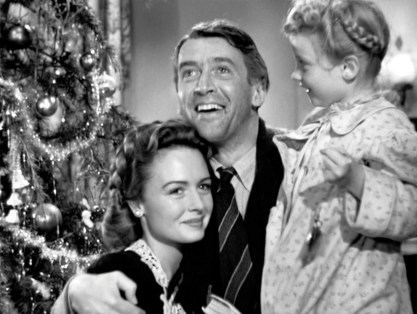
Capra bought it and brought in a slew of writers to polish the story. They hired another a well-known actor James Stewart to play the main character renamed George Bailey and in December of 1946, “It’s a Wonderful Life” was released in theaters.
- ← Previous
- 1
- 2
- 3
- …
- 6
- Next →
 UNREMEMBERED