
Australia’s Rabbit Fence And The Man Responsible For It Being Built
By Ken Zurski

Thomas Austin likely had no idea he alone would be blamed for the massive jackrabbit infestation in Australia which grew so expeditiously that it reached epidemic proportions in the late 1800’s. Austin was an avid hunter and was looking for something, anything, to hunt. Rabbits seemed an obvious choice to an Englishman, but they weren’t native to Australia. So someone had to bring them in. That someone was Thomas Austin.
Today, a long fence from the top of the country to the bottom still stands as a testament to his poor judgment.
Here’s the story.
Born in Somerset, England, Austin a sheep farmer, came to Australia’s Western District of Victoria in 1831. At the time Australia was not unified country but an island made up of five British Colonies. Austin may have been asked to come and help establish the agriculture and livestock footing in the region. He built a retreat of nearly 30-thousand acres called Barwon Park and became a distinguished member of the Acclimatization Society of Victoria, which introduced new animals and plants to the colony. Austin liked birds, so he brought in blackbirds and partridges. His grazing land was used mainly for sheep and horses.
Austin, who was wealthy and socially connected in his native land, liked to hunt and often hosted lavish shooting parties. But there was a problem. Unlike in England where hunting was a sporting good time, in Australia, there was nothing in significant numbers to aim at. So he had an idea. Bring me some rabbits, he ordered.
In 1859, a ship called Lightning on consignments brought 24 wild rabbits to Austin for breeding. Austin let a few go in hopes of hunting their offspring. “The introduction of a few rabbits could do little harm and might provide a touch of home,” he said at the time.
He had no idea.
The locals clearly stood by Austin. A little sport couldn’t hurt the neighborhood, in fact it might actually help the economy, they thought.“We hope that the common interest will be felt in saving them from being destroyed until they have so far increased to render shooting of one of them now and then as a matter of trifling importance,” an editor of the Southern Australian opined.
Austin’s plan worked perfectly.

In 1867, Queen Victoria’a second son Prince Alfred, Duke of Edinburgh, came to visit and stayed at the Austin ranch. Together the two men spent the day hunting and in just over three hours had shot and killed nearly 1000 rabbits. The Duke got nearly half of the kills and was so pleased that he came back for more the following year with even better results: more than 1500 rabbits down. The local press was quick to point out the obvious absurdity of it all. “In such an indiscriminate slaughter,” they reported, “ we cannot see how any precise conclusion can be arrived at.” Already the apparent growth of the bunny population was getting notice.
But the hunting was glorious.
Austin however was embarrassed that he could only offer the Duke modest accommodations at his ranch and certainly nothing befitting royalty. The slight, in Austin’s mind, gnawed at his English pride. So after the Duke left, Austin began construction of a larger home, a lavish 42-room mansion in hopes of having more royal visits and more successful hunting parties. The Barwon mansion as it is called today was completed in 1871. Six months later, Austin was dead at the age of 54. His widow, Elizabeth ,and most of their 11 children stayed at the mansion for many years. The hunting parties stopped, but the rabbits did not.
They would become Thomas Austin’s legacy.
Well, that and the fence.
But first lets backtrack a bit to May of 1787. That’s when 11 ships sailed from Great Britain and landed at Port Jackson, Australia, an area already explored and claimed by Captain James Cook nearly two decades before. The ship was loaded with a large crew and hundreds of “convicts” whose sentences were years of “transportation,” or in effect deportation. Until 1776, they were deposited in the thirteen American colonies, but since the colonies were now free of British rule, the new Americans understandably didn’t want them. The convicts, mostly petty thief’s, including women and children, would serve their sentences on unspoiled land, working to establish a new colony, or penal colony, in this case. But first they had to survive the harsh conditions of the journey. Stuck in cramped quarters below deck, with closed hatches, and filled with rats, parasites and other maladies, dozens either died or were sickened. The crew had no morals either. Women were raped and many were kept without food and water as punishment. Land was a welcome sight.
On January, 26 1788, now known as Australia Day, a new British settlement was born on the island. Among the new residents were several caged rabbits (reports are there were five) who were brought along for reasons unclear. Later a dispute between two colonists over their ownership was reported. But not much else is known of the rabbits fate. Likely they became someone’s dinner. But it is worth noting in regards to this story, that it was the first time rabbits were introduced to Australian soil, but only a few.
More stories of rabbit-farming enclosures in Australia appeared after that, but nothing more than controlled breeding. Basically rabbits were bred to be eaten, like chickens or turkeys are today.
That is until Austin was looking for something to hunt.
By 1864, while Austin was still alive, complaints started coming in from farmers throughout the region. Their crops were being overrun and decimated by the bushy tailed critters. Although the jackrabbits certainly weren’t native to the land, the land was perfect for them to thrive. Winters were mild and ideal for year round breeding and widespread farming on the rich soil meant they always had something to eat. Bunny families quickly grew in very large numbers until they were not only destroying crops but plant species as well. Young trees in orchards were felled by “ringbarking,” a process by which an animal strips away a portion of the bark completely around the tree. also known as girdling. Girdling eventually kills the tree.
Austin must have known about this, but was powerless to stop it. He could only kill so many.
In 1864, government officials stepped in and offered a substantial reward for “any method of success not previously known in the Colony for the effectual extermination of rabbits”. More than a thousand suggestions were received. Many were deemed unsafe, but that didn’t stop the use of poisons and other widespread killing methods including one called “ripping” where sharp tillers were dragged along the ground dismembering the rabbits in their burrows and effectively destroying and burying them at the same time. Other animals like ferrets and cats were used, but to little impact. And besides, no one wanted more cats. (The feral cat population was actually a problem like the rabbits in Australia, but on a much smaller scale).
Finally in 1901, the idea of building a wall was raised and quickly approved by the Colonel Government. But a wall in a practical sense was a bit of an exaggeration. Typically a wall to keep large predators – or people – out is built high, sturdy and solid. But in this case the offender was only five inches tall. So, in essence, the “wall” would be more like a fence and similar to one you would put up in your garden for the same purpose – only straighter and much longer. The fence was planned at a little over three feet in height and made mostly of wood or iron; then covered in barbed wire and wire netting. The bottom would sit six inches below the surface.
The fence would extend from new South Wales to Southern Australia a distance of about 346 miles, effectively creating a border along the northern mid-territories. The fence’s objective was to keep the rabbits from spreading into the western territories. A rabbit plague across the entire land mass would be irreversible and devastating. If anything, the makeshift “wall” would contain the rabbits in an area where exterminating them was somewhat more feasible. Two more fences would be be built extending the length to nearly 1500 miles total.
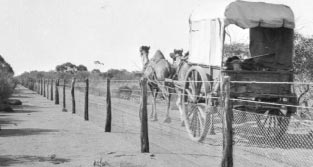 It was a massive undertaking and would take nearly seven years before all three proposed sections were completed. In the southern regions, known as the Great Victoria Desert, camels were used to pull carts and transport material since they could survive the heat and go for days without water, a scarcity in the outback.
The fence had limited success. Rabbits were wily creatures who found ways to breach it. Some were agile enough to simply jump over it. Still for a time, population was being controlled at least in some respect by slowing the rabbits down at the fence border and rounding them up for mass killings. But there were still millions more left. In 1898, it was reported to be nearly 300-million. By comparison, the human population in all of Australia at the time was 3-million.
Across the world, and especially in the U.S., Australia’s rabbit dilemma was treated seriously, but also with a humorous tone. “Br’er rabbit is a terrible pest in Australia” the Chicago Daily Tribune reported in April 1901, tying the article into the upcoming Easter holiday and a cutesy tale about Mollie Cottontail, Br’er’s wife in the Uncle Remus stories, who is “responsible for all the [Easter] eggs.”
The situation in Australia was dire enough, however, to warrant several paragraphs of startling comparisons and anecdotes. “Geniuses who love to calculate, have figured out that the tails of the 25,000,000 [yes, that’s 25 million!] rabbits killed in a year in Australia if sewn together would girdle the earth [a reference to girdling, no doubt].” Hunting them down, the article goes on to report, had been as successful as “drying up the ocean by dipping the water out a spoonful at a time.”
Austin was not mentioned in any coverage at the time. Only later would his name become synonymous with the bunny epidemic.

Too bad really because after Austin’s death , Elizabeth, his widow used her husband’s money to open up a hospital for incurable diseases in Heidelberg, a suburb of Melbourne. She also founded the Austin Home for Women, in Geelong, a port along the Barwon River, and Victoria’s second largest city by population.
Elizabeth died in 1910. In her obituary, she was lauded for her philanthropic contributions. “Since the incorporation of the institution in January of 1882, it has won for its benefactress the affection and gratitude of hundreds of unfortunate incurables who were denied admission to the general infirmaries.”
For her efforts, Elizabeth should be the Austin best remembered in Australia today.
Instead her husband, Thomas, the hunter, for completely different reasons, gets the nod.
After all, he released the bunnies.

Clean Up Please: The Struggle To Get Everyone To Take A Bath
By Ken Zurski
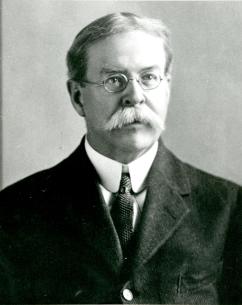
In 1902, psychologist and chemist, William Thomas Sedgwick released a book titled Principles of Sanitary Science and Public Heath which was a compilation of lectures he gave as a professor of biological sciences at MIT.
In it, Sedgwick extolled the virtues of good personal hygiene to keep infectious diseases away. “The absence of dirt,” he urged with conviction, “is not merely an aesthetic adornment.”
Basically, he was telling everyone to take a bath.
Sedgwick was onto something. Until then bathing in particular was an option most people chose to ignore. That’s because for centuries, cleanliness was seen as a sign of weakness or impurity. In some ancient religious philosophy’s, being wet, or letting the water touch you, was akin to allowing the devil enter your body. And in other circles, bathing was considered a sign of sexual mischievousness. Queen Isabella of Castile bragged that she took a bath only twice in her life, on her birth day and her wedding night. And Saint Benedict, an English monk who lived a solitary and monastic life, said “bathing shall seldom be permitted.” Of course that was a long time ago when attitudes were based on god fearing principles, not logic. But even at the turn of the 20th century, personal hygiene was still somewhat taboo.
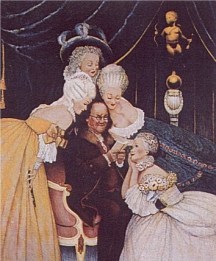 Sedgwick of course wasn’t the first to encourage others to get well by getting clean. Benjamin Franklin, a man of many titles, was also an early advocate of good hygiene habits.
As America’s first diplomat in France, Franklin thoroughly enjoyed the pleasures of taking a bath, a European luxury, although his desires may have been influenced more by the pretty French maids who administered it. “I have never remembered to have seen my grandfather in better health,” William Temple Franklin wrote to a relative. “The warm bath three times a week have made quite a young man out of him [Franklin was in his 70’s at the time]. His pleasing gaiety makes everybody love him, especially the ladies, who permit him always to kiss him.”
Despite this, Franklin couldn’t help but get clean, right?
However, when a large tub of warm water wasn’t present, Franklin liked to take what he called “air baths.” Franklin thought being inside and cooped up in a germ infested, walled, and shuttered space, was the reason he got colds. So to keep from getting sick, Franklin would open the windows and stand completely naked in front of it. Ventilation was the key to prevention, he explained, although others likely weren’t so emboldened.
In the mid 19th century, bathtubs were heavy and costly and those who could afford it used it as much for decoration as for its intended purpose.
Before indoor plumbing, a large tub may have been made of sheet lead and anchored in a box the size of a coffin. Later bathtubs became more portable. Some were made of canvas and folded; others were hidden away and pulled down like a Murphy Bed. They were called “bath saucers.”
It wasn’t that most people didn’t understand the merits of taking a bath, but it was a chore. Water had to be warmed and transported and would chill quickly; then dumped. Oftentimes families would use the same bath water in a pecking order that surely forced the last in line to take a much quicker dip than the first.
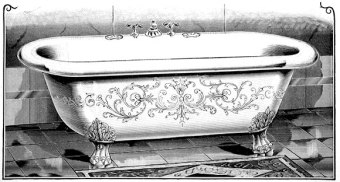 In the later half of the 19th century, as running water became more common, bathtubs became less mobile. Most were still bulky, steel cased and rimmed in cherry or oak, but stationary. Fancy bronzed iron legs held the tub above the floor.
Ads from the time encouraged consumers to think of the tub as something other than just a cleaning vessel. “Why shouldn’t the bathtub be part of the architecture of the house?” the ads asked. After all, if there is going to be such a large object in the home, it might as well be aesthetically pleasing.
Getting people to actually use it, however, that was another matter.
Sedgwick had medical reasons to back up his claims. As an epidemiologist, he studied diseases caused by poor drinking water and inferior sanitation practices. Good scientific research, he implied, should be all the proof needed. But attitudes and decades old habits needed to change too. “It follows as a matter of principle,” Sedgwick wrote, “that personal cleanliness is more important than public cleanliness.” He had a point. Largely populated cities were dirty messes, full of billowing black smoke from factories, coal dust, and discarded garbage and waste. Affixing blame for such conditions was more popular than actually doing something about it. Sedgwick focused on self-awareness to make his point. “A clean body is more important than a clean street,” he stressed.”Sanitation alone cannot hope to effect these changes. They must come from scientific hygiene carefully applied throughout long generations.”
People, it seemed, had to literally be scared into taking a bath.
Something Sedgwick understood, but fought to amend.
“Cleanness,” he wrote in his book, ”was an acquired taste.”
Mark Twain, Nikola Tesla and the “Irregular” Solution
By Ken Zurski

Around the same time Nikola Tesla was making waves in America for inventing an alternating current (AC) electrical power source and engaging in a “War of Currents” with his former employer and now adversary Thomas Edison, one of the Serbian-born scientist and engineer’s lesser known laboratory experiments took an unexpected and unusual turn.
It was in the 1890’s and Tesla had perfected what he called the Oscillator, or an AC generator that introduced a reciprocating piston rather than the standard rotating coils to generate power. Tesla used steam to drive the piston back and forth and a shaft connected to the piston moved the coils through the magnetic field. The result was higher frequencies and more current than conventional generators.
He patented this machine and unveiled it to great curiosity at the Chicago World’s Fair. “Mr. Tesla has taken what may be called the core of a steam engine and the core of an electrical dynamo, given them a harmonious mechanical adjustment, and has produced a machine which has in it the potentiality of reducing to the rank of old metal half the machinery at present moving on the face of the globe,” the New York Times raved.
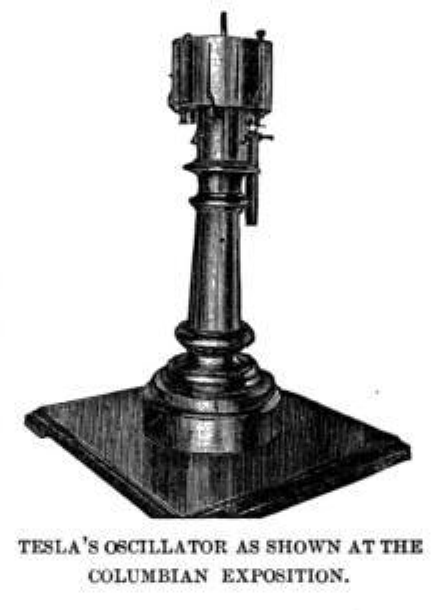
Proving the “mad scientist” was never satisfied with his own work and always tried to improve what he had already achieved, when Tesla returned to his New York lab he attempted to use compressed air instead of steam. He built this on a platform that vibrated at a high rate, driving the piston when the column of air was compressed and then released. Even though it didn’t generate enough electricity to power a lighting system, Telsa was amused nonetheless, especially when he stood on the platform. “The sensation experienced was as strange as agreeable,” he wrote, “and I asked my assistants to try. They did so and were mystified and pleased like myself.”
Only one problem. Each time Tesla or one of his assistants stepped off the platform, they had to run to the toilet room. The reason was obvious, especially to Tesla. “A stupendous truth dawned upon me. Some of us, who had stayed longer on the platform, felt an unspeakable and pressing becessity which had promptly been satisfied.”
Basically, they had a sudden urge to empty their bowels.
Intrigued, Tesla kept experimenting and ordering his assistants to “eat meals quickly” and “rush back to the lab.” Tesla may have failed in an attempt to upgrade his own machine, he thought, but succeeded in the prospect at least of using electricity to cure a number of digestive issues.
But to be sure, he unsuspectingly enlisted the help of a friend.

Mark Twain and Tesla were seemingly unlikely acquaintances. In addition to his writing, Twain was a failed inventor, or at least a failed backer of inventions, like the automatic typesetting machine which he poured thousands of dollars into and even more into finding a workable electric motor to power it. Unsuccessful, Twain read about Tesla’s AC steam-powered motor generator and gushed at its simplicity and ingenuity. “It is the most valuable patent since the telephone,” Twain wrote without a hint of his usual sarcasm.
Tesla had sold his invention to lamp maker George Westinghouse’s company which also impressed Twain who lost a sizable portion of his own fortune on the typesetter machine. So at some point the two men met and Twain visited Tesla’s lab. The result is a famous photograph of Twain in the foreground acting as a human conductor of electricity as Tesla or an assistant looms mysteriously in the background. But Tesla fondly remembers helping his friend too. “[Twain] came to the lab in the worst shape,” Tesla recalls, “suffering from a variety of depressing and dangerous elements.”

As the story goes, Twain stepped on the vibrating platform as Tesla had suggested. After a few minutes, Tesla begged him to come down. “Not by a jugfull,” insisted Twain, apparently enjoying himself. When Tesla finally turned the machine off, Twain lurched forward looked at Tesla and pleadingly yelled: “Where is it?”
He was, of course, asking for direction to the toilet room. “Right over there,” Tesla responded chuckling. But Tesla knew he had done Twain a favor. “In less than two months, he regained his old vigor and ability of enjoying life to the fullest extent.”
Of course, Tesla never did patent or market a machine for such a specific purpose and Twain didn’t talk about it, so it’s mostly lost to time, unlike the photograph. Both men now have an important place in history and numerous books are written about them. Twain’s recollections are mostly in his own hand. But the story of Twain’s visit to Tesla’s lab and Twain’s resulting step on the oscillating platform is found in Tesla’s versions, not Twain’s.
Perhaps, as one Tesla biographer suggests, it was all a big practical joke, which certainly – and quite remarkably – turns the tables on both men’s reputations considering Twain was the humorist and Tesla the brain.
Despite this, and knowing the outcome, even if it was only intended for a laugh, both men were likely pleased with the results.
But for completely different reasons.

How An Insane Asylum May Have Inspired the Iconic Twin Spires of Churchill Downs
By Ken Zurski
In 1794 a man named Isaac Hite, a Virginia Militia Officer, came to the Kentucky frontier with other surveyors to stake claim on scenic tracts of land given to them for fighting in the French and Indian War. They founded the properties as promised, but also encountered more Indians. And so in his newly adopted home now known as Anchorage, just outside of Louisville, Hite was killed by the hostile natives.
Or was he?

The introduction of a book containing Hite’s personal journal disputes claims he was struck down, but rather died from “natural causes,” at the age of 41. His companions, the book asserts, “had died years before, and violently, while taking Kentucky and holding it against the Indians.” One theory is that Hite was injured by Indians and later died from his wounds. But how he died isn’t as important as what he left behind. A parcel of land where he settled, started a family, and ran a mill and tannery.
Through the years, and for many generations, Hite’s descendants tended the land known as Fountain Bleu and an estate they dubbed Cave Springs Plantation. Then in 1869, the family sold the parcel to the State of Kentucky. The reason the state wanted it was explicit: open a new government institution for troubled youths near its largest city.
The rural, secluded site of Hite’s Cave Springs was the perfect setting for such a facility. Originally known as the “Home for Delinquents at Lakeland,” it was named after the path that led to it’s front gate, Lakeland Drive. It was converted – or just transformed – into a mental hospital in 1900 and renamed to reflect the often misunderstood and misdiagnosed residents who inhabited its 192 beds. “The Central Kentucky Lunatic Asylum,” as it was now called, became the state’s fourth facility for such a purpose.
As with any institution for the mentally challenged, in the early 20th century, the day-to-day operations were marred by allegations of abuse, malfeasance and deaths. Massive overcrowding was reported in the mid 1900’s and in 1943 the state grand jury found the asylum was committing people that were neither insane nor psychotic. One man was reportedly admitted for simply spitting in a courtroom. While the scientific merits of electric shock therapy and lobotomies were morally judged, the reports of fires, murders, and multiple escapes at the facility consistently filled the newspapers. It was a horror show.
Since many died on the grounds, many were buried there too. So stories of ghosts and haunted spirits are attributed to the site. “Have the mournful souls that died at Central State remained at the only home most of them ever knew?” a local ghost hunter asked.
The grounds, however, are also tied to the storied history of the Louisville underground. Literally, a series of caves and tunnels used before prohibition to move shipments – perhaps contraband during the Civil War – from the river docks to downtown buildings. Since a small cave existed before a tunnel was added, Hite was probably the first to discover the hole through the rock on his newly claimed property. Later after the state took over, the cave was reinforced with brick walls and pillars and used as cold storage mostly for perishable items like large cans of sauerkraut. The inside was reportedly lined with so many sauerkraut cans it was given a name by the locals: Sauerkraut Cave.
In the back of the cave a tunnel was built which has its own back door, so there was a natural entryway and a man made exit. Many morose stories about the lunatic asylum involve Sauerkraut Cave, including tales of residents who may have used it as an escape route or more graphic reports of pregnant patients who went there to give birth and abandon their babies. Those who visit the site today say without lights the cave would have been too dark and too flooded to navigate. Still, desperate patients may have drowned or froze to death trying.
Regardless of how many people perished on site or off, the general scientific worth of the experiments, and the ghastly stories that followed, the building itself was considered a architectural wonder at the time it was built.
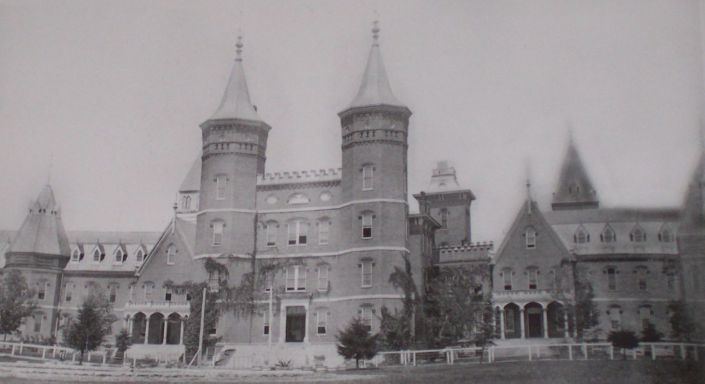
Looking like a medieval castle in the front, the three story structure with wing additions on each side was made of solid red brick with stone trim. The small pane windows in the main building had segmental arches with brick molding and the facade was highlighted by a columned porch and railing. On the side of the main building is two identical towers, shooting high into the air and inspired by the Tudor revival style used in its original design. It quickly became one of the Louisville area’s most distinctive and important buildings when it opened its doors in 1869. By the time it came down, in the late 20th century, it had represented something else entirely.
But it’s legacy may be more lasting than you think.
Enter Joseph Dominic Baldez.
Baldez wasn’t even born yet when the asylum building was built, but eventually worked for the firm that created it. D.X Murphy & Bros was an offshoot of another firm established by Harry Whitestone. In the 1850’s. Whitestone, an Irish immigrant, designed some of the city’s elaborate homes, hotels and hospitals, including the Home for Delinquents on Lakeland Drive. When Whitestone retired in 1881, his top assistant Dennis Xavier (D.X.) Murphy took over the business. Baldez began working for Murphy at the age 20.
In 1894, Baldez, a native of Louisville and a a self-effacing, self-taught draftsman, started work on a project at the area’s racetrack known as Churchill Downs, home of the Kentucky Derby, the prestigious race for three-year-old thoroughbreds held every year at the beginning of May.
For 20 years since the track was built, the seating had been on the backstretch, facing west, a mistake, since the late afternoon sun would be directly in spectators eyes. So a new larger structure was planned on the other side, facing east, or directly near the one-eighth pole on the stretch. The D.X. Murphy firm was hired and the young Baldez, at 24, was commissioned to design the new stands. He went to work constructing a 250-foot long slanted seating area of vitrified brick, steel and stone with a back entrance wall lobby which on its own was not only fancy and stylish, but efficient too. It was graciously received: “The new grandstand is simply a thing of beauty,” raved the Louisville Commercial. The new grandstand included a “separate ladies section” and “toilet rooms,” the paper noted.
The Courier-Journal also chimed in: “With its monogram, keystone and other ornate architecture, it will compare favorably with any of the most pretentious office buildings or business structures on the prominent thoroughfares.”
Then there are the candles on the birthday cake, so to speak.
The Twin Spires.
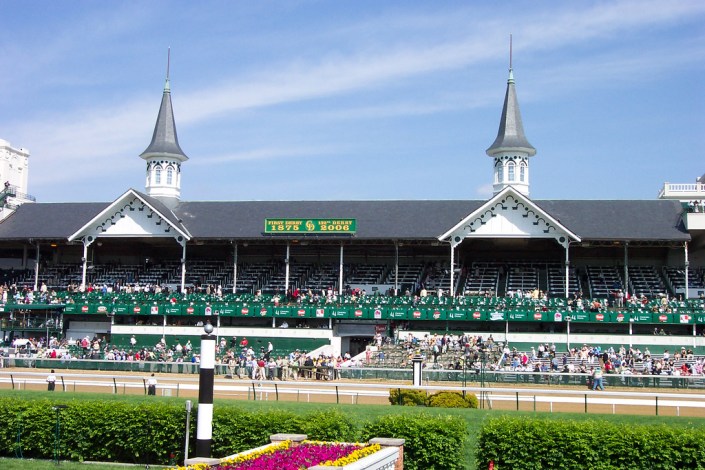
Whether Baldez was asked to include it, or came up with the idea on his own is unclear. His diagrams clearly show what he intended to do: put one large spire on either side of the grandstand for ornamental decoration. Each spire would be 12 feet wide, 55 feet tall, and sit 134 feet apart from center to center. The base shape was octagonal for strength and surrounded by eight rounded windows which were designed to stay open (although later were glassed over to keep birds out). Above the windows was a decorative Feur-de-lis, or a “flower lily” shape, flanked by two roses which were decorative rather than symbolic since the race didn’t become the “Run for the Roses” until the late 20th Century.
Although others, like the track president at the time Col. Matt J. Winn, greatly admired the spires, Baldez was indifferent about his work. “They aren’t any architectural triumph,” he argued. “But are nicely proportioned.”

Although no one can be absolutely certain, and little about Baldez is known other than his designs, the building which housed the mental patients on Lakeland Drive on the former property of one of its first residents may have sparked the idea for the Twin Spires at Churchill Downs. The comparisons are justifiable. Both have large steeples, two in fact, and the tops of each are similar in design. Plus, Baldez knew the asylum building well by working at the firm that built it.
Perhaps as some suggest, the name Churchill Downs was also an inspiration for Baldez’s “steeples.” Churchill, however, was not a religious connotation, but the surname of the original owners John and Henry Churchill who leased the land to their cousin Colonel Meriwether Lewis Clark who subsequently built the track on the property.
Unfortunately, only pictures can tell the story now. The original asylum building was torn down in 1996 to make way for expansion. The Sauerkraut Cave is still there , but only as a curiosity. It’s entrance is marred by graffiti and only the brave – or crazy – dare enter it today. Other than the cemetery, the cave is the last vestige of the old grounds.
Baldez never told anyone what drew his interest in adding the adornment to the roof of Churchill Downs, but he gets credit for a lasting legacy, not only to horseracing, but to American culture in general.
Col. Winn knew it. “Joe, when you die, there’s one monument that will never be taken down,” he reportedly told Baldez.
He was talking about those famous Twin Spires.
From the Kentucky Derby to the First Triple Crown Winner to You’re in the Army Now
By Ken Zurski
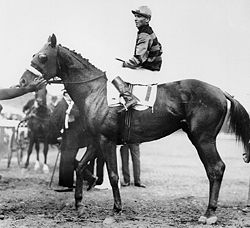
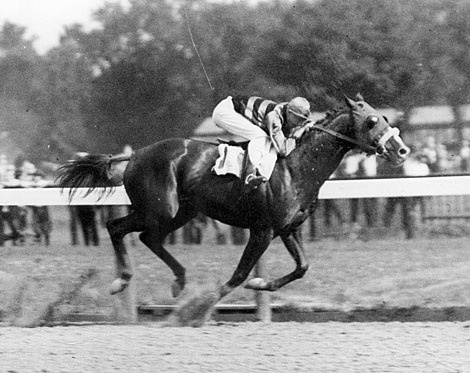
Sir Barton is officially the first horse to capture the elusive Triple Crown, a feat that requires winning three prestigious races as a three-year-old: the Kentucky Derby, Preakness and Belmont Stakes. Sir Barton did it in 1919, but the distinction was not given until 1948. That’s because at the time there was no award for winning all three races, only accolades for being a good horse.
But all that changed in 1930.
That year, Gallant Fox won each of the three races in a row and the New York Times proclaimed: “[The jockey] gave all the credit to his mount which by winning the Preakness, Kentucky Derby, and Belmont had equaled the feat of Sir Barton. These two horses are the only ones to win the ‘triple crown.’ ”
That’s the first time, claims the Times, that the words “triple crown” were used in relation to horseracing.
It’s interesting to note that the term has often been ascribed to Charles Hatton, a writer for the Daily Racing Form, who started using “triple crown”’ five years later when Omaha accomplished the same three race sweep as Gallant Fox. “‘Triple Crown’ was a journalistic device,” Hatton later recalled. “It kind of fell out of my typewriter.”
Regardless of who penned the phrase, after Omaha’s victories, the words “Triple Crown” were widely used to describe the three race achievement – and has been ever since. Later, when the racing board officials went back to assign the very first winner of the Triple Crown, Sir Barton was retroactively given that stature nearly 28 years after accomplishing the feat.
Sir Barton had good bloodlines, but entered the starting gate in Churchill Downs on May 10, 1919 as a maiden, meaning he had never won a race. He was expected to be a rabbit, or a horse that sets the pace for a stablemate horse who presumably has a better chance of winning. Sir Barton’s job was simple: Take the lead, keep a quick pace, and let his stablemate Billy Kelly benefit from a fast time up front and come running hard down the stretch at the end. There was nothing illegal about such a ploy. Both horses had the same owner and were coupled in the betting. But unpredictably reigned supreme that day. Sir Barton took the lead as ordered, but never relinquished it, beating all eleven horses in the field and capturing the 45th Kentucky Derby by five lengths. “Sir Barton raced into the lead at once and well, ridden, led under restraint until reaching the stretch, where he was shaken up and easily held Billy Kelly safe in the eighth (pole),” the race notes read.
Four days later Sir Barton was entered in the Preakness Stakes and again led all the way. He won another race, the Withers Stakes, before easily taking the Belmont Stakes in New York and setting an American record for a mile-and-three-eighths, the distance for the Belmont at the time (it’s now the longest of the three Triple Crown races at a mile-and-a half). Sir Barton accomplished all this – four victories in all – in just 32 days. Today the time distance between the Kentucky Derby and Belmont is 35 days.
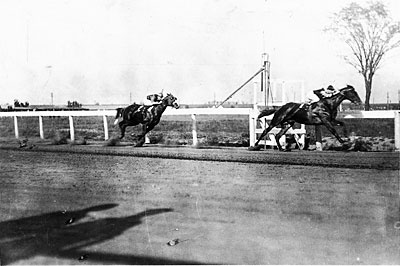
The following year Sir Barton continued his winning ways, but a match race against another accomplished racehorse Man O’ War effectively ended his career. The contest between the two horses was run on the notoriously hard surface of Kenilworth Park in Windsor, Ontario. Barton, who suffered from hoof problems, never challenged Man O’ War and lost by seven lengths. He was retired to stud after the defeat and although sired several foals who won stake races, there were no Triple Crown winners in his stock. He was considered a failure in the barn.
So in 1933, at the age of 17, he was enlisted.
Technically, Sir Barton became a “working” horse.
Officially, he had joined the U.S. Army.
The U.S. Army Remount Service was originally a part of the Union Army and began during early days of the Civil War. Its purpose was clear: to train horses for battle. It’s objective obvious: provide all Calvary and artillery units with useful horses. By contrast, on the Confederate side, each participate was asked to bring his own horse.
But there was more confusion than organization at the Union Remount Service depots. No one knew exactly what to do or how to do it. Questions and debates, rather than solutions, kept piling up. Like how many horses were needed? What type of training was necessary? Where will the horses come from? And how much would the government pay? Plus, there were staffing issues, poor leadership and as usual with any new institution without historical legalities to back it up– corruption. But it was useful. Horses were a vital tool in ground warfare and the Remount Service provided quality horses. Each depot could handle between 10-thousand and 16-thousand horses each. There were about a half dozen depots in the country.
The government purchased Sir Barton from a stud farm in Wyoming for just under $500 and assigned the colt to the depot in Nebraska, named Fort Robinson, a makeshift horse farm.
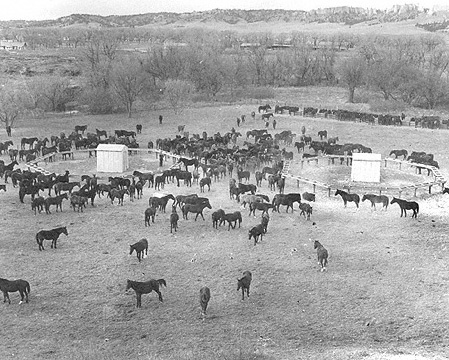
What Sir Barton did in the Army is not exactly clear. After the Civil War ended, the Remount Service was used mostly for breeding and not much else. Many horses died in the war and needed to be replaced. So there was a purpose.
When America entered the first World War, the fighting took place overseas so men, not horses, traveled to Europe. The British used horses extensively during the Great War, but they had their own reserves. With nothing to serve and foals outnumbering demand, the U.S Remount Program was finally disbanded in 1948, shortly after the end of World War II.
Sir Barton likely had little do as military horse. He sired horses and was used for training mostly. Also, being a champion racehorse may not have had its advantages either. Sir Barton didn’t have to run fast or beat others, he simply had to work. Most of the horses were thoroughbreds, like Sir Barton, so he fit right in, despite being the only Kentucky Derby winner.
His time in the Army was short, however. He served less than a year before being sold to a Wyoming horseman named Doc Hylton who brought the champion colt back to his ranch for more stud duty.
In 1937, Sir Barton died of colic at the age of 21.
Eleven years later, after being posthumously honored as the first Triple Crown winner, his story became one for the record books.
‘The Paramount Girl’ and the Road Trip to the Movies
By Ken Zurski

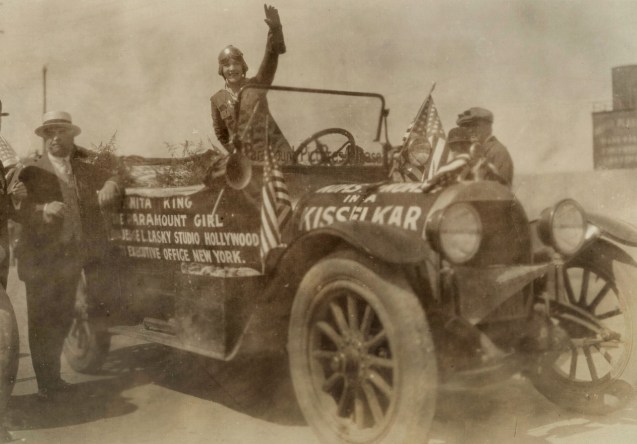
On October 19, 1915, Hollywood silent movie actress Anita King pulled into Times Square in New York City and became the first woman on record to drive a touring vehicle solo across the country.
She broke no speed record – 48 days – but was she really trying? Movie giant Paramount Studios sought publicity for the stunt and publicity is exactly what they got. The papers were all over it. “Colorful, convoluted and contradictory” is how one writer described King’s elaborate and perhaps embellished tales from the road.
But it was never boring.
King made stops at over a hundred Paramount theaters and graciously greeted well wishers along the way. But in between – and for most of the 3,000-plus mile journey – the 30-year-old, curly-haired blonde, still had to drive long stretches by herself, on paved and unpaved roads, and in all types of weather. In the Sierra Mountains, she recalled, a tramp tried to hitch a ride. “I wouldn’t permit myself to show how frightened I was,” King said. “I handed him a flask of whiskey I had in the car and told him to come to the theater where I was appearing the next night.” He did, according to King, bringing a bouquet of picked flowers with him.
Some of the reports were bleak.
King “wilted in the heat,” went one newspaper account.
“She was nearly a goner” read another.
Each story King told reporters seemed to be more extraordinary than the next. In one harrowing incident, just outside of Reno, the car’s tires became stuck in the mud. King spent hours trying to shovel them out, but got nowhere. Then suddenly, she was not alone. A “mad coyote” joined her company. “Gee it looked as big as a horse,” she explained. “I finally killed him, and knew nothing more until I was picked up by prospectors, who heard the shots of my gun.”
King was born to immigrant parents who settled in Michigan City, Indiana. Her father committed suicide in 1896 when she was 12 years old and only two years after that her mother succumbed to tuberculosis. King was a grief-stricken teenager and an orphan. She moved from Michigan City to Chicago where she found work as a model and actress. In 1908, at the age of 24, she traveled to California and became fascinated with motor vehicles. She competed in a few auto races but after an accident decided to concentrate on her acting career instead. She appeared in a couple of comedic films, bit parts really, but nothing star making.

That’s when she heard her boss, motion picture producer John L. Lasky, talking about the Lincoln Highway, the newly opened coast to coast route between San Francisco and New York City that ran through 13 states.
Although it was dedicated in 1913, the road was still a work in progress and Lasky said – perhaps jokingly – that it would be at least ten years before the highway would be in such shape that a lady could make the drive without difficulty.
King chimed in. She could drive a car and she could make the trip now. Seeing the promotional value in the stunt, Lasky was on board telling her he would pay for it and secure a major sponsorship with the Kissel Motor Car Co. for transportation, a machine built for endurance and advertised as “every inch a car” and an “all-year vehicle.” King’s job was to act like a “movie star” and in return, Lasky promised, he would make her one.
King was ecstatic.
Dubbed “The Paramount Girl,” in the papers, King drove the Kissel Kar with a “new set of Firestone tires,” another Lasky sponsor. “There will be nobody with her,” the Los Angeles Times reported, “her only companions will be a rifle and six shooter.”
The trip began appropriately in front of Lasky’s Paramount studios in Hollywood.
When she arrived in New York City, King received a hero’s welcome. She was the honored guest at a ceremonial dinner and shook hands with dignitaries. In typical fashion though, the city’s newspapers, while celebratory, were skeptical too. “Miss King, in spite of being on the road from September 1 to yesterday, had no marks of tan or sunburn,” the New York Sun questioned. King explained she used grease paint on her face all the time. “I was determined I wouldn’t come into New York City with a red nose,” she said.
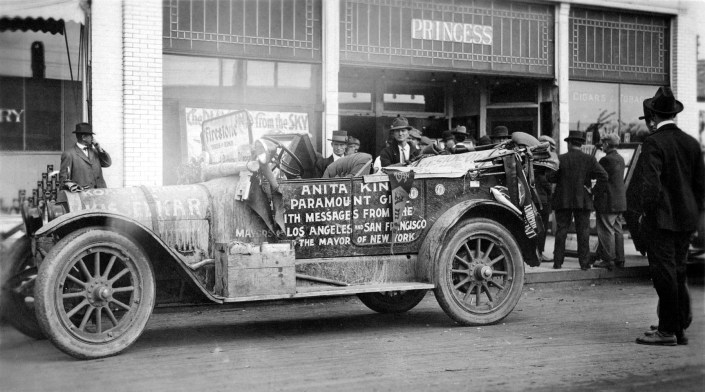
King became a darling celebrity and a movie titled ”The Race” starring King and Victor Moore went immediately into production. It was released the following year.
Much to Lasky’s surprise, the film was a disappointment. It got poor reviews and ran for only a week. King’s true-life exploits on the road, as it turned out, just weren’t as interesting on the silver screen.
King however remembered the groundbreaking trip fondly. In an interview, she recalled meeting a young girl on the side of the road who had packed a bag and wanted to runaway with King to the movies. From the heart, King gave her a lesson in humility.
“I would give the world to have what you have right there in that home,” she said.
Then King got back in her car, waved goodbye to the little girl, and drove off to her next adventure.
The Legacy Of The Buffalo Is Recounted In Vastly Different Ways
By Ken Zurski
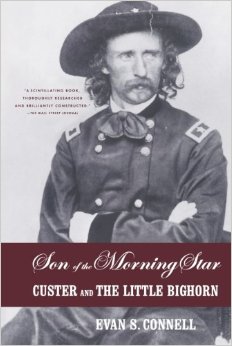
In Son of the Morning Star, Evan S. Connell’s brilliant but unconventional retelling of the life and death of George Armstrong Custer, a part of the author’s captivating account is the detailed descriptions of what it would have been like to live, explore and fight in the vast and mostly uncharted territory of the Western Plains.
A land that Custer among others were seeing for the first time.
Custer’s life, of course, ends in Montana at Little Bighorn. But in the context of his story, and examined in Connell’s book, is the role of the country’s most populated mammal at the time: the buffalo.
The human inhabitants had vastly differing opinions on the buffalo, both revered and reviled, but Connell wisely avoids a scurrilous debate. Instead, he gives a fascinating glimpse, based on good research and eyewitness accounts, on what it was like to see the massive herds up close and why they were ultimately decimated. The reasons were just as divided as cultures.
At first the descriptions were formidable. “Far and near the prairie was alive with Buffalo,” Francis Parkman, a writer, recalled after seeing the herds in 1846, “….the memory of which can quicken the pulse and stir the blood.”
Indeed Parkman was right about the prairie being “alive” with buffalo, but unfortunately there is no exact number of how many were in existence before the Calvary arrived. That’s because there was no way to survey the population at the time. Connell doesn’t speculate either, but based on recollections like Parkman’s, others have estimated from 30 million to perhaps as much as 75 million buffalo may have roamed the plains at some point, maybe even more.
“Like black spots dotting the distant swell,” Parkman continued, “now trampling by in ponderous columns filing in long lines, morning, noon, and night, to drink at the river – wading, plunging, and snorting in the water – climbing the muddy shores and staring with wild eyes at the passing canoes.”
The description of herd sizes is nearly incomprehensible. Col. Richard Irving Dodge reported that during a spring migration, buffalo would move north in a single column perhaps fifty miles wide. Dodge claims he was forced to climb Pawnee Rock (Kansas) to escape the migrating animals. When he looked across, the prairie was “covered with buffalo for ten miles in each direction.”
In 1806, Lewis and Clark, one of the earliest explorers to encounter the massive herds gave an ominous warning. “The moving multitude darkened the whole plains,” Clark relayed.
The sound of the migrating herd was just as impressive as the numbers. The bulky animals each weighed close to a ton each, so when they all galloped, the ground shook. “They made a roar like thunder,” wrote a first settler along the Arkansas River.
The large groupings, however, made it easier to strike them down. And when the killing started, it didn’t stop. In 1874, when Dodge returned to the prairie, he saw more hunters than buffalo. “Every approach of the herd to water was met with gunfire,” he recalled

Killing buffalo became a sport, even for foreigners. Connell reports that The London Times ran ad for a trip to Fort Collins and a chance to kill a buffalo for 50 guineas. Many gleefully went for the adventure, not the challenge. As Connell explains, English lords and ladies came to sit in covered wagons or railway carriages and fire at will. You couldn’t miss.
“Enterprising Yankees turned a profit collecting bones,” Connell wrote, explaining that it was the hide and bones and not the meat they were interested in. “Porous bones were shipped east to be ground as fertilizer; solid bones could be whittled into decorative trinkets – buttons, letter openers, pendants.”
Many settlers not knowing what else to do with a wayward buffalo grazing on their land, just shot it and left it for the wolves to feed. “The high plains stank with rotten meat” Dodge wrote.
“In just three years after the gun-toting Yankees arrived,” Connell soberly relates, “eight million buffalo were shot.”
By the beginning of the 20th century, they were nearly all gone.
The Native Americans killed buffalo too, but it was for survival, not sport. Nearly every part of the animal was used for food, medicine, clothing or tools. Even the tail made a good fly swatter. According to the Indians, the buffalo was the wisest and most powerful creature, in the physical sense, to walk the earth. Yet the Indians still played a part in the animal’s near extinction. Large fires were set by tribes in part to fell cottonwood trees and feed the bark to their horses. The massive infernos, some set one hundred miles wide, were necessary to clear land for new grass. Although no one is quite sure, thousands of buffalo and other animals surely perished in the process.
In contrast, Connell includes claims by early pioneers that the Indians were just as wasteful as the “white man” in killing the buffalo, leaving the dead carcasses where they lay, and extracting only the tongues to exchange for whiskey. These reports contradict that of agents stationed at reservations after government agreements were reached. James McLaughlin who was at Standing Rock in South Dakota helped organize mass buffalo killings, but only to stave off starvation, he claims.
Regardless, the difference in attitudes is what may have inflamed tensions between the “palefaces” and the natives.

Dodge claims the buffalo were shot because they were “the dullest creature of which I have any knowledge.” Dull meaning stupid in this sense. They would not run, Dodge purports. “Many would graze complacently while the rest of the herd was gunned down.” Dodge says his men would have to shout and wave their hats to drive the rest of the herd off.
So according to Dodge – and Connell’s book supports this – the buffalo were removed for meager profits and to get them out of the way of railways and advancing troops. This incensed the Indians, especially the Lakota, who in spite of their reliance on the buffalo, had more respect for the embattled “tatanka,” in a spiritual sense.
After all, in comparisons, they named their revered leaders and holy men after the beasts.
Custer knew one.
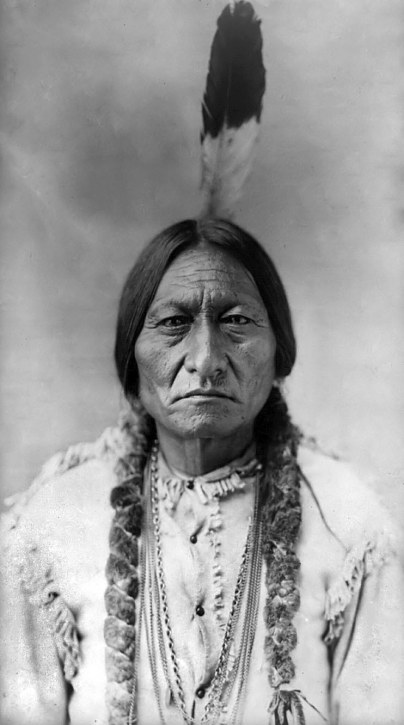
His name was Sitting Bull.
The Stinking Truth About The Phantom’s Opera House

By Ken Zurski
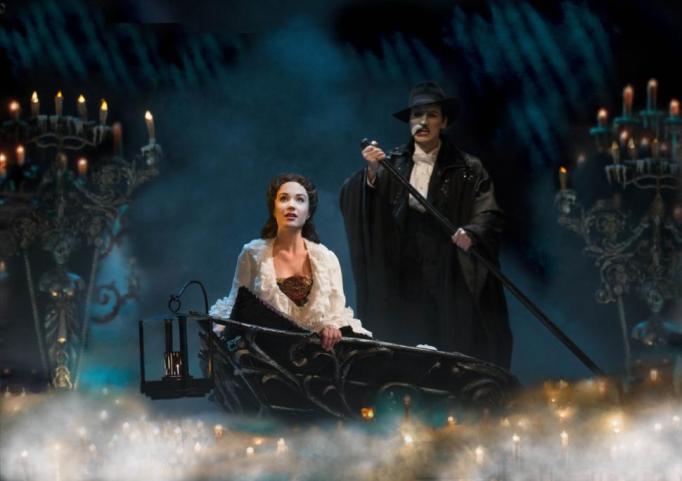
(Note: This story was inspired by a playbill for The Phantom of the Opera at Her Majesty’s Theater in London).
In Paris, around the mid 1800’s, a man named Eugene Belgrand was hired to overhaul a system of underground sewer tunnels that were built nearly five centuries before and while still in use, was in desperate need of repair.
The plan was to make the tunnels more functional in the era of modernized sanitation, which at the time, wasn’t very sanitized at all. That’s because in 19th century Paris, as in other large European cities, waste was still being tossed onto the street, washed away by the rain, and ending up in filthy rivers, like the Seine, where even the shamelessly rich and privileged who strolled the fancy stone walkways of its shore, were appalled.
The old tunnels could still be used, officials determined, but needed reinforcements and additions to be more effective. The French engineer’s task was simple: make it better.
That of course was the practical reason for the upgrade. The more emotional plea came from Parisons who were just plain sick of the consistently putrid smell and squalor conditions. Women especially complained that they were forced to carry parasols all the time for fear of being dumped on from windows above. So Belgrand reshaped the tunnel routes, put in more drains, built more aqueducts, and started treatment plants. Eventually, 2,100 km (1300 miles) of new pipes were installed and the Paris sewer system became the largest of its kind in the world.
But not necessarily the most reliable.
Many of the early tunnels were built tall and wide, but not designed for uniformity. The chutes weren’t long enough or sufficiently sloped enough to keep the flow moving. Victor Hugo in his 1862 novel Les Misérables called the Paris sewers a “colossal subterranean sponge.” Even improved, the waste would still back up and somebody – or something – had to unclog it. Workers would do their best to dislodge the muck first by hand – usually with a rake. When it was too deep, or wouldn’t budge, dredging boats were used with some success. But when a boat didn’t work, by far the most effective method was using the wooden ball.
Yes, a wooden ball.
The ball was around 5-feet in diameter and resembled a wrecking ball in size, but not nearly as heavy. Constructed out of wood and hollow inside the outside was reinforced with metal for more solidity.

Some mislabeled it an “iron ball,” assuming it was solid throughout, which if true would have been far too cumbersome to move. Several men with ropes could easily lift the wooden ball or pull it into position. With a push the ball was sent careening into a tunnel. (Think of a bowling ball rolling down an alley gutter – only on a much larger scale.)
A London society newsletter in 1887, praised its dependability: “As soon as it comes to a point where there is much solid matter in the sewer it is driven against the upper surface of the pipe and comes to a standstill. Meanwhile the current gathering strength behind it rushes with tremendous force below the ball carrying away all sediment or solid matter and leaving the course clear.” The ball worked well for a time, but eventually its effectiveness wasn’t enough. By the early 20th century, a more streamlined method was deployed that harnessed and released rain water. The increase in the current’s velocity would flush the obstruction away. “The rain which sullied the sewer before, now washes it,” Hugo declared.
The Paris tunnels are still in use today and tourists to the city can visit a museum dedicated to the centuries old system. Guided tours lead patrons through narrow stairwells and dank rooms as the sound of waste water is heard rushing through the tunnels below. Even the wooden balls are on display.
But the Paris tunnels have more history than just collecting and deporting sewerage
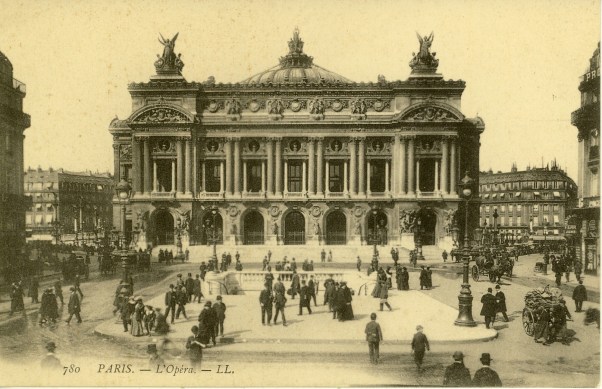
When the famous Paris Opera House was built in the 1870’s, architect Charles Garnier’s construction team ran into a problem. While digging the foundation wall, they hit an arm of the Seine, likely an extension of the tunnel system that led to the river. They tried to pump the water out but it kept coming back. So Garnier designed a way to collect the water in cisterns thereby creating an artificial lake nearly five stories beneath the stage.
It is in this “hidden lagoon” that author Gaston Leroux had an idea for a book that he claims was based on real events. In the story titled Le Fantôme de l’Opéra, a troubled soul named “Erik,” who is grossly disfigured, escapes to the catacombs and the lake below the Opera House. By banishing himself from society, “Erik” became a “ghostlike” figure until a sweet soprano’s voice lures him back to the theater’s upper works.
In the popular musical version that came out many years later, the “Phantom of the Opera” takes his unsuspecting love interest Christine on a gondola ride through the underground lake.
A scenario that if true, would be far less romantic than portrayed in the famous theatrical production.
Whether or not the lake was connected to the tunnels or ran directly from the Seine River, didn’t matter. The result would still be the same. Instead of being mesmerized by the experience as if in a fantasy world, in reality, the lovely Christine would likely be holding her nose, gagging, or worse.
Cue the music.
A Salute to the Long Play (LP) Microgroove Vinyl Record
 By Ken Zurski
In 1948, the LP (Long Play) microgroove vinyl record was introduced by Columbia Records for the sole purpose of playing more music on a phonograph or analog sound medium. Circular in shape like its predecessors, the LP was larger in diameter at 16-inches and turned at 33 1/3 revolutions per minute, much slower than previous versions.

The LP itself was designed to replace the 12-inch records being manufactured for RCA Victor player’s in the 1930’s. The smaller plates had tighter grooves and less background noise, but unpredictable sound clarity overall.
The larger LP’s were slow to catch on at first, representing only a slight percentage of sales for consumers who were accustomed to the smaller size, faster speeds (78 rpm) and shorter play time. But as home stereo systems improved, LP’s were streamlined back to 12-inches and quickly became the preferred choice of buyers.
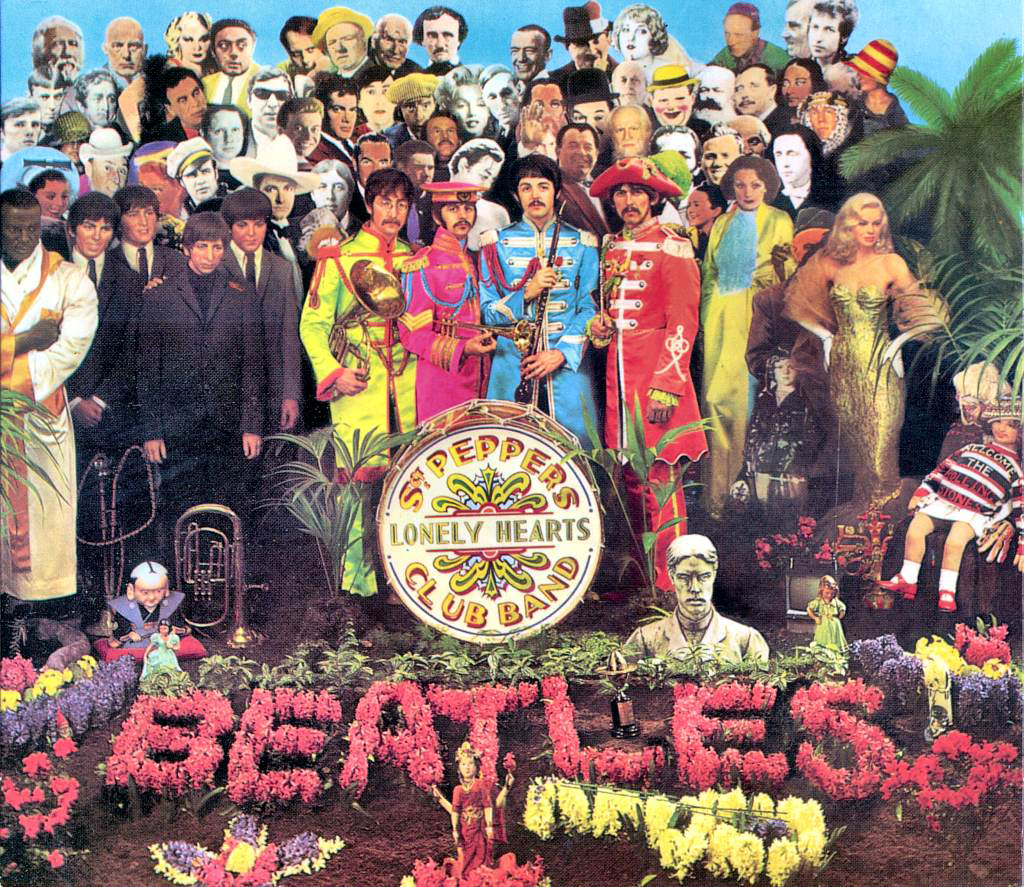
In the 1960’s and continuing into the 70’s, music artists such as the Beatles and Pink Floyd found a niche by exploiting the availability of time per LP side. They began experimenting with varying layered pieces of music, thereby making, marketing and selling albums with longer songs and conceptual themes. In some instances, two LP’s were included.
Then in the 1980’s, thanks to MTV and the demand to buy popular music, chain record stores opened in malls across America and record sales – included the smaller 45 rpm singles – continued to rise.

But it wouldn’t last.
Introduced in the mid 80’s, the new compact disc format (CD) was cheaper and less expensive to produce. The CD’s were about the same price as a vinyl album, but a CD player was costly. Eventually demand drove down the price and by the 1990’s, the age of the LP mostly disappeared. Mainstream record stores transitioned to stocking and selling only CD’s on their shelves.
Recently however, with no physical attributes attached to digital music, there’s been a surge in demand for vinyl. Newly pressed vinyl records of repackaged older and some newer music has become popular as turntables sales have increased as well. In fact according to the Recording Industry Association of America‘s midyear report for 2019, vinyl album sales may soon overtake sales of CD’s for the first time since 1986. This trend has prompted many new artists who have only produced music for the CD and digital markets to promote vinyl packaged versions of their albums as special editions.

According to c/net: “Just because vinyl may soon outpace CDs doesn’t mean music lovers are trading in their iTunes accounts for turntables. Streaming remains the most popular way to consume music, accounting for 80% of industry revenues, and growing 26%, to $4.3 billion, for the first half of 2019.”
Bu the LP just wont die. Today, original LP’s from the early 40’s to the mid 80’s are considered nostalgic and collectible. Many privately owned record shops, or independents as they are called, continue to thrive by specializing in rare or out of print editions. And online markets, swap meets and thrift stores are filled with opportunities to sell or purchase used albums.

A Telegraph Operator’s Night To Remember

By Ken Zurski
Late in the evening, April 14, 1912, on a passenger liner in the Atlantic Ocean, telegraph operator Harold Cottam was getting ready for bed. Cottam was the only wirelessman on board the ship bound for Gibraltar by way of New York. The day had been busy as usual and Cottam was looking forward to shutting it down for the night.
The radio, however, remained open.
“Why?” he was asked later in an inquiry.
“I was receiving news from Cape Cod.” he replied. “I was looking out for the Parisian, to confirm a previous communication with the Parisian. I had just called the Parisian and was waiting for a reply, if there was one.”
At this point, Cottam might have been asked about allegations, based on the late hour, that he was listening to Cape Race in Newfoundland for English football scores, clearly against regulations. But under oath, he said it was only the Marconi base at Cape Cod he was monitoring.
Cottam says he kept the telephone on his head with the hope that before he got into bed, a message would be confirmed.
“So, you were waiting for an acknowledgement [from the Parisian]?”
“Yes, sir,” Cottam conferred
Cottam says he received no word from the Parisian, but did get a late transmission from Cape Cod to relay a message to another ship steaming to New York from England’s Southampton shore. The large ocean liner had been sailing for several days and the messages – mostly personal correspondence for passengers – did not go through. Perhaps Cottam, who was closer, would have better luck. “I was taking the messages down with the hope of re-transmitting them the following morning,” Cottam said.
But Cottam didn’t wait until morning. He immediately tried to reach the ship.
“And you did it of your own accord?”
“I did it of my own free will,” he replied
Cottam said he sat down at the telegraph desk and tapped out these words: “From the Carpathia to the Titanic are you aware of a batch of messages for you”
The reply came quickly.
CD followed by Q, a general distress call.
“And what did it say?” he was asked.
“Come at once,” Cottam explained,
“Come at once.”
 UNREMEMBERED