
The Frankenstein That Created a Monster – Painting
By Ken Zurski
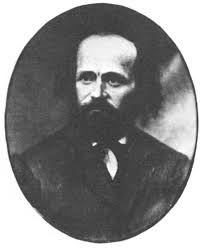
Godfrey Nicolas Frankenstein, despite the name, was no mad scientist. Quite the contrary, he was a painter. But like the fictional Dr. Victor Von Frankenstein, he also had a vision that consumed his thoughts, his passions, and his ambitions for nearly two decades of his professional life.
It all started in 1844 when he visited Niagara Falls.
A visit to the Great Falls, especially by a painter was not unusual at the time. Plenty of artisans found the vastness of the Falls a great challenge. They would sit for hours and attempt to recreate its beauty either on canvas, paper or wood engravings. Many realized a single rectangle was too confining. They tried long strip paintings, panoramas, curved cycloramas and three dimensional dioramas, anything to replicate what it was like to see the Falls in person.
Frankenstein was a natural artist. He came from a family of painters who migrated from Germany to New York City when Godfrey was just 11. Already a prodigy, Godfrey began designing signs for money which turned into his own full-fledged sign-making business at the age of 13. At nineteen, he opened a portrait studio in Cincinnati. Two years later he was the first president of that city’s Academy of Fine Arts.
In 1844, at age 24, he went to the Falls.

The trip changed him. Now he had a purpose as an artist to create a lasting legacy. This was his plan: He would paint murals of the Falls , perhaps hundreds, all from different perspectives and then show them to audiences one at a time, like a moving picture, telling a story in the process.
Year after year, for nearly nine years, he went back to the Falls. He went during the changing of the seasons making small sketches of one angle the first year followed by another angle the next. He bravely stood in all kinds of weather. He drew the Falls in contrasting and opposite ways: by moonlight and in bright sunshine; before and after a rainstorm; and during a snowfall followed by a thaw. Each time, Frankenstein would set up his easel and produce scene after glorious scene. He sketched the Falls and it’s surroundings from the top and from the bottom, close up and far away and from one side to the other.
Frankenstein then began a five year process to transfer the sketches to canvas. He picked 80 to 100 good drawings and copied each one to single panels that stood at least eight foot high. The end product was a roll of canvas that when unfurled was nearly 1000 feet long. When it was displayed, one panel would be viewed followed by the next, creating a seamless spectacle of broad landscapes and augmented perspectives. In addition, the audience would get a geology lesson. Frankenstein cleverly juxtaposed scenes from different years to show the changes, including the rock slide that dropped the overhang known as Table Rock into the churning waters below.

“Frankenstein’s Panorama” as it was called, was a huge hit. In 1853, thousands flocked to the Broadway Amusement Center in New York to sit in the dark and watch the scenery unfold . Live music played and commentary by Frankenstein himself completed the entertainment. And all this for only 50 cents.
Reviewers were just as enthralled: “We see Niagara above the Falls and far below…We have sideways and lengthways; we look down upon it; we are before it, behind it, in it….into its spray on the deck of the Maid of the Mist; tempting its rapids among the eddies; skimming its whirlpool below…”
One commentator didn’t shy away from the works massive size and realism: The spectre of death seemed implicated in the medium’s own mode of representation; like a cadaver…the canvas resembles a living being…and yet there is a paradox in the close resemblance to death…”
In 1867, Frankentstein traveled to Europe and spent two years abroad painting. “Europe acknowledged that Mont Blanc and Chamont Valley never before have been painted with such power and beauty,” the Cincinnati Enquirer reported. It is said that popular English songstress Jenny Lind bought many of Frankenstein’s paintings and brought them back to London.
Frankenstein would also have a cliff named after him, a 1000 foot high rock formation near the Saco River in the White Mountain National Forest of New Hampshire. “This giant rock formation looms above the highway and seems to bear a profile of Frankenstein’s Monster embedded in the rock,” a hiking trail website describes, then clarifies: “However, the cliffs were, in fact, named for a painter.”

Why the cliff is named after Godfrey is not clear. Most people who visit the park understandably make the connection with Mary Shelly’s fictional monster.
Godfrey’s family likely had no idea the immortalizing to come when they innocently adopted the surname in 1831. At the time, Shelley’s book originally named The Modern Prometheus had been out for over a decade. The title was changed to Frankenstein during it’s second printing in 1823. Still it took years for the work to be fully appreciated.
In the book, Shelley’s protagonist, Dr. Frankenstein turned a passion into an obsession and literally creates a monster that ultimately destroys him.
Godfrey Frankenstein, the painter, had better results.
The name, however, seems to fit perfectly.
(Sources: Niagara: A History of the Falls by Pierre Berton)
She Won a Golf Match Into History and Didn’t Even Know It
By Ken Zurski
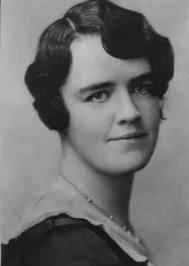
In 1900, 22-year-old Margaret Abbott was an American in Paris studying art and living with her mother when she read a newspaper ad looking for women to compete in a golf tournament.
The contest, the ad read, was open to all amateurs.
So Abbott, a skilled golfer back in her hometown of Chicago, took a break from her studies and urged her Parisian friends, even her mother, to enter the contest.
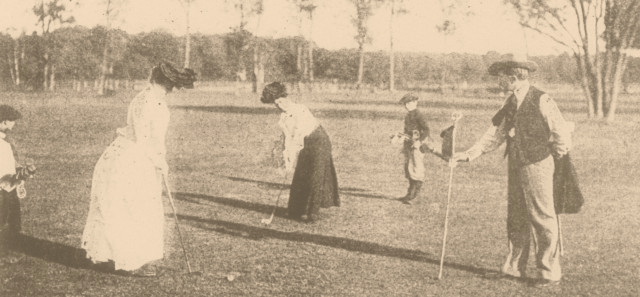
Together they played a nine-hole match, which to no one’s surprise, Abbott won by two shots and a total score of 47.
Her closest opponent the papers reported, “Had more than one piece of luck in getting bunkered and hitting trees.” Abbott’s mother, Mary, an accomplished novelist, finished 18 strokes behind her daughter.
Abbott was modest in victory, playfully claiming it was due to her conservative attire. “[The other ladies] apparently misunderstood the nature of the game,” she said, “and turned up to play in high heels and tight skirts.” Abbott, for her part, wore a long dress that swept the grass.

Abbott may not have known it at the time, but the Olympic Games – the second of its kind- was being held in Paris that summer.
Or was it?
No one was quite sure.
By today’s standards, the 1900 Games in Paris were an unorganized and confusing mess. There was no opening or closing ceremonies and contests were spread out over six months. In fact, there was so much confusion about schedules that few spectators or journalists were present at the events, which were so slipshod in preparation, that no one, not even the participants, knew if it counted.
Despite this uncertainty, nearly 1000 athletes showed up to compete. And for the first time, women, were included too.
Abbott by association, was one.
That’s because the sport of golf – and the match Abbott won – turned out to be a part of the overall competition.
So Abbott, who never knew she was competing for such an honor, is considered the first woman to win a gold medal at the Olympic Games.
A distinction which comes with a clarification.
No medals were awarded that year.
For her efforts, Abbott won a porcelain bowl.
‘Giant’ Tuba Players Were a Hallmark of John Philip Sousa’s Band
By Ken Zurski
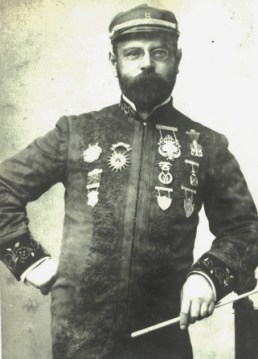
John Philip Sousa, known affectionately as the “March King,” not only composed stirring music for marching bands, he helped define it as well. Disappointed by the sound of the standard B-flat bass tuba – the one with the circular bell opening in front – Sousa sought to make it better. “It was all right enough for street-parade work,” Sousa wrote about the front-facing tuba, “but its tone was apt to shoot ahead too prominently and explosively to suit me for concert performances.”
Sousa had an idea. Why not point the bell of the instrument up rather than forward and let the sound resonate over the top of the band instead. So in 1893, a tuba was modified and manufactured to Sousa’s specifications and the Sousaphone, as it was called, was born.
The original Sousaphone was a huge piece of brass. Weighing in at upwards of 30-plus pounds, it’s circular base wrapped around the player’s shoulder at the top and just below the waist at the bottom. The bell would reach skyward some two feet above the player’s head.
Sousa was pleased. He used the Sousaphone exclusively in concerts. At first, trying just one mixed in with the standard tubas, but eventually replaced them all with Sousaphones.
The new tuba was given an appropriate nickname: raincatcher.
Thanks to Sousa’s ingenious design, the new tuba’s stood out in sound and size. And as it turned out, the men who played the “raincatcher” did too.
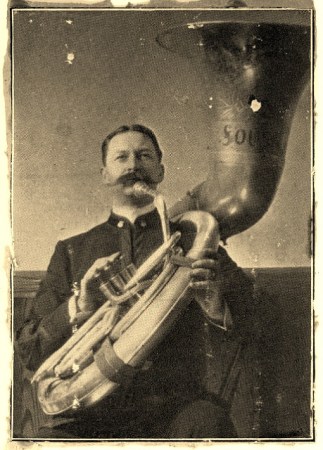
Whether it was genius ploy by Sousa or just coincidence, at least one Sousaphone player in the band was tall.
In fact, for its time, they were considered very tall.
Herman Conrad was the first to play the Sousaphone. According to sources he stood a whopping “6-foot-6,” although it was more likely 6-foot-4. One ad proclaimed Conrad was a “six foot eight giant!”
When Conrad left the band, John W. Richardson took his place. He was perhaps more accurately listed at “6-foot-6.” Another tubist named William Bell was also reported to be “6-foot-6.”
No one could explain this phenomenon except that Sousa must have had a a little P.T. Barnum-like showmanship in him. Certainly not out of character for a man who loved to entertain the masses outside of music too, specifically baseball, something he enjoyed just as much as conducting.
While on the road and in-between concerts, Sousa would make his band members don uniforms and take the field so he could play exhibition games against local teams. The tall tuba players apparently weren’t so nimble on the ball diamond. During one game, Richardson reached down to grab a grounder and split the back of his trousers. Sousa, who was usually the pitcher on the team, let out a hearty laugh.
Even if it was all in good fun, the tuba player’s height, whether accurate or not, was good marketing for the band. Each had their likeness featured prominently in advertisements, usually standing or holding the Sousaphone. In one rather effective ad, Richardson is seen next to a woman listed as the harpist who is only five-feet tall. Richardson is holding the Sousaphone upside down. The bell is directly over the woman’s head appearing as though it might swallow her whole. Richardson, by comparison, looks like a giant.
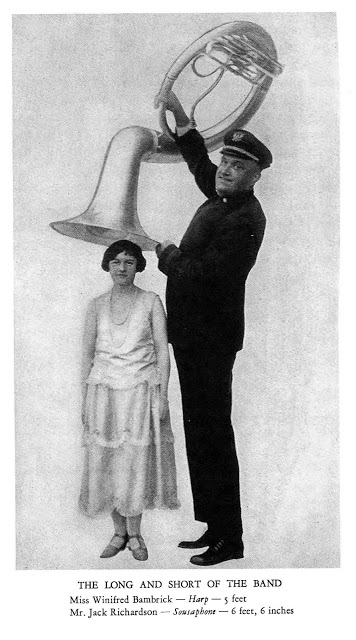
Despite the fanciful publicity, Sousa’s patriotic marches were the biggest draw. “He is the master band leader of them all,” Richardson raved.
In 1911, the string of very tall tubists was broken when Arthur Griswold joined the group. By this time, the towering Sousaphones were a staple in Sousa concerts.
Griswold was listed at 6-foot-2.
Even though he was taller then most of the band members, he was still considered small in size compared to the tuba players who preceded him.
So, in jest, they called him “shorty.”

(Sources: The Incredible Band of John Philip Sousa by Paul E. Bierley; various internet sites)
Short Furniture Got No Reason? Why, Yes it Did!
 By Ken Zurski
If there is one distinctive feature about furniture in the early to mid 1800’s, especially the parlor chairs, it is the height of the legs. While many leg posts are decoratively ornate, they are also quite short, and certainly much lower than what is considered standard today.
The history of furniture is a bit sketchy on this dissimilarity. Style, fabrics and materials tend to dominate the evolution of furniture. But speculation is – backed up by good statistics – that we as humans were just smaller in height and therefore furniture was made to reflect that.
Basically the lower we stood, the lower we sat.
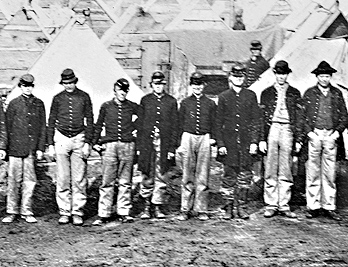
The Civil War is a good example of this height disparity.
Statistics were actually taken for large groups of men. For instance, in the 44th Massachusetts Infantry, of the 98 soldiers between the ages of 17 and 40, the average soldier’s height was 5-foot 7- inches. The shortest man in the regiment was 5-foot 3-inches and the tallest 6 -foot 1-inch. The most surprising stat is on the higher end where based on the average, very few men were six-feet and above and no one was more than one-inch over the six-foot threshold.
Today nearly 15-percent of all men are over six-feet tall, with the average height of a American male at 177 cm, or 5-feet 10-inches. The average height of an American women is 164 cm, or approximately 5-foot 4-inches tall. Only statistics based on race changes this slightly.
So why did we get taller? Evolution is the simple answer, but even that is convoluted, as development suggests a reversal in size. “The average population should have become shorter because the shorter individuals in the population were, from an evolutionary fitness perspective, more successful in passing on their genes,” wrote Scientific American in 1998. “But this did not happen. Instead, all segments of the population–rich and poor, from small and large families–increased in height.”
Scientists claim better nutrition especially in children is the reason we got taller since the rise in height began to take root in the later half of the 19th century when there was an emphasis on living longer. It has since leveled off.

But even as the Civil War suggests, while most men stood under 6-foot-tall, there were exceptions.
Like Abraham Lincoln. ‘
Standing at 6 ft 4 in, Lincoln towered over Civil War generals like Ulysses S. Grant, who was above average at height for the time at 5 ft 8 inches. Pictures confirm this discrepancy in height. The stovepipe hat certainly adds to Lincoln’s size, but there is no doubt the 16th President stood unusually high for his time.

This means Lincoln must have been an uncomfortable guest in most Victorian-style residences of the era where ceilings were built lower and door frames tighter. Except in his own home which was modified to accommodate his tallness, Lincoln did a lot of ducking.
But his biggest obstacle may have been trying to find a suitable place to sit.
However, one permanent seat, made of marble, is the perfect size.

A Salute to the Hand Salute – How Far Back Does it Go?
By Ken Zurski
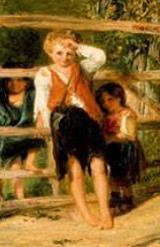
In 1833, an Irish-born English artist named William Collins exhibited an oil on wood painting he appropriately titled, Rustic Civility. In the colorful image, three children are seen near a wooden gate that blocks the path of a dirt road. Collins shows the gate has been opened, presumably by the children. A boy is propped up against the open gate securing it’s place. Another smaller child cowers by the boy’s side. Yet another looks straight ahead from behind the gate.
But why and for whom did the children open the gate?
Well, that’s just a part of the painting’s mystique or as one art connoisseur wisely describes, “its puzzle.”
Upon closer inspection, however, the “puzzle” appears to be solved.
Most obvious is the shadow near the children’s feet. It is a partial outline of a horse and upon its back a rider in a brimmed hat. The children have opened the gate to make it easier for the rider, probably a stranger to them, to pass.
“People are amused at having to find out what is coming through the gate, which few do, till the shadow on the ground is pointed out to them,” the sixth Duke of Devonshire noted after buying the curious painting for his collection.

The work in some circles has been wrongly classified as a children’s picture. True, Collins would specialize in putting children in his paintings, but they were not specifically made for children. “Rustic” was part of his repertoire and a theme for several paintings including Rustic Hospitality, where friendly villagers welcome a wayward traveler who has stopped to rest near their cottage.
Today, most of Collins works are in London museums. His representations of English countryside charm in the early 19th century were very popular. Rustic Civility, however, seems to be remembered for a more significant and historical reasons. The young boy in the painting is holding his hand to his head in a gesture that closely resembles what we know today as a military salute.
A gesture not yet so easily defined at the time.
According to various sources, the origins of the hand salute goes back to medieval times when knights would salute one another by tipping their hats. Since their heads were covered with heavy and cumbersome armor, oftentimes they would just raise the visor in recognition.
In the Revolutionary War, British soldiers would remove or raise their hats in the presence of a ranking officer, an easy task since head gear at the time was used as decoration only and made of lighter material.

In subsequent wars, when soldier’s helmets became more protective the act of actually removing the head gear was too risky. A simple hand raise to the brow would suffice.
By the 20th century and during the two World Wars, saluting became more streamlined and distinctive, with the hands either palm out (the European version) or palm flat and down, the American preference.
Regardless of its history, Collins is credited at least with featuring a salute, albeit slyly, in his painting Rustic Civility. The boy appears to be “tugging his forelock,” an old-worldly expression of high regard and a gesture that suggests an early incarnation of the modern day hand to forehead signal.
This inclination of course is a matter of opinion. Perhaps, as others might suggest, the boy is just shading his eyes. After all, the location of the shadowed horse and rider puts the perspective of the sun’s light directly in the boy’s path. However, in close up, it does appear as though the boy is grabbing a lock of hair.
This clearly supports the salute theory.
Unfortunately, by the time any serious debate was raised, Collins, the artist, was dead.
So in historical context, let’s give the painter his due: To open a wooden gate while on horseback is a difficult thing to do. The children helped the man by opening the gate. The boy then saluted in deference – or civility as the title suggests.
A sign of a respect for an elder in need, Collins likely implied.
And respect is what the “salute” stands for today.

When The World Met Queen Marie of Romania
By Ken Zurski
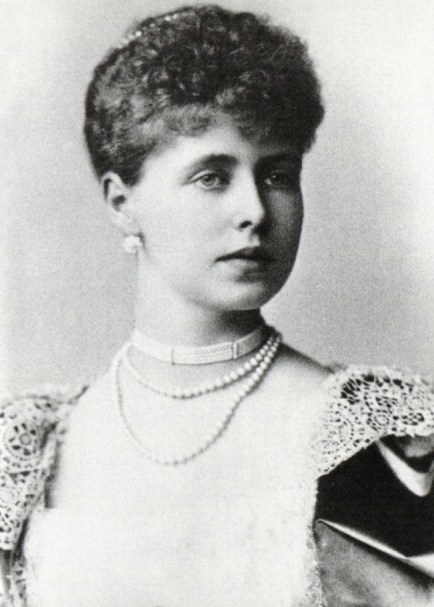
In the summer of 1919, King Ferdinand of Romania sent his British born wife Queen Marie to Paris to attend the Treaty of Versailles, a historic meeting of allied leaders designed to form a peace treaty and draw a new map of Europe at the end of the First World War.
“My God, I simply went wherever they called me,” the Queen said, stating the obvious.
The glamorous Marie did more than just attend. She hobnobbed with the press, flirted with world leaders, including the Big Four (Italy, England, France and the U.S.), and although she had an important job to do for her country, found time to go on lavish shopping sprees too.
By the time the historic Treaty was over, everyone knew a little bit more about the outlandish Queen Marie. And thanks in part to her unorthodox efforts, Romania, at least on paper, had doubled in size.
Born into royalty as Princess Marie of Edinburgh in 1875 in Kent, England, Marie was the eldest daughter of her mother also named Marie, the only surviving child of Tsar Alexander II of Russia, and Alexander, the second son of Queen Victoria and a naval officer who moved the family extensively throughout her childhood. The Princess was a good catch, even as a youth, and gentleman came calling for her including a first cousin George (later George V of England) who professed his love for Marie, but was turned away.
In 1893, at the age of 18, Marie married Ferdinand, a third cousin, who by default, was the heir to the Romanian throne. King Carol I, Ferdinand’s uncle, and his wife had only one daughter so the succession fell to his brother Leopold, who renounced his rights in 1880. Leopold’s son did the same in 1886. So even before the turn of the 20th century, Ferdinand was the heir-presumptive. In 1916, when Carol died, Ferdinand became the King and Marie the Queen of Romania.

Marie was a different kind of Queen, less submissive and daringly independent. During the start of World War I, Marie spent time with the Red Cross in hospitals risking her own life in the disease filled tents. Although she was British born, she had great respect for the Romanian people and would venture into the countryside unaccompanied by guards. Many villagers crowded her in adulation; kissing her hands and falling down at her feet. “At first it was difficult unblushingly to accept such homage,” she wrote, “but little by little I got accustomed to these loyal manifestations; half humbled, half proud, I would advance amongst them, happy to be in their midst.”
In contrast to Marie’s adventurist spirit her husband, the King, was far less dynamic. Quiet and shy and as one writer described “stupid” too, Ferdinand’s most enduring feature was his ears which stuck out the sides of his head like a teddy bear. He said little and mattered even less.
Marie, however, was the complete opposite. Pretty and intelligent she spoke out when asked and seemed to have a good knowledge of foreign affairs. She also had little interest in being a committed wife. Blaming a loveless marriage, she was boldly unfaithful and found multiple lover’s in dashing figures like a Canadian millionaire miner from the Klondike. (In her later years, rumors abounded that one of her longstanding paramours, the nephew of Romania’a Foreign Minister Ion I. C. Brătianu, was the father of her children (six in all, three girls) except for the one that eventually became a bad King. That one was Ferdinand’s, went the biting accusation.)

In November of 1918, when war activities ended, Marie was the outspoken one not her husband. Sending her to the Treaty in Paris instead was an obvious choice for the King, if unprecedented.
So Marie went and brought her three daughters along with her. Together they shopped, dined and were generally the life of any party they attended. The Queen wore out those who tried to follow her. She charmed her way to negotiations and gained admirers along the way. “She really is an unusual woman and if she was not so simple you would think she was conceited,” chimed the British Ambassador to France. David Lloyd George, the Prime Minister of Great Britain, was just as forthright: “{Marie] is a very naughty, but a very clever woman.” he professed. Edward House, an American diplomat and U.S. President Woodrow Wilson’s chief adviser on European diplomacy and politics, was even more complimentary, calling her, “one of the most delightful personalities of all the royal women I have met in the West.”
Instead of being intimidated, which many had predicted, Marie intimidated others with her saucy manners and speech. In one instance, she invited herself to lunch with President Wilson, then showed up fashionably late with an entourage of ten in tow. “I could see from the cut of the President’s jaw,” one guest noted, “that a slice of Romania was being looped off.”
According to reports, Marie dominated the conversation. “I have never heard a lady talk about such things.” remarked Wilson’s traveling doctor. ” I honestly do not know where to look I was so embarrassed.”
In the end, Romania grew in size and population. In fact, of all the contributors at the conference, Romania is widely considered to have picked up the greatest gains, including Transylvania which became – and still is – a part of “Greater Romania.” King Ferdinand could only wait for word back home. He sent letters of encouragement and advice to his wife, which she mostly ignored.
“I had given my country a living face,” she said about her visit.

(Sources: Paris 1919 by Margret MacMillian; My Country by Queen Marie; various internet articles)
George Perec: The Author Who Left Out The Letter ‘E’
By Ken Zurski

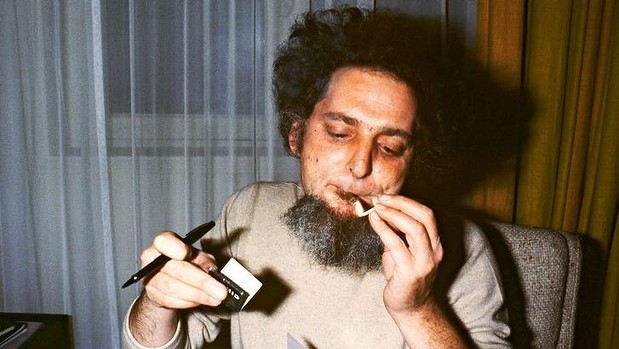
Beginning with the first line of the first chapter, “Incurably insomniac Anton Vowl turns on a light,” and in every sentence thereafter, nearly 300 pages in all, there are no words with the letter “e” in the French novel, A Void.
Not just words that start with the letter “e,” mind you, but any word with the letter “e” in it.
Therefore, while words with an “e” are consciously left out, in the context of the text, they don’t actually exist.
…A rumour, that’s my initial thought as I switch off my radio, a rumour or possibly a hoax.
Propaganda, I murmur anxiously—as though, just by saying so, I might allay my doubts—typical politicians’ propaganda. But public opinion gradually absorbs it as a fact.
A Void was the brainchild of author George Perec, who wrote La disparition (disappearance) in 1969, and was later translated to English in 1994.
Why a writer would take on such an unusual challenge defies explanation. A good author should add to his repertoire of tools, not subtract them. So leaving out a vowel, especially the most popular one, just doesn’t make any sense.
To clarify, according to the book “From Cryptographical Mathematics,” the letter “e” is the most commonly used letter in the English language and nearly 13-percent of all words contain it, at least once.
For example, the first sentence of this very article has nearly 40 words in it; sixteen words containing at least one “e,” for a total of 22. So excluding it, even in French, which uses the same English letters, seemed to be an insurmountable task. (The French or Latin alphabet is similar to English and vowels are the same, expect written with accents like ê. So the prose is somewhat disjointed, especially in translation.)
But this is exactly the kind of discourse Perec reveled in.
Perec was born to Polish Jew immigrants, both victims of the war– his father died a soldier and his mother likely perished at Auschwitz. He started writing at the University of Paris and joined a fringe literary group named Ouvroir de Littérature Potentielle or “Oulipo,” for short.
The name means “literature potential,” but certainly not potential in the practical sense. “[We] seek new structures and patterns which may be used by writers in any way they enjoy,” the group described. To achieve this, constraints (in writing) were encouraged, which was far more challenging. The group also included mathematicians since problem-solving was part of the writer’s methodology and often involved works that delved in complicated mathematical patterns. Suddenly Perec had a mission, as did the group, to experiment and twist the conventional rules of fiction.
A Void, therefore, is a lipogram, meaning a single letter is left out.

The protagonist of Perec’s story is a detective named Anton Vowl (Voyl in French) who must confront a missing void, possibly his own, in a world of impending doom. “I must admit right away that its origin was totally haphazard,” Perec writes in the book’s postscript, perhaps tongue in cheek. “I had no inkling at all, as an acorn contains an oak, that anything would come out of it.”
Some literary critics, however, have established a deeper implication. After all, Perec was a Holocaust orphan. Perhaps the loss of his mêre (mother), pêre (father) and familie, one modern day writer surmised, are words he cannot repeat. All have the letter “e” in them. The missing “e,” therefore, is his personal void.
“The absence of a sign is always the sign of an absence, and the absence of the E in A Void announces a broader, cannily coded discourse on loss, catastrophe, and mourning,” author Warren Motte speculates in an article about Perec written in 2104.
Perec’s later work would be equally complicated and puzzling. He even wrote a novel where ê was the only vowel used.
Many feel his greatest literary contribution is a 700-page book titled Life a User’s Manual, another exercise of intricacies. “The sequence of chapters in the novel is determined by a figure from chess known as the “Knight’s Tour,” in which a knight visits every square of the chessboard once and only once,” Motte writes.
And If that wasn’t interesting enough, there is the constraint: ‘Perec used an algorithm, “orthogonal Latin bi-square order 10,’ to elaborate pre-established lists of the 42 different elements (objects, characters, situations, literary allusions and quotations, and so forth), that would figure in each of the ninety-nine chapters of Life.”
In 1982, at the age of 45, Perec, a chain smoker, died of lung cancer.
Even sick, Perec continued to work at a feverish pace. “There was not a day gone by that he didn’t write,” a friend ascribed. Shortly before his death, Perec sent a letter to his publisher. It was reported to be a list of works he wanted to complete.
Sadly, we will never know what else he had in mind.
The Doctor Who Prescribed More Quiet Time
By Ken Zurski
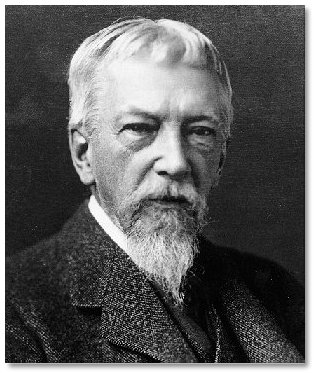
In the late 1800’s, Dr. Silas Weir Mitchell came up with a treatment for those suffering from mental and physical exhaustion.
The “Rest Cure,” as it was called, was a radical 6 to 8 week program that consisted of bed confinement and a special diet, like drinking heavy milk fats. The most important feature of Mitchell’s plan, however, was an environment of relative quiet and relaxation. No physical activity allowed. None. Even speaking was discouraged. And walking – forbidden.
Patients, mostly women, were ordered to limit any movement while in bed, usually left alone for long stretches, and dependent on others to wash and feed them. Mitchell believed the inactivity or “rest” increased the patient’s weight and blood flow.
He also dabbled in electrical therapy.
Mitchell was no quack. He had a degree from a respected Philadelphia medical institution and became a specialist in neurology, a relatively new science. Eventually his brain work led to helping Civil War veterans who suffered from nervous maladies. He is known to have coined the phrase,”phantom limb,”referring to the recurring sensation of a lost body part due to injury or amputation.
Mitchell’s work was both groundbreaking and experimental. But mental illness was still undefined and many women sought answers for their incessant tiredness and melancholy moods.
Writer Virginia Wolfe was one. She followed Mitchell’s plan, but later ridiculed it. “You invoke proportion; order rest in bed; rest in solitude; silence and rest; rest without friends, without books, without messages; six months rest; until a man who went in weighing seven stone six comes out weighing twelve,” she wrote.

Another writer, Charlotte Perkins Gilman went even further. She wrote a scathing story about the treatment that caused her to “go insane.”
Gilman’s short story, titled “The Yellow Paper,” was based on a character who unsuccessfully goes through the “Rest Cure.” The “yellow paper” in the title refers to the wallpaper in the room, which comes to life and mutates into various shapes and sizes, slowly driving the sheltered patient insane. “The whole thing goes horizontally,
too, at least it seems so, and I exhaust myself in trying to distinguish the order of its going in that direction.”
Upon hearing of Gilman’s criticisms, Mitchell’s advice back to her was twofold: Get more rest, he implied, or in essence, stop writing.
The bickering aside, Mitchell’s reputation was solid. The painful hand and foot condition, Erythromelagia, was originally named Mitchell’s Disease after him. Even Sigmund Freud’s famous work factors into Mitchell’s legacy.
Some claim the “Rest Cure” was the inspiration for Freud’s psychoanalytic couch.

The Dagger’s Deed
By Ken Zurski
In the iconic painting The Death of Caesar (1867), artist Jean-Léon Gérôme’s portrayal of the famous assassination on the Ides of March, 44 B.C., the unfortunate victim, Julius Caesar, is seen crumpled in the foreground while his murderers celebrate by raising their weapons in victory. The only man holding a weapon at his side is Brutus, who is seen with his back turned, walking toward the other celebrants. Perhaps, as history suggests, Brutus dealt the final blow.
He also carries a sword.
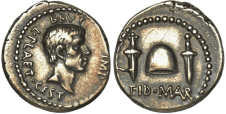 This would seem appropriate for the time, since swords were used by Roman soldiers. But the weapon of choice to kill Caesar was not a sword, but a dagger. Brutus all but confirms it in a coin he commissioned after Caesar’s death. On the coin are two daggers with different shaped hilts.
Presumably, the first dagger belongs to Brutus. The second likely belongs to another assassin.
The shorter daggers make more sense in the killing of Caesar. They were as martial arts experts explain today, “streamlined and remarkably light.” They were also very effective, especially at close range. Plus, a dagger could easily be hidden in a toga and retrieved quickly. The only advantage a sword would carry is the distance between the striker and the intended target. But that was in combat and against another armed assailant.
 Caesar was ambushed and received blow after excruciating blow. A brutal and revolting mess, historians explain, and not an easy task.
Instead of celebrating with weapons held high, as Gérôme’s painting suggests, more realistically, the band of conspirators would be hunched over from exhaustion and nausea. Their hands and white garments covered in blood.
“Few felt comfortable talking about it,” author Barry Strauss (The Death of Caesar) writes about the gruesome aftermath of military daggers, “and fewer still doing it.”

Not Just a Right to Vote, But A Right to Be Heard
By Ken Zurski
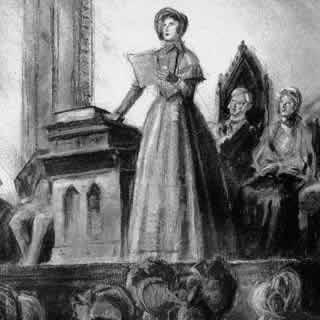 In July of 1848 a teenager named Charlotte Woodward read an announcement in a local newspaper about a group of women who would be meeting at a Methodist Church in Seneca Falls, New York, a modest wagon ride from her family’s farm near Syracuse. “A convention to discuss the social, civil and religious condition and rights of woman, “ the ad read. Woodward was intrigued.
Woodward had been a school teacher at age fifteen but mostly worked at home, sewing gloves for merchants to sell. The work was long and the pay nearly nonexistent. This was the role of a woman at the time, no identity and no apparent social status other than tending to her family or husband’s needs and eventually having babies, oftentimes lots of them. A woman’s wages, if she worked, belonged to her spouse. She had no rights, no advantages. “She was her father’s daughter,” one writer stressed about the role of women in the mid 19th century, “until she became her husband’s wife.”
She was, however, protected by law against physical abuse, but only with “a stick bigger than a man’s thumb.” A punishment would be imposed, but no damages were ever awarded for injuries since no woman had the right to sign any legal documents.
Woodward was unmarried and feared no man, but she fumed at the prospects of working the rest of her life for others and eventually to a man she might be forced to wed, but did not love. “Every fiber of my being reveled, although silently, for all the hours that I sat and sewed gloves for a miserable pittance which, after it was earned, could never be mine.” Her interest in the women’s rights convention was more a revelation than a curiosity. “I wanted to work, but I wanted to choose my task and I wanted to collect my wages.”
So she went to Seneca Falls.

The convention was the brainchild of two women, Lucretia Mott and Elizabeth Cady Stanton, who attended the World’s Anti-Slavery Congress in London in 1840 as part of a women delegation, four in fact, and first of its kind. Their voices were mostly silenced. Some reports had the women turned away at the hall entrance. Returning home, Mott and Stanton gathered a lively group of women who discussed equality behind closed doors. In 1848, they felt it was time to take their case public. So they announced the convention’s date and invited anyone, even men, to come. Men could be part of the second day’s activities, the ad implied. “The first day would be exclusively for women.”.
Apparently, men didn’t care for rules not imposed by men. So on the first day, more than 50 lined up in front of the church. Some women were appalled, but Woodward recalls the men as “uncommonly liberal,” apparently meaning they had open, not closed minds. One man was proof of that. His name was Frederick Douglass.
But it wasn’t just men who were outside of the church that day. It was the women too. The church doors were locked and only the minister had a key. Apparently, the minister, who earlier approved the conference, had changed his mind after talking to the elders of the church, all men of course. As one story goes, the women stood on each other’s shoulders, managed to open a window shutter, climb inside, and open the doors. Nothing more was reported of the minister’s emphatic reversal after that.
Mott was a very good speaker, a rarity for a woman. Not that she was well-spoken, many were, but that she had the natural ability to express her views in front of a large audience. Public speaking was not something a woman could practice at the time. James Mott, her husband would hold order since by law, women could not. The ladies were there to change the laws, not break them.
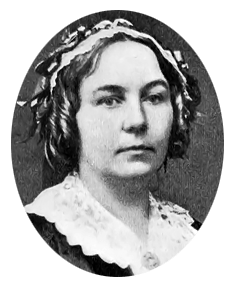
By the end of the two days and nearly 18 hours of speeches, debates and readings, most of the women including Woodward signed a document titled “Declaration of Sentiments,” similar to the Declaration of Independence. The 1000 word document began with an opening statement that revised text from Thomas Jefferson’s original declaration and first sentence. It read: “We hold these truths to be self-evident, that all men and women are created equal.” The two added words were obvious.
The statement ended this way:
“The history of mankind is a history of repeated injuries and usurpation on the part of man toward woman, having in direct object the establishment of an absolute tyranny over her. To prove this, let facts be submitted to a candid world.”
And then came the point of the conference, the sentiments, or “facts.” These were the rules that must change. Among them were disapproval’s of common law, mostly taken for granted by men. “He has taken from her all right in property, even to the wages she earns,” read one. “He has compelled her to commit to laws in the formation by which she had no voice,” went another. “He has made her, in marriage, in the eyes of the law, civilly dead.”
Only one sentiment was a sticking point for the women. It read: “He has never permitted her to exercise her inalienable right to the elective franchise.” This was a social decalration, some argued, not a political one. The right to vote would likely get the least support from men. And besides, it might be the one sentiment that men were so strongly against that they would ignore all the others. After much debate, most of the women wanted the voting rights stricken from the document. But Frederick Douglass, a self-educated former slave, spoke in favor of its inclusion. “In this denial of the right to participate in government,” he eloquently stated, “not merely the degradation of woman and the perpetuation of a great injustice happens, but the meaning and repudiation of one-half of the moral and intellectual power of the government – of the world.”
Later, Susan B Anthony, who was not at the conference, would make voting rights the cornerstone of the suffragette movement, a debate that became more contentious after the Civil War ended and freed slaves also demanded the right to vote. Once again, Douglass was at the forefront. But it was not an easy sell, especially for women whose efforts to that point had been one frustrating roadblock followed by another.

In 1866, Anthony’s mouthpiece, the outspoken Stanton, went too far. She called former slaves “ignorant(s) and foreigners,” and chastised Douglass and others for putting blacks rights before a woman’s. Douglass, who to that point supported suffrage, angrily countered: “When women, because they are women, are hunted down…when they are dragged from their houses and hung upon lampposts, when their children are torn from their arms, and their brains dashed upon the pavement, when they are objects of insult and outrage at every turn, when they are in danger of having their homes burnt down over their heads…then they will have the urgency to obtain the ballot equal to our own.” In the end, the Fifteenth Amendment was passed which included race, but not gender. In principle, blacks could vote, but not black women.
But that fight would come much later. In 1848, Douglass’ words about women being “one-half of the moral and intellectual power of government” rang true. The call for men to integrate women in elections was included in the “sentiments” and the resolution passed.
When it was over, most men were apathetic. Some sarcastically called the two days of meetings a “Hen Convention” and mocked the proceedings. “If there is one characteristic of the sex which more than another elevates and ennobles it,” one newspaper editor, obviously a man, wrote, “it is the persistency and intensity of a woman’s love for man. The ladies always had the best place and choicest tidbits at the table.”
But despite the protests, the convention sparked more debates, more meetings and a movement which would last for years.
Woodward had no idea how that day would change her. She eventually joined Anthony’s suffrage camp and spent the rest of her life fighting for the right to vote.
Finally in 1920, after the passing of the Nineteenth Amendment, she had the chance.
Sadly, though, she never got to cast that first – or any – ballot.
Charlotte Woodward Pierce, her married name, was the youngest to sign the “Declaration of Sentiments” and now some seven decades later, of the 68 women who participated in Seneca Falls, she was the sole survivor.
On election day 1920, she fell ill and stayed home. The next year, her eyesight went bad. “I’m too old,” she said. “I’m afraid I’ll never vote.”
That same year she died at the age of 92.

(Sources: Judith Wellman, Historian Historical New York; “The Scarlet Sisters: Sex, Suffrage, and Scandal in the Gilded Age” by Myra MacPherson)
 UNREMEMBERED