
Bishop Sheen and the Communist Meeting
By Ken Zurski
 The old Hotel Commodore building sits at the corner of 42nd street and Lexington in the heart of Manhattan’s thriving business hub once known as Terminal City, a complex of hotels and offices conveniently connected to New York’s bustling Grand Central Station.
Gloriously introduced in 1919, the hotel boasted a total of ten elevators and 2000 commodious rooms, each one elegantly designed and quite modern for its time. The ceilings were built low for a trendier look, and the largest and most expensive room came with its own working waterfall.
The spacious reception area was touted as “The Most Beautiful Lobby in the World,” and outside the main entrance, patrons were greeted by a statue of the man the hotel was named after: Cornelius Vanderbilt, a former steamboat entrepreneur and railroad and shipping tycoon, known as “The Commodore.”
From the moment the Commodore opened its doors, rooms were almost always filled to capacity and overflow crowds from the train station nearby moved feverishly about the hotel’s lobby. With such anxious and hurried activity inside, one could easily maneuver through the excited throng without being noticed or paid any mind. And so it was here at the Hotel Commodore in a quaint corner of the dining room, in a table for two, an unlikely conclave took place between a well-known Catholic priest and a communist sympathizer.
The year was 1937, two years before Germany invaded Poland and the start of the second World War. Fulton Sheen was a brash 42-year old monsignor, who was arguably the most popular public figure of the Catholic Church. His voice was known to thousands of listeners as the host of The Catholic Hour, which debuted in 1930 at WEAF in New York and nearly a decade later boasted a resume of 106 radio stations. Sheen was the first and only host. “I will preach Christ and him crucified,” he humbly stated when asked the purpose of the program.
Sheen’s modest upbringing began in El Paso, Illinois where his parents owned and ran a hardware store. Born in 1895, the first child of Newt and Delia (Fulton) of Irish and German descent, Peter John Sheen was just a toddler – and a constant crier due to a nagging case of tuberculosis – when something extraordinary happened. An errand boy at the store, fearful of being caught with a cigarette, threw the lighted butt under the stairs and directly on top of a fifty gallon drum of gasoline. It ignited. Soon, the whole business section of El Paso went up in flames including the Sheen hardware store, which was reduced to smoke and ash. Deciding not to revive the hardware business, Peter’s father bought a farm instead.
But Peter hated life on the farm. He was smart, gregarious, and quite the thinker even at an early age. The laborious chores didn’t challenge his mind. How to get out of doing them however, did. In one incident, he recalls destroying a wagon wheel with a saw just to avoid the work. “From the earliest age I showed distaste for anything associated with farm life,” Sheen later admitted.
His parents agreed. In order to give their two sons an education (Peter was the older by two years), they moved to Peoria and enrolled the boys in a parochial school. Sheen’s path to God was underway. School was also where he became known as Fulton. Although the boy had been born and baptized as Peter, when the school asked what name he went by, Sheen’s maternal grandfather chimed in (perhaps mishearing the question) and said his last name instead. “It’s Fulton.” The name stuck.
Archbishop Spalding, the patriarch of Peoria’s Catholic Schools, was influential in young Fulton’s life. While serving as an altar boy during Sunday Mass, Sheen slipped and dropped the wine cruet. The sound of the bulb-shaped container bouncing across the hard surface echoed off the high walls and arched ceilings. Years later, Sheen quipped: “There is no atomic explosion that can equal in intensity of decibels and explosive force that can equal the sound of a wine cruet hitting the marble floor of a cathedral in the presence of a Bishop.” Expecting a stern tongue lashing, young Sheen braced for his punishment. But the Bishop was thoughtful instead. After Mass, he asked, “Young man, where do you plan on going to school when you get big?” The answer was as obvious to Sheen as the question.
“Why Spalding Academy of course,” he said, referring to the high school founded and named after the Bishop.
“No,” Spalding said. “Tell your mother that I said when you get big you will go to Leuven (University) and someday you will be just as I am.”
When Sheen told his parents about the Bishop’s words, his mother gasped. “That’s in Belgium,” she said.
The Archbishop’s prophecy came true. Sheen attended high school at Spalding Academy where he exceled in academics and drama, then enrolled in Leuven, the largest and oldest catholic university in the world. “Oh, this is where Bishop Spalding told me to go,” he remembered thinking to himself while entering its doors for the first time.
 In September of 1919, Sheen was ordained at St. Mary’s Cathedral in Peoria. The next day he performed his first mass. In the ensuing years after his ordination, Sheen traveled, preached, and studied. Then in the summer of 1925, he returned home and was assigned to St Patrick’s Church in an impoverished section of Peoria. A humble, lowly position as a curate may have riled many men of his educational background, but Sheen enjoyed being home and helping the poor. Two years later, he was called to teach at the Catholic University in New York and left Peoria for good.
In 1926, Sheen went on the radio. It was a perfect outlet for his talent. He prepared scripts and preached the word of God, not just to believers but non-believers as well. This was his torment at first. How to preach the teachings of Christ to non-Catholics? Sheen found a way. He was a natural on the airwaves. His conversational style and ability to explain God‘s will through compassion and love struck listeners of all faiths. The show was called The Catholic Hour, but Sheen made it everyone’s hour.
He talked of God’s gifts to all mankind, and the weekly faithful listened. The first time he mentioned the evils of communism, however, even the FBI took notice.
Louis Budenz, a leading communist supporter, noticed too. Bundez and Sheen did not know each other personally, but like Sheen, Bundez, the son of Irish immigrants, grew up Catholic and was an altar boy too. But as an adult he left the church and followed another path. Now both men were talking about communism – only in vastly different ways.
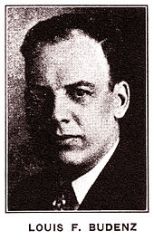 Born in July of 1891, Budenz followed his mother’s advice and emulated her passionate support of Irish Revolutionaries by attending labor strikes and rallies. Violence ensued on occasions, but the action usually ended only in mass arrests. In each case, it helped that Budenz was also a practicing lawyer. (Time Magazine claims Bundez was arrested 21 times and 21 times he got off without an indictment.)
Next up for Budenz was joining the Communist Party. It was a logical decision. He would work as a writer and espouse his views and opinions in print. The Daily Worker, a communist newspaper, was the perfect outlet, and in writing for it, Budenz found his calling. Among his communist friends and co-workers, he quickly rose in the ranks.
The Worker never wavered in its support of Soviet leader Joseph Stalin even after he executed many of his adversaries, claiming they were out to destroy him. Many party members balked at Stalin’s blatant abuse of power. Fascism was the true threat, they cried, and Stalin’s actions mimicked a certain fascist leader of Germany. When Stalin and Hitler joined forces in 1939, the Communist Party fractured. The Daily Worker, however, remained loyal to the new Soviet-German pact, and Budenz, who was uber-loyal to the cause, became its new editor.
The paper wielded great power. “We turned on everyone who refused to go along with our new policy,” a former co-worker of Bundez ascribed. Many supporters of Stalin were staunch Hitler haters who could not comply. The Daily Worker never blinked in its allegiance to Stalin, and Editor-in-Chief Budenz made sure there was one consistency under his direction: total support of Soviet polices whatever they may be.
The rule generated an enemies list that was far reaching and long. They targeted individuals and organizations including the burgeoning Catholic Church.
During the Christmas season of 1936, Budenz took aim. In that month’s issue of the Worker, an article written by Budenz posed a series of questions directed at the Catholic Church and the radio host monsignor Sheen in particular. Explain your criticism of communism, Budenz asked. Sheen responded.
No one had to go any further than Sheen’s radio show to know that the “media preacher” was a staunch opponent of communism. It was a bold stand even for a priest. In the 1920s, anti-communism fever had spread in the United States thanks to President Wilson and the first “Red Scare.” But during the Great Depression that followed, a number of destitute Americans sought answers and solutions that were more in line with socialist thinking. In their minds, capitalism, specifically the profit driven owners and bosses, were the enemy. Therefore, they declared, socialism could only be attained by defeating capitalism.
By banding together, the empowered workers fought with a vengeance; staging heated rallies and strikes in protest. These were mostly laborers living off meager wages. Many had lost their jobs and homes. Capitalists exploited the amount of immigrants within these groups. Since many had come from countries influenced by communistic principles, they claimed, socialist ideals must be closely aligned with communism.
 Russia was no birthday cake. Stalin was a ruthless leader. But there was a model of consistency in his polices that appealed to angry workers. When Hitler turned on Stalin and Stalin joined the Allied forces, a genuine wave of support spread through even the most hard boiled detractors. After all, there was a bigger concern now and a more valued prize: the crushing and ultimate defeat of the Axis Powers: Germany and its partners, Japan and Italy. Most Americans were ambivalent. No one trusted Stalin, and refuted communism as an unacceptable alternative to democracy, but they reluctantly gave Russia, now a war ally, a temporary pass.
Yet some Americans were ultimately drawn to this leftist ideology. During this time, the organized Communist Party of America gained momentum – and new members – although they never seriously challenged the two mainstay political parties in elections.
The FBI kept tabs of such activity. The agency closely watched communist party leaders and unfairly labeled them “Soviet spies” for lack of a better term. The Bureau’s interminable leader J. Edgar Hoover led this charge. Hoover hated Stalin and everything to do with communism, war pact be damned. The FBI even had a file on Sheen, thinking that the radio host might bring some of the most hardened sympathizers – Soviet and Nazi – to Hoover’s attention because of all the hate letters the priest received.
Sheen wanted nothing to do with the politics of it all. His message was simple: religious freedom must reign. He pounded that message home in speeches and sermons on the radio. A communistic society, he hammered, is no place for a Catholic.
Budenz was confused by the church’s stance. He published an article in the Worker critical of the Catholic faith and its leaders. “How strange it is to see in a world so set up, where Catholic spokesmen in so many instances belabor communism,” Budenz wrote.
In particular, he mentioned Sheen by name. As a man of compassion, Bundez inferred, how could he [Sheen] speak against those who were trying to help the poor and downtrodden?
Sheen sent a booklet back to Budenz titled Communism Answers Questions from a Communist. In it, he cited incendiary quotes from Marx and Lenin and articles from Soviet newspapers describing the economic hardships under communism. In his own words, Sheen wrote: “I’m rather surprised that a communist is not more familiar with Communistic literature and should have asked for texts. But there they are.”
Budenz’s strategy backfired. Sheen’s pamphlet was published and sold 65,000 copies. Many of the quotes were used to refute speakers at pro-communism rallies, including speeches by Budenz.
Incensed and perhaps intrigued by Sheen’s words, Budenz asked to meet with the church leader. “In hopes that they could win me over to their cause,” is how Sheen would later describe it.
Of course, the monsignor said yes.
Although it was meant to be private, Sheen gladly let the pronouncement of the meeting slip. “I’m having dinner with a leading communist tonight,” he exclaimed to an inquisitive newspaper reporter. “In fact, I’m looking forward to the encounter with great pleasure.”
The time and place however was never revealed. The press never figured it out. The two men met in private at the Hotel Commodore.
In their later years, both men recalled their “odd” meeting. “In an obscure corner we talked for an hour in earnest, quiet tones,” Budenz exclaimed.
Bundez remembers the monsignor’s smile and intense blue eyes. “He told me that he was leaving for England that summer.” Each year Sheen preached in Soho. “Near the house where [Karl] Marx labored,” the monsignor pointed out.
Despite opening with small talk, the insouciant greetings soon turned serious. The conversation drifted to the parallels of communism and fascism, something Bundez vehemently denied. “There is this merit in the communist view that does not inhere in fascism,” Budenz angrily contended. “Communism has within it the promise of democracy and the end of dictatorship in its doctrine of the withering away of the state.”
In Sheen’s own recollections, Budenz’s bickering about communist and fascist differences were inconsequential. There was only one objective in the monsignor’s mind. “I told him I did not want to talk about communism,” Sheen later wrote. “I wanted to talk about his soul.”
The next few minutes became solidly etched in Budenz’s mind. He remembered it vividly even years later as the moment that eventually changed his life. Describing Sheen’s restraint at first Budenz said, “He was not disposed to contradict me. That would have only aroused my personal pride and enticed me to further argument.”
“What he did instead,” Budenz reflects, “took me totally by surprise.”
Sheen rose and pushed aside the cutlery on the table. He bent forward and “waved his hand in argumentation.” In a voice snarling with contempt, he said: “Let us now talk of the Blessed Virgin.” Budenz froze with fear. “It was an ‘electrifying moment,’” he later described.
According to Budenz, Sheen spent the next few minutes talking “of the miracle of Lourdes, with the promises of Our Lady, the prayers of the church, and the conversion of Russia within her grace.”
Budenz was transfixed. He later confessed: “In the course of my varied career, I have met many magnetic men and women, have conferred with governors, and senators, have stood in court twenty-one times as a result of labor disputes – breathlessly awaited the verdict and each time experienced the triumph of acquittal – but never has my soul been swept by love and reverence as it was that April evening.”
The two men departed that day and would not meet or associate again for another nine years.
Bundez battled his own personal convictions in that time, but could not shake the power of one simple statement; the last words Sheen spoke before departing. “I will always pray for you because you have never fully lost the faith,” the monsignor said.
Nine years later, Budenz wrote Sheen a letter. “I’m returning to the Catholic Church,” he said, “and bringing my family with me.” Sheen welcomed him back without regrets. In 1945, Budenz confessed his sins and Sheen baptized him.
 Budenz’s “turning (to God),” as Sheen called it, was also a major boon for Hoover and the FBI. In the now former communist, Hoover had a rat – and names, lots of them. Budenz enthusiastically complied. He was interviewed for 3,000 hours by FBI agents and, in the end, sent several leaders of the American Communist Party to prison for treason.
For Sheen, Budenz’s conversion was just another day at the office. One night the monsignor received a call came from a member of the Communist Party, who asked: “Is it true that you received Louis Budenz into the Catholic Church?”
Sheen coolly replied, “Don’t tell me the Daily Worker is at last interested in the truth?”
The man’s retort, Sheen remembers, were words that “cannot be found in any manual of prayer.”
Even the Daily Worker was blindsided by the news that its influential leader had switched sides. Sheen had kept tight-lipped about the defection right up to the day Budenz was received by the church. In fact, in that day’s edition of the Daily Worker, Budenz was still listed as editor-in-chief.
Sheen continued to condemn the evils of communism even after World War II ended.
Under the post-war agreement, Stalin’s Russia would be part of an American plan to bail out the European nations strangled by the economic toll of the war. Even Germany would be included. But Stalin balked. He refused any help from the U.S. and especially hated the idea of the Germans getting aid. He mapped out his own dominance of Europe. The Cold War began.
Most Americans, thanks to the government’s persuasiveness, were optimistic that Russia would stay on our side after the war. But based on past principles, Sheen never bought into it. He continued to blast Stalin and communism on the air.
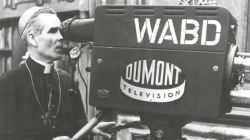 The Catholic Church tried to diffuse some of Sheen’s comments by posting a lookout in the radio studio. The mandate was clear: cut the microphone if Sheen mentioned anything about the Russians and communism. Sheen had said all along that his battle was not with the Russian people but with the Soviet government’s polices. Still the Church wanted no backlash. Because of the scrutiny, Sheen nearly quit the radio show, but endured the pull of the church’s leash with grace. Eventually he moved on to television, a medium where he is most remembered today.
Many years after his death in 1979, an effort was launched to consider cause for sainthood, a holy consecration and stringent requirement by the Catholic Church. Sheen’s followers claim at least one miracle (at least two substantiated miracles is needed for canonization) can be attributed to him: an unexplained reversal of fate by a stillborn baby, who somehow survived after the child’s parents claimed they asked for prayers of convalescence in Bishop Sheen’s name. The Vatican offered no response to the so-called miracle, but a request to move Sheen’s body to Peoria for inspection and relics, another strict requirement, was initially denied. (Update: In response to a lawsuit filed in 2016 by Sheen’s oldest living descendant, in March 2019, A New York City appellate court denied an appeal by the Archdiocese of New York attempting to prevent the removal of Sheen’s remains from a crypt beneath New York City’s St. Patrick’s Cathedral to Peoria, Illinois).
Although he may never become a saint, Sheen is still considered influential for being the first “face” of Catholicism on both radio and television. His persistent stance on communism, however, gets lost in the strong spiritual side of his faith. Sheen, however, credits himself for correctly predicting the grim future and spread of communism.
Shortly after the war, during a speech in Akron, Sheen was approached by a high-ranking official in the clergy and asked, “What are you talking about tonight?” Sheen coolly replied, “About Russia and Eastern Europe and how Russia will take over all of Eastern Europe.”
The man was furious.
“You’re crazy! Russia is a democracy,” he insisted. “It is no longer communist.”
Sheen started down a flight of stairs. He wanted no part of a confrontation. But as his foot hit each step, Sheen remembers the man pointing his finger and yelling at him from above.
“You’re wrong! You’re wrong! You’re wrong!” the man said.
Sheen reached the bottom, turned and looked up. “Someday you will see,” he said, “Eastern Europe will belong to the communists.”
The man was left standing and wondering.
The monsignor bowed his head and quietly walked away.

(Sources: Treasure in Clay: The Autobiography of Fulton J. Sheen; This is My Story by Louis Budenz; America’s Bishop: The Life and Times of Fulton J. Sheen by Thomas C. Reeves; Enemies: A History of the FBI by Tim Weiner).
Note: This article was original published in April 2014. It has been re-titled, updated and posted on this website.
Uncovering Manson’s Teenage Years: The Peoria Connection

By Ken Zurski
Thanks to author Jeff Guinn’s biographical book of Charles Manson, titled Manson: The Life and Times of Charles Manson, a few more details emerge about the notorious killer’s time as a boy, his introduction to crime, early run-ins with the law, and in particular, his short but volatile stint in the nation’s heartland, specifically Peoria, Illinois.
Sometime in the late 1940’s, Guinn explains that Manson, or “Charlie” to his friends and family, and another boy named Blackie Nielson broke out of Boys Town in Omaha, Nebraska, stole a car and drove it to Peoria where Nielson’s uncle lived.
Manson was in Boy’s Town after failing to stay at another boy’s school in Terre Haute, Indiana. His mother Kathleen insisted Charlie go to a reform school while she served prison time for a bit role in an attempted robbery masterminded by her brother Luther, Charlie’s uncle.
In Terre Haute, Manson ran away and ended up in Indianapolis where he robbed a few dime stores. He needed the money to rent a room and hide. He pushed his luck though and got caught. The sympathetic judge went easy on young Charlie. “Erroneously assuming that the boy was Catholic,” Guinn writes, “the judge sends him to Boy’s Town, the most famous juvenile facility in America.”

That would straighten him out, the judge conferred. But it didn’t work. Boy’s Town had a reputation for turning wayward boys around, but it was no prison and security was lax. Manson and his new friend, Blackie, left the grounds, hotwired a car and hightailed it to Illinois.
What happens next is fragmentary. It’s probably why Guinn spends only a few paragraphs on it. In fact the word “Peoria” isn’t even listed in the book’s index. But Manson’s time in Peoria may be just as influential on the young boy’s life as his first arrest in Indianapolis. It’s also just as surprising, considering his age. After all he was only thirteen, according to Guinn.
Guinn writes that Charlie and Blackie set out to rob a few businesses in Peoria, including a grocery store. But these “knock offs” were different. Charlie had a gun. Even Guinn’s not sure how he got it, possibly stole it from Blackie’s uncle. But how is not as important as – why? In hindsight, it’s apparent the young boy was headed towards a more complicated life of crime – even murder. But instead of ripping off a few dinky stores just to get by like he did in Indianapolis, this time Manson armed with a weapon appeared to be doing it for fun. When Manson got caught again, a Peoria judge wasn’t so lenient. He sent Charlie to a hard core reform school in Plainfield, Indiana where adult supervisors were more like drill sergeants. The rest of Manson’s youth plays out similarly – bit robberies, run-ins with the law and eventually some prison time – until we get to the 1960’s and the unfortunate reasons why he is famous today.
But that was it for Manson’s time in Peoria.
Throughout the years, a few articles in the Peoria Journal Star bulletin the arrests but offer few details. Did Manson really try to rob the Chevrolet dealership on Main Street and jump into a squad car instead of a getaway car, as the paper claims? Heady stuff, for sure. But true?
Thanks to the efforts of Peoria Journal Star columnist Phil Luciano who in 1992 wrote a letter to Manson asking: What brought you to Peoria and what did you do here? Manson wrote back as he often did to reporter’s inquiries. His answers are lucid enough, but not very descriptive or specific. Manson recalls stealing some jewelry, putting it in a safe and dumping the safe over a bridge onto railroad tracks below. “Yeah, I did a lot of growing up in that town (Peoria),” he writes in the letter, “fast growing up.”
Manson’s other recollections of Peoria makes it sound like he was in town for months, if not years (Guinn’s book isn’t clear on this. Likely, it was only for a couple of weeks). Of course, for Manson, this comes nearly 50 years after the fact. A lot more scandalous and disturbing events took place in the man’s life since then, including the murder of actress Sharon Tate and four others on August 8th and 9th, 1969.
Guinn claims that his correspondence letters from Manson were mostly ramblings about how he had been wronged and not much else. “That’s all you need to know,” Manson curtly answered one letter after offering nothing substantial in return. Apparently he didn’t like books written about him.
Manson was sentenced to life for the Tate/LeBlanco murders, incarcerated in a California State Prison, frequently denied parole, and died on November 19, 2017 at the age of 83.

The cover of Guinn’s book shows a picture of a neatly dressed young man. He is smiling and seems content. Although his gaze is slightly off, there’s only a hint of the “crazy eyes” that his cousin’s claim Charlie possessed at times.
The more recognizable image of the convicted killer with tussled hippie-like long hair and a creepy blank stare would come later, when Manson was in his late 20’s and early thirties.
While in Illinois, Charlie was just a teenager.
The Jamestown Lottery
America’s first lottery winner was a London tailor. His name was Thomas Sharplisse. We know this rather trivial historical fact thanks to a man named John Stow who decided to chronicle English life in in the 16th century. His book Survey of London was released in 1598, a life’s work indeed, since he was dead just seven years later at the age of 80. At the start of the 17th century, however, other diarists picked up the slack, commissioned by King James I, and continued to record anecdotes and life experiences of fellow Londoners. The Stow’s Chronicles is the result. And through it, we know the name Thomas Sharplisse.
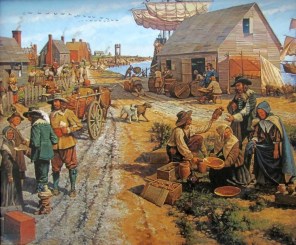 Sharplisse was certainly a tailor and from London, but had nothing to do with America except as other Londoners did at the time a passing interest in what was going on overseas. It was after all 1612. The stock holding Virginia Company of London, had funded the first English colony in North America, the struggling James Towne, or more commonly known as Jamestown, named of course in honor of his majesty.
The newly established settlement (actually it was the second incarnation, the first was James Fort) was reeling from sickness, starvation and occasional attacks by hostile Indians. They were in desperate need for more supplies, but the Virginia Company was broke. So the King approved a lottery, a game of chance really, but also an opportunity for fellow countryman to invest at a time when charitable contributions didn’t exist.
Marketing for the lottery was in the guise of a song:
To London, worthy Gentlelmen,
goe venture there your chaunce:
good lucke standes now in readinesse,
your fortunes to advance
In June of 1612, Sharplisse was among the jostling crowds that gathered in a specially constructed “Lotterie house” near St. Paul’s Church in London to watch tickets drawn in the first Great Standing Lottery. The person who pulled the tickets – in some cases, a child, whose innocence was visible proof of the fairness of the game – dipped his arm into the first drum. Then the second drum was opened and a corresponding slip either a blank or a prize was pulled out. In the words of one contemporary account, the scene was viewed by a gathering of “Knights and esquires, accompanied with sundry grave discreet citizens.” Then the second drum was opened and a corresponding slip either a blank or a prize was pulled out.
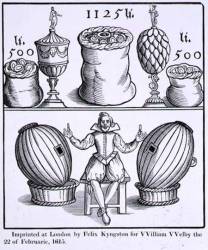
Little else is known about Sharplisse except that he spent two-shillings-and-sixpence on a chance. And according to Stow’s Chronicles, Shaprlisse’s ticket was the Grand Prize winner – four thousand crowns in “fayre plate, which was sent to his house in a very stately manner.” It was a fortune at the time. Two Anglican churches took home smaller winnings
After the Virginia Company paid for the prizes, salesman, managers, and other expenses, the remaining revenue covered the cost of shipping people and supplies to Jamestown. It was such a vital resource that Captain John Smith referred to the lottery as “the real and substantial food.” Disappointing, however, was the turn out. Nearly 60-thousand lottery tickets went unsold. Eventually, the crown banned lotteries that benefited Jamestown because of complaints that they were robbing England of money.
More than a century later, citizens of the Thirteen Colonies used lotteries to fund the American Revolutionary War.
(compiled by Ken Zurski. Some text was reprinted from The Lottery Wars: Long Odds, Fast Money, and the Battle Over an American Institution).
Ernest Shackleton, Bugs Bunny, and the ‘Nimrod’ Factor

By Ken Zurski
The Nimrod Expedition despite its name was not a mission for dummies. Led by British explorer and Antarctic specialist Ernest Shackleton , the mission set off in January of 1909 with the objective of becoming the first team to reach the South Pole. That didn’t happen, but they did get closer to the pole than anyone else, just under 100 miles.
Basically they were all “nimrods,” like the expedition name would suggest, but not in the way you think.
That’s because at the time, the word “nimrod” represented something different than it does today. Strength and courage was its bent. A nimrod basically was held in high regard. The name demanded respect, not jeers.
The polar expedition itself is named for Shackleton’s hand picked ship, the Nimrod, a reference to Nimrod, the biblical figure and “mighty hunter before the Lord” from the Book of Genesis. Nimrod was an older boat and needed work, but Shackleton had little recourse with limited funds. He would eventually praise the small schooner as “sturdy” and “reliable.”

Nimrod was not an uncommon moniker. In the mid 19th century, financier Cornelius Vanderbilt named a steamboat Nimrod to compete with other commuter boats on New York’s Hudson River. Befitting his reputation, Vanderbilt demanded the Nimrod be stronger and faster than the others. No doubt the naming of the ship reflected this too.
And in 1899, composer Edward Elgar wrote a symphonic piece that had 14 variations each written for or about a personal acquaintance.

The ninth variation was titled Nimrod. “An amusing piece,” Elgar said referring to his friend and subject, August Johannes Jagear, a music publisher and accomplished violinist. Rather than a slight, however, Elgar’s piece was a compliment. Jäger in German meant “hunter.”
Then in 1940, thanks to cartoon character named Bugs Bunny, the meaning of the word changed forever.
 During a short titled “A Wild Hare,” Bugs called his nemesis Elmer Fudd a “poor little nimrod,” a reference to Fudd’s lack of skills as a hunter. Bugs sarcasm was evident, but most children didn’t get it. Nimrod, the word, soon became synonymous with a bumbling fool, like Fudd’s character.
Today, the Merriam-Webster Dictionary lists the word “nimrod” as slang for “idiot” or “jerk.”
That may have been the implication, but certainly not the description, of Shackleton and his crew. But those who wished to board the Nimrod, some might say, were playing a fools game.
Shackleton didn’t hide the discomforts and dangers of the mission when he advertised for a team of men . “A hazardous journey,” he warned, with “low, wages, bitter cold, long hours of complete darkness. If they made it back, which was “doubtful,” Shackleton implied, “honor and recognition” would await them upon return.
Basically, only Nimrod-types need apply, he implored.
Good thing Bugs Bunny wasn’t around to dissuade them.
When Christmas Interrupted the War
By Ken Zurski
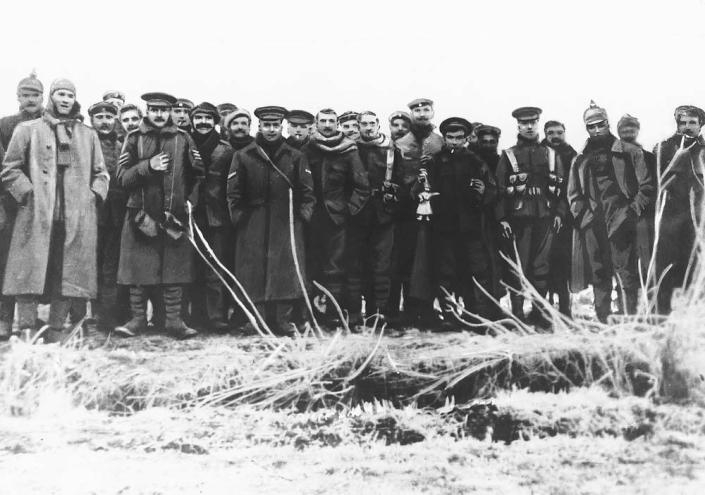
At the first light of dawn on Christmas Day, 1914, only five months after the outbreak of war in Europe, a group of weary German soldiers emerged from their trenches and approached the Allied forces across an area between them known as no-man’s-land.
“Merry Christmas,” the Germans called out in their enemies native tongue.
At first, the Allied soldiers feared it was a trick, but seeing the Germans unarmed they climbed out of their trenches and shook hands with the enemy soldiers.
“I think I have seen today one of the most extraordinary sights that anyone has ever seen,” British Captain A.D. Chater later wrote to his mother. “We were just going to fire on them when we saw they had no rifles, so one of our men went to meet them and in about two minutes the ground between the two lines of trenches was swarming with men and officers of both sides, shaking hands and wishing each other a happy Christmas.”
The men exchanged presents of cigarettes and rations and sang carols. “First the Germans would sing one of their carols and then we would sing one of ours,” recalled another British soldier named Stephen Lovell. “When we started up “O Come, All Ye Faithful,” the Germans immediately joined in singing the same hymn to the Latin words Adeste Fideles. And I thought, well, this is a most extraordinary thing — two nations singing the same carol in the middle of a war.” There was even a documented case of soldiers from opposing sides playing a good-natured game of soccer.
Captain Chater quickly realized his adversaries held the same concerns and thoughts as his comrades. “From what I gathered most of them would be glad to get home again as we should,” he wrote. “We exchanged cigarettes and autographs, and some more people took photos.”

On the German side, sentiments were similar. “What I had still believed to be madness several hours ago I could see now with my own eyes,” recounted German soldier Josef Wenzl. “One Englishman, who was joined soon by another, came towards us until he was more than halfway towards our trenches — by which point some of our people had already approached them. And so Bavarians and English, until then the greatest of enemies, shook hands, talked and exchanged items.”
Some soldiers used this short-lived ceasefire for a more somber task: the retrieval of the bodies of fellow combatants who had fallen within the no-man’s land between the lines.
But the fighting would continue once the brief respite ended. Each man knew it. They faced a court martial or worse if they refused.
“This extraordinary truce has been quite impromptu,” Chater’s letter continued. “There was no previous arrangement and of course it had been decided that there was not to be any cessation of hostilities.” Chater jokingly suggested the goodwill may continue after a week. “We are, at any rate having another truce on New Year’s Day, as the Germans want to see how the photos come out!”
Elsewhere the war raged on. Even on that day of December 25 1914, a reported 149 British troops were killed by enemy fire.
On one battlefield however, there was a “Christmas truce,” as it is often called.
A single star stood still in the sky directly above,” Wenzl recalled about that day, “and was interpreted by many as a special sign.”
(Some text reprinted from History.com “Christmas Truce of 1914”)

Two Minutes
 By Ken Zurski
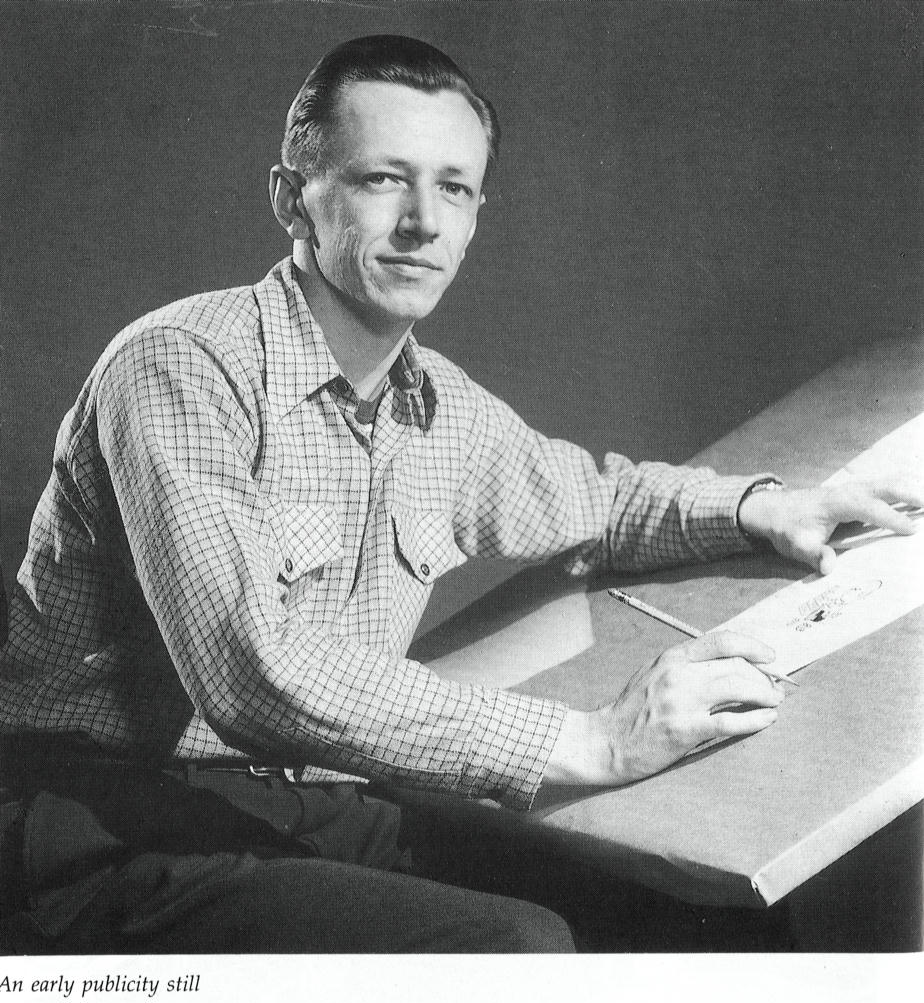
When “A Charlie Brown Christmas” was produced for television in 1965, Peanuts creator Charles Schulz asked for one thing in particular. That the special be about something. Namely, he insisted, it be about the true spirit of Christmas.
Otherwise, he said, “Why bother?
Of course, the spirit of the holiday is exactly what the special is about. Mostly lighthearted and inspirational, it’s highlighted by a moving scene in which the Linus character, blanket in hand, stands on a spotlighted stage and explains the true meaning of Christmas. It includes a biblical passage from the Book of Luke.
His words, like the special itself, has been charming audiences ever since.
 Charming, however, was not the word CBS executives used when they first viewed the completed special. They hated it -– or just didn’t get it. The pacing was off, they thought, and the music was different, classical in parts, jazzy in others. “This is probably going to be the last [Peanuts special],” one executive chirped. “But we got it scheduled for next week, so we’ve got to air it.”
The producers were deflated. “We thought we’d ruined Charlie Brown,”one exclaimed.
Until then, the only controversy was whether or not to include the use of a biblical verse in an animated special. Schulz again insisted. “If we don’t do it,” he said “who will.” Coca-Cola, the soft drink giant that sponsored the special, gave their blessing.
Linus’s big scene has reached iconic status now, both in popular culture and religious circles.
“For unto you is born this day in the city of David a Savior, which is Christ the Lord,” Linus recites. “And this shall be a sign unto you; Ye shall find the babe wrapped in swaddling clothes, lying in a manger. And suddenly there was with the angel a multitude of the heavenly host, praising God, and saying: ‘Glory to God in the highest, and on Earth, peace and goodwill towards men.
“That’s what Christmas is all about, Charlie Brown.”
Linus’s effective speech is also credited to the child actor who provided the voice. Before the special, Peanuts characters had only been heard in a Ford Commercial. The producer’s wanted them all to be voiced by children. Christopher Shea was only 8 years old at the time. He had the most innocent sounded voice and was tapped for the Linus character. His measured, straightforward reading is considered legendary. “It’s one of the most amazing moments ever in animation, “raved Peter Robbins, the original voice for Charlie Brown. Robbin’s voice was picked for Charlie Brown because it sounded “blah.”
Even though CBS thought it would only run for a year and be forgotten, once it was in the public consciousness, attitudes changed. Instantly, people began talking about it. The next year, the special won a Peabody award and an Emmy for Outstanding Christmas Programming. A lasting tribute to Charles Schulz original vision that it be about something – something with a message.
One scene in particular is still considered, as a producer described it later, as “the most magical two minutes in all of TV animation.”

How a Picture Print of a Steamboat Wreck Ties Into Christmas
By Ken Zurski
On the evening of January 13, 1840, a paddlewheel steamship named the Lexington was halfway through its voyage along the Atlantic coast, a short commuter jaunt between New York City and Stonington, Connecticut, when it caught fire and quickly burned. The fire started in the mast but spread to a large load of cotton bales, which caused a raging inferno that engulfed the entire ship. Many frightened passengers were forced to jump into the frigid water.
By the time a rescue ship, the sloop Merchant, arrived around noon the next day, only a handful of people were found clinging to floating bales or other debris. Nearly all of the 143 on board perished. Only four were found alive, among them three crew members including the ship’s pilot who told rescuers he huddled with others at the bow before it was overcome by fire. He found a bale and was able to sit out of the icy water until help arrived. Only one passenger survived.
The news was devastating to loved ones back in New York where most of the dead resided. The big city newspapers relayed the story in their usual graphic and expressive detail and imagination soared with the shocking details. At the time newspapers were just words on paper with no illustrations. Thanks to the Lexington disaster however that was about to change.
 A man named Nathaniel Currier was making lithographs of mostly business products like architectural plans and music manuscripts. Lithography, a process of printing using limestone, grease and water was not new, it had been invented nearly 30 years before Currier, an accomplished lithographer, perfected the craft in Boston and opened a New York shop of his own. But small printing jobs were not profitable and Currier needed to branch out. So he did portrait prints and memorials of the dead and finally made some money. In 1835, he had another idea. He produced a print depicting a true-life disaster. The print needed no more explanation other than the long title that accompanied the scene: Ruins of the Planter’s Hotel, New Orleans, which fell at two O’clock on the Morning of the 15th of May 1835, burying 50 persons, 40 of whom Escaped with their Lives. A picture that showed the news of the day, and produced at a rapid speed too, was striking indeed. It was a huge seller.
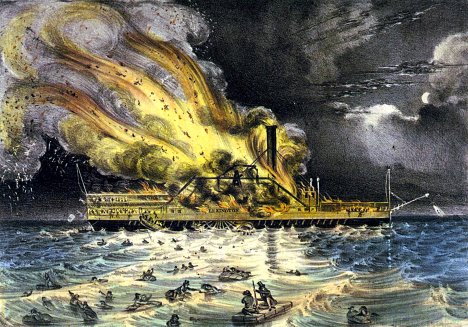
In 1840, Currier made another disaster print. It too had a long and detailed title: Awful Configuration of the Steamboat Lexington in the Long Island Sound on Monday Evening, January 13. 1840, by which melancholy occurrence over One Hundred Persons Perished. Based on an eyewitness description. the scene was as just as detailed as the newspaper’s words. The wounded steamship is seen burning in the background while a smattering of passengers struggle to stay above the choppy water. Some are on floating debris, others not. One man in a top hat and tails is seen reaching out to save another woman. Tragically, both are doomed.
Currier sold a bunch of the Lexington prints and was soon contacted by the editor of the New York Sun who wanted to put the depiction in the paper. An engraving of another steamboat wreck Home appeared in a competing a New York paper and the Sun was eager to do the same. Currier agreed and the Lexington print was boldly featured in a special edition.
But that’s not why Currier is remembered today.
 Experiencing a windfall from the Lexington sales, in 1852, Currier hired James Merritt Ives to be his bookkeeper. Just looking at the two men, the pairing was a physical mismatch. Currier was tall and thin while Ives was short and stout. But the two gelled together. Ives was an artist and quickly streamlined the business with his own and others artistic abilities. In turn, he built up a sizable and profitable inventory. Ives soon became a valuable and dependent part of the team and he and Currier bonded as co-workers and friends. Their eventual partnership In 1857, began the company we know today as Currier and Ives.
Through the years Currier and Ives issued and sold colored and uncolored prints of every variety, included portraits, city and rural landscapes, trains and ships of note, famous race horses, and historical pictorials like milestones of the Civil War.
Currier and Ives left behind a lifetime of memories and thanks to a a print of the Lexington wreck, forever changed an industry. But their most lasting prints are featured during the holiday season. The folksy scenes of snow and sleigh rides evoke a spirit that is immortalized every year on Christmas cards.
The song Sleigh Ride compares the Currier and Ives prints to other Christmas traditions like chestnuts popping and “pumpkin pie” as having “a happy feeling nothing in the world can buy.”
…It’ll nearly be like a picture print
By Currier and Ives
These wonderful things are the things
We remember all through our lives!
For Currier, however, it all started with a disaster.

Why “Jingle Bells” Is Such An Odd Christmas Song
By Ken Zurski
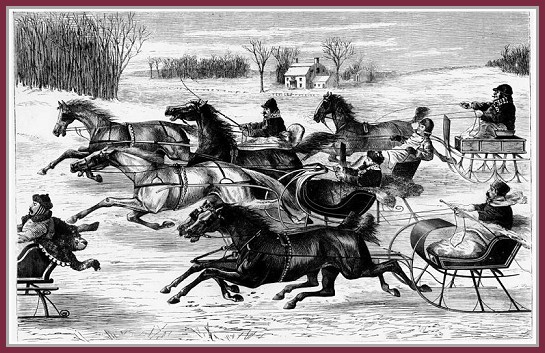
Besides the wintry scene, snow and sleigh, there isn’t much Christmas spirit in the song “Jingle Bells.” In fact the word Christmas, Santa or anything else holiday related isn’t included in the song at all. It’s about sleigh riding, more or less. More specifically, it’s about sleigh racing. After all, “dashing through the snow” didn’t mean taking a leisurely ride through the countryside. Oh and the bells, the “jingle bells,” they were there for a specific reason too.
Like many traditional Christmas songs, “Jingle Bells” has a strange and fascinating history. Even the first arrangement, which was less upbeat, is different than the one we hear today. Still it has a somewhat festive tone. So much so that early on, it is said, “Jingle Bells” was a used as a party song, featured in drinking establishments, and sung by drunkards who would clink their glasses like bells when the word was mentioned.
 This is not too difficult to imagine, since the song was written in the 1850’s, presumably inside a tavern. James Lord Pierpoint, a New Englander is credited with authoring “Jingle Bells.” Some suggest he wrote it in honor of the Thanksgiving feast rather than Christmas, which is unlikely on both counts. After all, how many carols were being written specifically about Thanksgiving?
Roger Lee Hall, a New England based music preservationist, does not refute or confirm the Thanksgiving theory only reiterates that Pierpoint may have written the song around or for Thanksgiving, but certainly not about it (although some may argue the song is about traveling). But like the lack of any Christmas themes, the song does not invoke the spirit of food or sharing – only a time and place. So at least the snow fits, especially in the upper east. In this case, Medford, Massachusetts.
It’s also been reported to have been written for the Sunday Choir since Pierpoint was the son of a minister. But as others point out, the song may have been too “racy” for a church, even though by today’s standards it hardly warrants such distinction.
Obviously we don’t hear the “racy” stuff in the modern version of “Jingle Bells,” since many of the original lyrics and several verses are eliminated completely. Only the first and familiar verse of the song is heard and usually repeated several times:
Dashing through the snow
In a one-horse open sleigh
O’er the fields we go
Laughing all the way
Bells on bobtail ring
Making spirits bright
What fun it is to ride and sing
A sleighing song tonight!
In one unfamiliar verse, the rider and his guest, a woman friend named “Fanny Bright,” get upended, or “up sot” (meaning capsized) by a skittish horse:
The horse was lean and lank
Misfortune seemed his lot
He got into a drifted bank
And then we got upsot.
In another verse, a similar mishap is ridiculed by a passerby:
A gent was riding by
In a one-horse open sleigh,
He laughed as there I sprawling lie,
But quickly drove away.
The chorus is then sung similar to what we know it today:
Jingle bells, jingle bells,
Jingle all the way;
Oh! what joy it is to ride
In a one-horse open sleigh.
(The word Joy was eventually replaced by “fun” in later versions.)
The last verse references the races:
Just get a bobtailed bay
Two forty as his speed
Hitch him to an open sleigh
And crack! you’ll take the lead.
Jingle Bells was originally released as “One Horse Open Sleigh” and later changed to “Jingle Bells, or One Horse Open Sleigh.” It was copyrighted in 1859 and first recorded on an Edison Cylinder in 1898. Popular orchestra leaders like Benny Goodman and Glenn Miller did big band renditions of the song in the 1930’s and 40’s and crooner Bing Crosby would record it in 1943. Crosby’s bouncy version with the Andrew Sisters is still considered a traditional favorite.
Today, “Jingle Bells” evokes laughter and joy and is often associated with Santa’s reindeer, so the term has certainly transcended its original purpose. Sleighs made no sound as they glided over the snow and bells were used as a stern warning. Hear jingly bells coming? Get the heck out of the way.
Or else.
Oh, what fun!
‘The Christmas Legend’ and the Introduction of Mrs. Claus
By Ken Zurski
“The Christmas Legend” is a short story written in the mid-nineteenth century by a Philadelphia missionary named James Rees. It tells the tale of a destitute American family that receives an unexpected visit from a couple of strangers on Christmas Eve. The constructive narrative sets up a deep exploration of family, loss and forgiveness; a classic Christmas formula. But the story itself is not widely known. In fact it would likely be completely forgotten had it not been for one word- “wife.” Today, it is cited as being the first time Santa Claus was associated with a spouse. It literately introduced the character we know now as Mrs. Claus.
Published in 1849, “The Christmas Legend” was part of a collection of 29 short stories written by Rees and compiled under the title, “Mysteries of City Life, or Stray Leaves from the World’s Book.” Each story is cleverly presented to represent the dissimilarity of many leaf types. For example, the maple leaf, Rees writes, is “golden and rich” and presents a sunnier disposition, while another like the gum tree leaf has a “bloody hue” and “stands fit emblem of the tragic muse.” He likens authors after the “forest trees” which “send forth their leaves unto the world.”
“And by what emblem shall we appear amongst those clustering trees,” Rees explains. “Let us see – Ah! The Ash Tree leaves are like ours, humble and plain to see, but hiding the silver underneath.”
In “The Christmas Legend,” Rees uses the spirit of the holiday to emphasis this point.
Here is the abbreviated story…
A family of four, mother and father, daughter and son, are sitting near the fireplace on Christmas Eve. The two children, especially the daughter, wonders if she should hang the stockings for Kris Kringle to come. But her mother raises doubt. There are more important things in life than earthly possessions, she states. “Poverty keeps from the humble door all the bright things of the earth, except virtue, truth and religion, these are more of heaven and earth, and are the poor man’s friend in time of adversity.”
“I thought that Santa Claus or Kris Kringle loved all those who are good, and haven’t I been good?” the daughter asks confused.
The mother tells her to leave the stocking up. “Customs at least should be observed, and perhaps the young heart may not be disappointed.”
The father is more introspective. He anguishes over a lost family member, the eldest child, another daughter who apparently ran away with a “dissipated” man seven years before and hasn’t been seen or heard from since.
Then there is a knock on the door.
Two strangers appear out of the night, an elderly couple carrying a bundle with “all their worldly wealth,” Rees writes. They ask how far away they are from the city and the father tells them it is “two miles.”
“Two miles?” the stranger says sadly, “we will not be able to reach it tonight. My dear wife is nearly tired out. We have traveled far today.”
The father invites them in and offers his best bed for them to rest. The strangers inquire if this is their whole family. “No. No,” the father says, “we had one other – a daughter.”
“Dead; Alas we all must die,” the old woman responds.
“Dead to us, but not to the world,” the man answers. “But let us speak of her no more. Here is some bread and cheese, it is all poverty has to offer, and to it you are heartily welcome.”
There is a silent pause, then the sound of cheerful merriment, music and laughter, is heard through the open windows and door. It’s their rich landlord, the father explains, mocking the poor. The old man interjects. “Ah, sir, human nature is a mystery, this is one of the enigmas, and can only be explained when the secrets of the hearts be known.”
The next morning, Christmas Day, the family awakes to find their small room filled with presents: books and games and toys. “O Father, Kris Kringle has been here,” the little girl says excitedly. “I am so happy.”
Here Rees as the narrator sets up the last part or moral of the story. “There are moments when the doors of memory and the bright sunshine of hope make the future all clear,” he writes. “Sorrow is not eternal; it has its changes, its stops; its antidote; they came in the moment of trial and – Presto! The whole scene of life is venerated in the pleasing colors of fancy.”
And that’s when something totally unexpected occurs. The old couple reappears to the family not as as they came, but as a vibrant young couple. The children recoil from fright, but the parents are curious. “How is this?” the father asks. “Why these disguises?”
“Hush, sir,” the once old man says laughing. “This is Christmas morn and we now appear to you not as Santa Claus and his wife, but as we are, the mere actors of this pleasing farce.”
The couple recognizes the old woman’s new face. It’s their long lost daughter. The girl hugs her mother, but the father is more skeptical, angry and weary of atonement. He lashes out at the girl as she approaches him. “Stand back!”, he shouts, then chastises the man who stands with her as a “paramour.” She begs him to reconsider. “No Father he is my kind and affectionate husband.”
“Ah, husband,” the father replies. He reaches for his daughter. They embrace.
Rees goes on to explain the girl ran away because she was “young and foolish” but loved the man who was forbidden from her home. They left America for England where her new husband became heir to a large estate. She sent letters home, but they were never received. Now she had returned back to her family on Christmas Day. A gift of love and hope. “Can you forgive me?” she asks.
“Say no more, all is forgotten. All is forgiven,” the father tells her.
Even though it is thinly defined, the mention of Santa Claus’s wife in “The Christmas Legend” is widely considered the first ever to appear in print. Two years later in 1851, the name Mrs. Santa Claus would be mentioned again in a story published in the Yale Literary Magazine. History tells the rest.
Today Mrs. Claus is considered a kindly old woman who helps her husband tend to his colds, stitches his clothes, and feeds his “round belly.”
“There are many interesting facts both historic and fabulous connected with the ceremonies, customs and superstitions of this day [Christmas], which if collected together today would make a curious and interesting book.” Rees explains in the introduction to his tale.
Apparently, he added to that.

.
How Twiggy’s Christmas Turn Got Upstaged by a Rock Star

By Ken Zurski
In September of 1977, British model and actress Twiggy appeared with Bing Crosby at the taping of the popular singer’s annual Christmas special. That year, the family holiday staple was being filmed overseas because the 74-year-old Crosby happened to be in Great Britain at the time for a concert tour. Crosby recruited several British entertainers as guests on the special titled “Christmas in England.” Twiggy was one.
Considered the “face of the 60’s” with a rail thin figure, short hair and strikingly large eyes, the teenage Twiggy was arguably the most recognized model in the world. In 1977, and at the age of 27, Twiggy was a still a multi-talented performer who picked up two Golden Globes for her work in The Boy Friend, a movie based on a musical set in the 1920’s about a theater group in England whose stage manager Polly (played by Twiggy) gets her big break when the leading lady literally “breaks a leg.”
In the Christmas special, Twiggy and Crosby sing a tender version of “Have Yourself a Merry Little Christmas.” Twiggy is refined, relaxed and clearly star struck. Crosby takes the lead on the song but the two trade verses and sing portions of the chorus together. Twiggy also appears in a sketch with Crosby and British actor Ron Moody, best known for his role as Fagin in the movie Oliver.

When the show was broadcast later that year, viewers watched with a heavy heart. Only a month after filming, in October, Crosby died from an apparent heart attack. The posthumously aired British-themed Christmas special would be his last.
In retrospect, Twiggy’s duet with Crosby is a sweet rendition of a holiday standard, done with class and professionalism, a trademark of Crosby with any singer. Twiggy held her own. But it’s forgotten today. However, another well-known British star – and an even more unlikely choice than Twiggy – would make a mark on the show that would last for years to come.
Glam rocker David Bowie initially turned down the request to be a guest because he didn’t like the song choice: “The Little Drummer Boy.” He eventually agreed to appear after Crosby’s musical arrangers wrote a new part of the song for him to sing, titled “Peace on Earth,” which he liked.
Peace on Earth, can it be
Years from now, perhaps we’ll see
See the day of glory
See the day, when men of good will
Live in peace, live in peace again
The two voices soared together. “Ah, that’s a pretty thing, isn’t it?” Crosby said after they finished the song.
Today, their version is considered a holiday classic.

 UNREMEMBERED