
History
The Split Thanksgiving Year: How FDR Altered The Holiday for Retail Recovery
By Ken Zurski

In September of 1939, Franklin Delano Roosevelt issued a presidential proclamation to move Thanksgiving one week earlier, to November 23, the fourth Thursday of the month, rather than the traditional last Thursday of the month, where it had been observed since the Civil War.
That year, the last Thursday of November fell on the 30th, the fifth week and final day of the month. That was considered a late start to the shopping season. The Retail Dry Goods Association, a group that represented merchants who were already reeling from the Great Depression, went to Commerce Secretary Harry Hopkins who went to Roosevelt.
Help the retailers, Hopkins pleaded.
Roosevelt listened. He was trying to fix the economy not break it.
Thanksgiving would be celebrated one week earlier, he announced.

Apparently, the move was within his presidential powers since no precedent on the date was set. Thanksgiving, the day, was not federally mandated and the actual date had been moved before. Many states, however, balked at Roosevelt’s plan. Schools were scheduled off on the original Thanksgiving date and a host of other events like football games, both at the local and college level, would have to be cancelled or moved.
One irate coach threatened to vote “Republican” if Roosevelt interfered with his team’s game. Others at the government level were similarly upset. “Merchants or no merchants, I see no reason for changing it,” chirped an official from the opposing state of Massachusetts.
In contrast, Illinois Governor Henry Horner echoed the sentiments of those who may not have agreed with the president’s switch, but dutifully followed orders.
“I shall issue a formal proclamation fixing the date of Thanksgiving hoping there will be uniformity in the observance of that important day,” he declared, steadfastly in the president’s corner.

Horner was a Democrat and across the country opinions about the change were similarly split down party line: 22 states were for it; 23 against and 3 went with both dates.
In jest, Atlantic City Mayor Thomas Taggart, a Republican, dubbed the early date, “Franksgiving.” Others called it “Roosevelt’s Thanksgiving” or “Roosevelt’s hangover Thanksgiving Day.” More politically, some dubbed it “Democratic Thanksgiving Day” and the following Thursday as “Republican Day.” One observer noted, “This country is so divided it can’t even agree on a day of Thanksgiving.”
In some Midwestern states, especially among farmers, the controversy was irrelevant thanks to a bountiful harvest. “This year the crops certainly justified Thanksgiving, even justified two,” reported the Omaha-World Herald.
Roosevelt made the change official for the succeeding two years ’40 & ’41, since Thursday would fall late in the calendar both times. Then in 1941 The Wall Street Journal released data that showed no change in holiday retail sales when Thanksgiving fell earlier in the month. Roosevelt acknowledged the apparent miscalculation.
However, due to the uproar, later that year, Congress approved a joint resolution making Thanksgiving a federal holiday to be held on the fourth Thursday of the month, regardless of how many weeks were in November.
On December 26, 1941, Roosevelt signed it into law.
The Man Who Gave ‘Google’ Its Name
By Ken Zurski
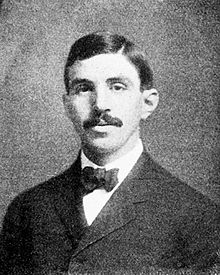
In the early half of the 20th century, shortly after World War I ended, mathematician Edward Kasner, a professor at Columbia University, devised the concept of showing the common features of whole numbers, no matter how large. As an example, he came up with the number one followed by a hundred zeros.
Writing out such a large number was ridiculous of course, and at the time formal names didn’t exist for numbers larger than a trillion.
But he needed a name.
So he asked his nine-year-old nephew Milton to intervene. During a causal stroll in New Jersey’s Palisades Woods, Edward wondered if Milton could come up with one. “Googol” was the boy’s answer. So Milton’s silly sounding recommendation became “Googolplex,” or one followed by a googol zeros. Kasner began using the name in his classes.
Flash forward more than 70 years in 1995 when two Stanford University students Larry Page and Sergey Brin began collaborating on a search engine they originally called BackRub. The project began to attract investors and bandwidth grew. But they needed a new name, something catchier, something they could easily register online.
Google was chosen as the common spelling of Googol which, thanks to Kasner, was as close to an infinite number as possible.
“We picked the name “Google” because our goal is to make huge quantities of information available to everyone,” Page later recalled.

When they presented the name however, math traditionalists balked. “You idiots, you spelled it [Googol] wrong!” one chastised. But Google.com was available and Googol.com was not. Besides, Page said, “It sounds cool and [still] has only six letters.”
According to an official statement Google’s corporate website (yes, there is one): “The name “Google” reflects Larry and Sergey’s mission to organize a seemingly infinite amount of information on the web.”
Simple enough. But what about young Milton? How did the word “Googol” pop into his head? Speculation runs rampant here. A great niece of Dr. Kasner, Denise Sirotta, claims her father Edwin, Milton’s younger brother, should get some credit since he claimed the siblings came up with the name together. “He was asked for a word with a sound that had lots of O’s in it,” she said.
Another observation seems to make more sense especially in the imaginative mind of a toddler. Caroline Birenbaum, another great-niece of Dr. Kasner’s, speculates the word was inspired by a comic-strip character named Barney Google, who debuted in 1919. She says Dr. Kasner, liked cartoons.
“He may have tweaked the spelling to avoid any trademark issues,” she claims.

Barney Google was an American comic strip created by Billy DeBeck, that originally appeared on the sports pages. Google had big “banjo” eyes, a mustache, a large bulbous nose, and wore a tuxedo-type suit. He was an “avid sportsman and N’er do well” involved with some of the more contentious contests like poker, prize fights and horse racing. Google’s bow-legged horse “Spark Plug” was introduced in 1922, and nicknamed “Sparky.” The horse was a nag who rarely raced, but when he did it became a big media event. Millions of readers bought in.
A popular song was introduced, a foxtrot, titled “Barney Google and Spark Plug”
Barney Google—with the goo, goo, googly eyes,
Barney Google—bet his horse would win the prize;
When the horses ran that day,
Spark Plug ran the other way!
Barney Google—with the goo-goo-googly eyes!
In 1934, another character named Snuffy Smith joined the fray and Barney Google and Spark Plug were phased out.
So Google, the word itself, was in the public consciousnesses long before the giant search engine came along. Still, Kasner had no idea that it would become so popular in the next century.
So where did his inspiration for the seemingly infinite number come from?
Kasner, who never married, cited a description of unrequited love. In a divorce case, he explained, a woman called the commitment she had for her husband as “a million billion billion times and eight times around the world.” Kaisner was struck by the expansive description. “It was the largest number ever conceived of,” he said. So he set out to immortalize it.
And his little nephew inspired a name.
Googolplex!

Charles Howard Hinton, the ‘Other Dimension,’ and the Birth of the Jungle Gym
By Ken Zurski
Mathematician Charles Howard Hinton was both equally fascinated and frustrated by the concept of the fourth dimension, also known as the “other dimension,” or the one dimension of time and space that no one had been able to verify or explain. Albert Einstein tried. He deduced in his Theory of Special Relativity that the fourth dimension is “time” and that “time is inseparable from space.” Since then science fiction writers have used the space-time continuum to great dramatic effect in their stories.
But in 1884, while Einstein was still a toddler, it was Hinton who wrote the definitive article on the subject. In “What is the Fourth Dimension?” Hinton explained that the theory behind a fourth dimension was firmly established, but there was no physical evidence to support it. That was the dilemma, he inferred: “If we think of a man as existing in four dimensions, it is hard to prevent ourselves from conceiving him prolonged in an already known dimension.” Hinton used a four-cornered room, or cube, for example, to explain how one can only reach three dimensions. “Space as we know it, is subject to limitation,” he conceded.
However, to teach his children math skills, Hinton built a three-dimensional bamboo dome with evenly spaced geometric shapes. His son, Sebastian, remembers climbing and hanging from the dome while his father called out intersections for the children to identify.
“X2, Y4, Z3, Go!” Hinton would command.
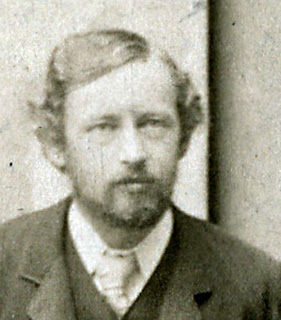
Hinton died unexpectedly in 1907 from a cerebral hemorrhage and while he is mostly remembered for his work on the fourth dimension, in stark contrast, he is also credited with introducing the first pitching machine – more like a gun – called the “mechanical pitcher,” and designed for the Princeton University baseball team. The machine used gunpowder to fire the ball.
But the geometric dome he created for his children also had a lasting effect. Especially on his youngest son Sebastian.
Here’s why:
Sebastian ended up marrying a teacher, Carmelita Chase, who grew up in Omaha, Nebraska and moved to Chicago in 1912 to become Jane Adams’ secretary at Hull House. That’s when she met Sebastian, a patent lawyer in town.
Carmelita was pretty, smart, and multi-talented. In college, she excelled in tennis (among other sports), acted in plays and sang in the choir. “She has distinguished herself in athletics as well her studies,” the Chicago Daily Tribune described in announcing the couple’s engagement in 1916. She and Sebastian would eventually have three children.
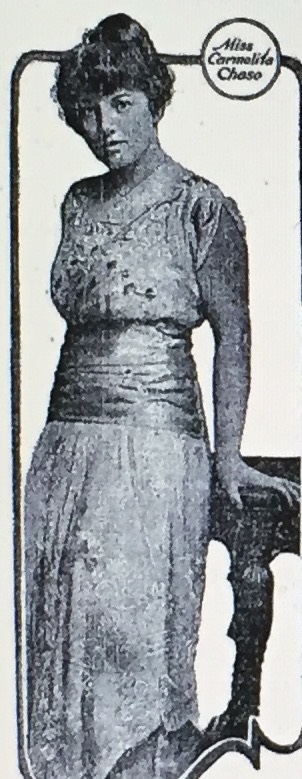
Shortly after getting married, however, Carmelita put most of her time and efforts into her work. She opened a kindergarten and nursery school at her Chicago apartment which was directly across from a park.
“Frustrated by her own ‘dreary’ school experience, she was determined to create learning environments for her school children and others that would be joyfully experimental,” author Susan Ware wrote about Carmelita in Notable American Women.
The type of teaching she endorsed already had a name: progressive education. For Carmelita, this included incorporating more outdoor activities like hiking, camping, farming and the care of animals to daily activities. “She would come into a room and it would be an explosion,” a former student recalled in the book Founding Mothers and Others, “But it was a happy occasion. She could sweep people up and carry them to Mars.”
In 1920, while watching his wife’s school children playing outside their Winnetka, Illinois home, Sebastian had a revelation. Why not build something they could climb on?
He envisioned a three-dimensional structure similar to his father’s geometric dome, but for play rather than instruction. He reportedly jotted down the idea on a napkin and perfected the plan for a patent submission. Then he built it.
Hinton called it a Jungle Gym.
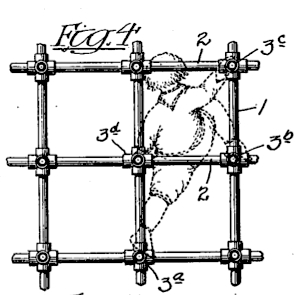
At the time of its conception, however, the Jungle Gym was never heralded as the important contribution to the children’s playground as it is today. In fact, Hinton’s only recorded words about his invention are attributed to his detailed patent filings: “Children seem to like to climb through the structure and swing their head downward by the knees, calling back and forth to each other. A trick which can only be explained of course by a monkey’s instinct.” While the name Jungle Gym never officially changed, many people began seeing the correlation with the primate’s distinctive behavior and started calling it “monkey bars” instead. The moniker stuck.
Unfortunately, Sebastian Hinton is a figure lost to time. Although he married a socialite in Carmelita, Hinton preferred to stay out of the spotlight. Tragically, just a few years after creating the Jungle Gym, he committed suicide in a clinic after reportedly being treated for depression.
Caremilta chose not to publicly disclose her husband’s illness and cause of death (he hung himself). She packed up the family and moved east. Today, she is best remembered for founding Putney School, an independent progress education institution in Vermont that is still in existence today.
Hinton’s original Jungle Gym is permanently on display in the backyard of the Winnetka Historical Society Museum.

P.T. Barnum’s Home Was Everything You Might Imagine It To Be
By Ken Zurski
Even though the redesign of the Royal Pavilion in Brighton, England in the early 19th century was the vision of its benefactor, Prince Regent, the future King George IV, the finished product, a mixture of many styles and influences, was the work of architect John Nash.
Nash’s design suited the future King, but hardly anyone else. “A masterpiece of bad taste” was one icy reception, while another described it as a “mad house.” Even Queen Victoria, wife of King William IV, King George’s successor, was unmoved calling it “odd” then demeaning its purpose. “Most of the rooms are low and I can see a morsel of the sea from one of my sitting windows,” she bemoaned, refusing to spend much time there.
Born in London in 1752, Nash earned a reputation for designing houses, castles really, for the wealthy. Eventually, his work caught the eye of the prince and in 1806 Nash became his personal architect. The re-imagining of the Royal Pavilion, originally called the Carlton House, was their partnership. Between 1815 and 1822, Nash added flourishing touches like the special dome features and another elaborate wing. The biting condemnations quickly followed.
But attitudes toward the Royal Pavilion would change.

In 1841, a rail line made it more accessible. Now more people could come and roam the grounds and enjoy the scenic location for themselves. And to the British commoner it was a work of art. Unfortunately the man who endured the constant jabs about his work from his peers, never lived long enough to see it appreciated. In 1835, shortly before the Pavilion became a popular tourist attraction, Nash died at the age of 83.
Nearly a decade after his death, Nash would be vindicated again when the Royal Pavilion was paid the ultimate compliment by an American and a visionary in his own right who not only admired the uniqueness of the building, he sought to copy it too.
In 1848 a mansion went up in the scenic countryside of Connecticut that looked oddly out of place for its location. Not only was it very large, occupying 17 acres of land, but the building itself with its exotic Indian influenced architecture looked like something you might spot in far off Mumbai or New Dehli, not Fairfield, near Bridgeport, Connecticut’s largest city.
All this was the creation of one man who commissioned the building of the mansion as a “permanent residence” for his family. His name was Phineas Taylor Barnum, better known as P.T. Barnum.
Barnum called his new home the Iranistan.
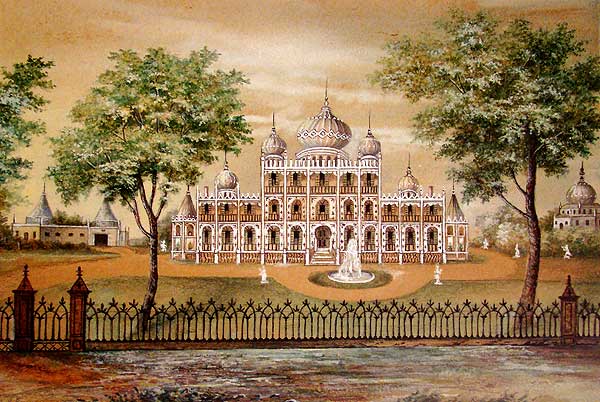
Barnum’s inspiration for Iranistan was Nash’s Royal Pavilion, a place he visited while doing a tour of England with his star attraction at the time, the 25-inch tall man known as Tom Thumb. Unlike others, Barnum was greatly pleased by what he saw. “It was the only specimen of oriental architecture in England,and had not been introduced into America,” he wrote.
Barnum hired a New York architect named Leopold Eidlitz to design it with the stipulation that he hold nothing back in terms of style and decorative elements. “The whole was finally completed to my satisfaction,” Barnum expressed, and on November 14, 1848, he held a house warming party for “a thousand guests.”
The invitees found a casual but garish palace to explore. Outside there was a circular carriage way , a fountain, urns and a decorative facade that was filled with symmetrically placed arched openings and numerous decks and porches. Topping the building were onion-shaped domes and minarets.
Inside, there was a circular divan under the dome, a large library adorned in Asian landscapes on its walls and elaborate stained glass windows that filled the rooms with colorful light. The grand ballroom sported a shiny wood floor with an inscription, “Love God and be Merry,” words Barnum used often.
“Elegant and appropriate furniture was made expressly for every room in the house,” Barnum would later write. “The stables, conservatories and out-buildings were perfect in their kind. There was a profusion of trees set out on the grounds. The whole was built and established literally ‘regardless of expense,’ for I had no desire even to ascertain the entire cost.”
In addition to the design, Barnum filled his home with animals of all kinds, as he did at his popular American Museum in New York City. Roaming the grounds of Iranistan were mandarin ducks, silver peasants, a cow named Bessie, and a pig named Prince Albert. The biggest attraction was Iranistan’s largest resident, an unnamed bull elephant. This, of course, was all by design. Barnum felt the addition of the animals, especially the elephant was good promotion for the museum. “When entertaining the public, it is best to have an elephant,” Barnum would later explain. It all started at his home.
But it wouldn’t last. Late on December 17, 1857, only nine years after it was built, the Iranistan was gone. Barnum, who was refurnishing the mansion at the time got the news the next morning by telegram while staying at the Astor House in New York. The building caught fire, he was told. It was a total loss.

The papers were consoling, but skeptical. Barnum’s good fortunes had recently taken a turn for the worse. It all started when Barnum sought to create a “perfect”town in Connecticut that he would call East Bridgeport. He convinced a large business, the Jerome Clock Company, to move their factory there in the hopes of bringing more people and jobs. The clock company agreed to relocate but first needed help to pay down a debt of $100,000 . Barnum loaned them the money, but was tricked into signing more cash notes. Soon he was responsible for a half million dollars of the companies debt and creditors were demanding money. Barnum was forced to go into bankruptcy and lost a fortune.
Many of his friends supported his plight with sympathy, loans and gifts, but others reveled in his misfortune. To his detractors, Barnum’s latest predicament – more like a humiliation – was subject to ridicule. “Here is a terrible illustration of where the practice of humbug will lead,” proclaimed the New York Herald.
The Chicago Tribune’s headline was even more biting. “The deceiver is duped,” it read.
In the midst of all this turmoil, Barnum lost his beloved Iranistan.
Initially, no cause of the fire was given. “It is supposed to have been set on fire,” was one newspaper dispatch, not mincing words, but refusing to elaborate. Later, it was suspected a construction worker dropped a lighted pipe. Barnum had recently moved some of the more expense furniture out of the Iransitan during the renovation and claimed he would soon return. His insurance money was far less then the initial cost of $150,000. “My beautiful Iranistan is gone,” Barnum would write in his autobiography
Barnum recovered financially after going on another successful tour of England with Tom Thumb. Upon his return he set out to build another home, again in Fairfield, called Lindencroft, that in its design was spacious, but far less extravagant than the Iranistan. “All the taste that money can could do was fairly lavished upon Lindencroft so that when all was finished it was not only a complete house in all respects, but a perfect home.” Barnum wrote his memoirs.
The biggest disappointment, however, was for the riders on a train line that would pass by the Iranistan grounds everyday. Not only was the impressive building gone, but they missed seeing the elephant, roaming the yard, helping plow the fields, and giving them all a thrill by raising its trunk and bobbing its head in a friendly gesture.

(Sources” The Great and Only Barnum by Candace Fleming; P.T. Barnum: The Legend and the Man by A.H. Saxon; various internet sites)
Dying For King, Country and Cloves

By Ken Zurski
In 1517, King Charles I of Spain, who had just assumed the throne at the tender age of eighteen, was approached by Ferdinand Magellan, a Portuguese explorer who came to the young King after being rejected by his own country. Magellan made Charles an offer. Let him sail around the world and in the process find a direct route to Indonesia and the Spice Islands, once successfully navigated by Christopher Columbus.
Charles found Magellan’s plan intriguing.
Columbus’s four voyages for Spain, among other revelations, claimed new lands and precious spices like cinnamon, nutmeg and cloves which grew in abundance on the elusive islands. If Magellan could find a way to get the spices back to Charles, Spain would reap the rewards and rule the spice trade.
Charles wholeheartedly approved the voyage and ordered five ships and a crew of nearly 300 men.

In 1519, Magellan set sail from Seville.
Four years later, limping back to port, only one ship named Victoria returned. Every other ship was lost including most of the men. Even Magellan was gone, hacked to death on April 27, 1521 after a fierce battle with a native tribe.
Despite this, the King was pleased.
The tragic news of the lost ships and crew was irrelevant. The Victoria came back with a cargo of 381 sacks of cloves, the most coveted of all spices. “No cloves are grown in the world except the five mountains of those five islands,” explained the ship’s diarist.
Charles questioned the returning men on claims of a mutiny and other charges of debauchery, but it didn’t matter.
He paid the royal stipends to survivors, basked in his clove treasure, and set in motion plans to put another crew back en route to the islands.

FDR Was a ‘Dying Man’ When Reelected for a Fourth Term in 1944.

By Ken Zurski
On February 7, 1951, the 22nd Amendment of the Constitution was ratified that set a two-term limit on the President of the United States. It states: “No person shall be elected to the office of the President more than twice, and no person who has held the office of President, or acted as President, for more than two years of a term to which some other person was elected President shall be elected to the office of the President more than once.”
Until then, although a handful of past presidents had tried, none had served more than two terms, a limitation the nation’s first president George Washington had advised others to follow. But at the time, there were no restrictions. So in 1940, the nation’s 32nd president, Franklin Delano Roosevelt, who had served two terms, broke new ground when he ran and was re-elected to a third term in office.
It wouldn’t end there.
But the next time Roosevelt ran it would be under far more grave conditions.
Roosevelt suffered from polio which limited his mobility, but in 1944 his appearance seemed to worsen. He looked feeble and weak; his eyes were often red and swollen; and his movements were slow and calculated. The American people heard rumors and speculation about the health of the incumbent, who was vying for an unprecedented fourth term in office, but no one was quite sure how bad his heath was.
So in March of 1944, nine months before the election, the White House announced a report by Roosevelt’s personal physician at the time, the surgeon general of the U.S. Navy, Dr. Ross McIntire, that claimed the 62-year-old Roosevelt was looking “tired and haggard” due to the stress and strain of the war years and nothing more.
“In my opinion,” McIntire added, “Roosevelt is in excellent condition for a man of his age.”
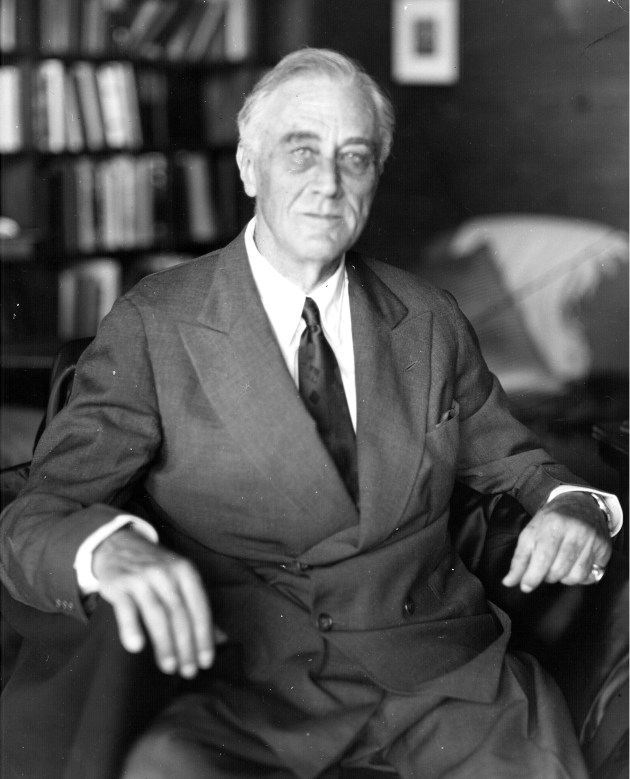
Behind the scenes, there were more pressing concerns. Dr. Frank Howard Lahey, a respected surgeon known for opening a multi-specialty group practice in Boston, was brought in for a consultation. Lahey’s connection with the Navy’s consulting board is what led him to the White House.
After a careful examination, Lahey informed Roosevelt that he was in advanced stages of cardiac failure and should not seek a fourth term. He even went so far as to warn Roosevelt that if he did win reelection, he would likely die in office. Roosevelt listened but did not follow Lahey’s advice. He felt it was his duty to continue.
The voting public agreed. Roosevelt, a Democrat, beat Republican challenger Thomas Dewey in what can be considered even by today’s standard as an overwhelming victory.
The voters, however, had no idea – at least not officially – that they had elected back into office a man who was living on borrowed time.
On April 12, 1945, less than three months after being sworn in for the fourth time, Roosevelt died.
The president’s death took most Americans by surprise. That’s because shortly after Roosevelt was reelected, McIntire went public again and helped quell the public fears by proclaiming FDR was fine.
Anything worse, he implied, would be “unexpected.”
Roosevelt Dies. Death Unexpected, the headlines blared, echoing McIntire’s previous sentiments.
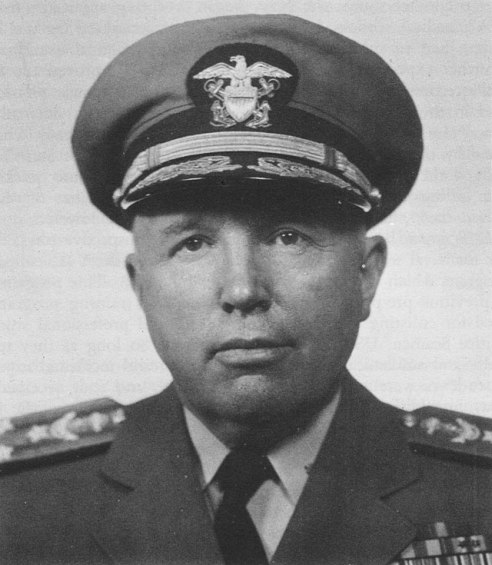
But an inquiring press wanted to know. As soon as Vice President Harry Truman was sworn in, questions were asked: How sick was the president? And if so, why didn’t the voting public know the truth about Roosevelt’s health?
In hindsight, Dr. Lahey’s report seemed to be the most truthful and forewarning. But information between a doctor and client is private. The White House only asked Lahey to consult the president. Whether the details were released was up to Roosevelt and his staff. Lehay himself could have spoke up, but chose to remain silent and honor the patient-doctor confidentiality agreement.
The report was concealed and only came to light six decades later.

The Out of This World Voice of Loulie Jean Norman
By Ken Zurski

Singer Loulie Jean Norman may not be a household name, but her voice is an unmistakable part of television history. More on that in a moment. First a little background.
Born in Birmingham, Alabama in 1913, Norman soon discovered a knack for singing. She was uniquely talented as a coloratura soprano, a vocal range most commonly suited for opera. Unlike counterparts like stage star Maria Callas, however, Norman took her gift to radio instead.
It was the 1930’s, and radio was just starting to emerge as an entertainment force. Norman was in her twenties at the time. Her voice and beauty were being noticed. So she moved from Birmingham to New York City to jump start her career. Modeling jobs paid the bills at first, but singing was her passion.
She eventually got bit parts in singing ensembles on several musical variety shows including one with Bing Crosby who would signal her out several times for her solo passages. Norman provided studio background vocals to hitmakers like Sam Cooke, Frank Sinatra, Mel Torme and Elvis Presley. On TV, she appeared on the Dinah Shore Show, with Dean Martin, and as a back-up on Carol Burnett’s popular variety program.
“When you sang,” a colleague once told Norman, “it was the angels [voice].”
But her most influential and unaccredited contribution is truly out of this world.

In 1964, when television producer Gene Roddenberry introduced a new space serial he asked a friend Jerry Goldsmith to write the theme music. Goldsmith was too busy but enlisted fellow composer and collaborator Alexander Courage, who was said to be no fan of the science fiction genre, but drew inspiration from a song he heard on the radio titled “Beyond the Blue Horizon, ” which was featured in the 1930 movie “Monte Carlo” and sung by actress Jeannette McDonald, a soprano.
Courage wrote the theme for Star Trek the TV series.
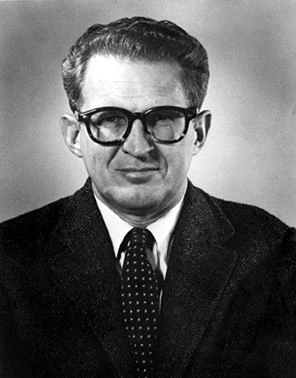
Roddenberry heard the music and for reasons some explain were financially motivated, wrote lyrics for the tune. “Hey, I have to get some money somewhere,” Roddenberry reportedly said. “I’m sure not going to get it out of the profits of Star Trek.”
In 1999, Snopes.com confirmed there were Star Trek lyrics and debunked the theory that they (unearthed here) were ever used in the TV show’s theme.
Beyond
The rim of the star-light
My love
Is wand’ring in star-flight
I know
He’ll find in star-clustered reaches
Love,
Strange love a star woman teaches.
I know
His journey ends never
His star trek
Will go on forever.
But tell him
While he wanders his starry sea
Remember, remember me.
Courage was surprised – and perhaps, a bit offended – by Roddenberry’s lyrical contribution. He had included a voice in his recording, but no words. In the end, as Snopes reported, the lyrics were never used.
The choice of a singer was another matter. Courage picked someone similar to MacDonald, who ironically died the year the theme was written. It was Loulie Jean Norman. At the time, Norman was known for her studio work. Plus, she wasn’t a big enough star to turn down such an offer. Norman had the range Courage needed to make the tune work.
Star Trek: The Original Series ran for three seasons and 79 episodes. In the third and final year, despite a growing fan base, Roddenberry was hopelessly fighting low ratings, high production costs, and threats from the network to cancel.
He reportedly couldn’t pay Norman her royalty cut that year.
So after the second season, the theme was re-recording without the vocals.
Norman continued to do studio work, mostly backing vocals for songs like The Tokens version of The Lion Sleeps Tonight. The papers called Norman “the invisible soprano” for the work behind the scenes. “You’ve heard the voice, even if you’ve never heard the name.”
Even though fame eluded her, Norman acknowledged she would have been uncomfortable with it. “The reason why I didn’t care about being a star is because I saw what happened to stars,” she said in 1995. “I was close enough to see that they were not very happy.”
Norman died in August of 2005 at the age of 92.
Her obituary mentioned that unrecognized role.
“A voice heard around the world,” it read, “in the wordless, Star Trek theme.
The Masterfully Coordinated Order to Clear the Skies on 9/11
By Ken Zurski
In Simon Winchester’s book The Men Who United the States, the author begins a chapter titled “And Then We Looked Up,” by giving a personal account of driving up the Sierra Nevada near California’s Donner Pass and seeing nothing but the overhead blue of a mostly clear early Autumn day.
Something struck him odd, however.

“Normally there were at least a few contrails lacing the sky,” Winchester explains.
This would have been noticeable Winchester points out because of the number of transcontinental jets usually waiting to land in Oakland or San Francisco, a couple hundred miles away. But on this crisp, clear Tuesday morning. Nothing. “No contrails whatsoever,” Winchester writes.
Winchester’s observation is understandable given the date: September 11, 2001.
The skies were empty of jets, because the skies across the entire country were emptied of jets.

How that happened is the basis of Winchester’s chapter and it starts with one man in particular, Ben Sliney, the operations manager at the Air Traffic Control Systems Command Center in Virginia.
On September 11, 2001, at approximately 9:45am EDT, Sliney on his own initiative – and through the collective advice of an experienced staff – gave an order he knew well, but never thought he would ever implement: SCATANA.
SCATANA is an acronym, of course, and stands for Security Control of Air Traffic and Air Navigation Aids. It’s a military and legal enforcement that within its power requires all commercial aircraft to land immediately at the airport closest to where they happened to be. It also required all airports to forbid any flights from taking off. A nationwide Ground Stop, as it is more commonly called.
In essence, it cleared the skies of contrails.
Such a command is rarely ordered in a lifetime and to hear it broadcast over the radio must have given each and every pilot pause. “This is not a drill” was repeated each time the directive was announced.
This is not a drill! This is not a drill!
Within minutes the nearly 5,000 commercial flights in the air began diverting to the nearest and safest place to land. “It was obeyed, masterfully,” Winchester writes, adding, “Every pilot appeared to cooperate; none of significance appeared to balk.” The total compliance is even more impressive given the assumption that most of the pilots had no idea why the order was given.
Since it was confirmed that hijacked planes were used like bombs to attack the World Trade Center Towers and the Pentagon and a third plane likely destined for anther location fell from the sky over Pennsylvania, each and every aircraft was regarded as a potential threat. “A weapon of vast power that could be unleashed at any of a score of targets,” Winchester writes.

Within an hour and half after Sliney had sent the signal, every plane was down – and safely. The intent of SCATANA had been achieved. All but military fighter jets and for a time, Air Force One,remained in American skies.
This likely didn’t sit well with the plane’s passengers who were bound for areas like Oregon or New York and suddenly found themselves on the ground at Lincoln, Nebraska, or somewhere else far from their original destination. Millions were certainly inconvenienced. Once they were in sight line of a television set, however, attitudes likely changed.
Three days later, the jets were back flying again as the country tried to recover and get back to some semblance of normality.
The man at the center of it all, Ben Sliney, seemed to take his role in stride.
In the book, Winchester doesn’t get into Sliney’s life story, only the significance of his actions that day. Sliney in his 50’s at the time was a 25-year vet of the FAA and knew his stuff. He had held various positions in air traffic control supervision before becoming the operations manager for the nation’s top air traffic control hub. It was a job he had worked hard to achieve.
On Tuesday, September 11, 2001 Sliney was in his first full day at that position.
That day he gave the unprecedented order. SCATANA: This is not a drill! This is not a drill!
And the skies cleared.

The Alarming and Defining Divorce Rate of 1915
By Ken Zurski
In 1915, the United States of America held the dubious distinction of having the highest divorce rate in the world. Comparatively, by today’s standard, the rate was relatively low at 10-percent, but at the time it was considered alarming. So much so that changes were made to help save the institution of marriage.
Why 1915? The book Victorian America explains that divorces increased fifteen-fold at the start of the 20th century and in 1915 reached a peak (the first time the percentage number hit double digits). But there were other reasons why that year in particular was significant. It was perhaps the last year before the world changed in a way in which everything shifted, both socially and culturally.
A war was on overseas and 1915 began with hope that US boys could stay out of the fray in Europe. Attitudes changed however in May of that year when the British ocean liner Lusitania was befallen by a German U-boat torpedo. Americans were among the victims. President Wilson heard the war cries, but still waited. In April 1917, as more American merchant ships were taken out by the Germans, he commissioned Congress to declare war.
Although the US was only in the “war to end all wars” a short time, it still had a significant impact on the nation’s sensibilities. The women’s rights movement had been underway for more than decade but gained footing after the war. Women found a role and acceptance by replacing enlisted men in manufacturing jobs and working in munitions factories. This only emboldened their resolve. In 1919, the 19th amendment was passed giving women the right to vote.
The Roaring 20’s was next.
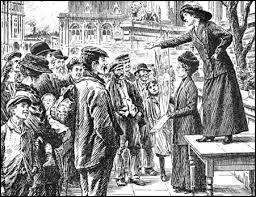
So one can argue that 1915 was the last conventional year before America and the world changed as a whole. For statisticians, it’s also a good spot in the historical timeline to make a point. And so that year, 1915, according to statistics, was the year more marriages began ending in divorce. It keep going up from there.
So why? Well that’s tricky and more difficult to pinpoint. Until then, getting a divorce was a process, often embarrassing and difficult for women who were dependent on a man to leave.
Getting married, however, now that was easy.
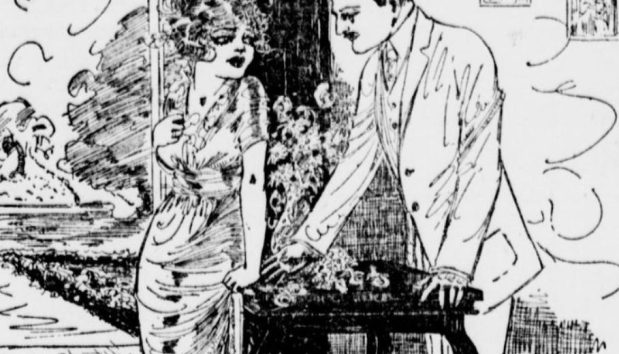
Men’s attitude especially towards sex usually led them to ask for their ladies hand in marriage sooner than later. “The moment you taste the happiness of the marriage union, you will curse yourself a fool, that you lived so long without it,” one frisky male suitor wrote to another in the late 1800’s. He wasn’t talking about chess pie.
It’s not that couples weren’t having premarital sex, but negative sentiments by more morally conscious women were hard to change and oftentimes carried down through generations. In many instances, out of necessity, women married men they did not love or find attractive. Some women abstained from sex due to fear. Once married, the desire was even less.
So just as quickly as marriages began, the physical relationship was strained. This led to more drinking and straying. So divorce became a tool that was fueled both by the liberation of women as much as it was the chauvinism of men.
According to Victorian America in 1915, “one out of every seven marriages ended in divorce in the nation at large.” And in some larger cities like San Francisco, one in four.
To counter this disturbing trend, marriage legislation was passed that raised the age of consent and called for stricter requirements to prohibit certain types of common-law, polygamous, even interracial marriages. Many states also strengthened rules for divorce by requiring longer stay of residence before petitioning for divorce and stricter guidelines by which a couple could legally be granted one. In most cases something criminal or abusive needed to be proven. Only two states, New Mexico and Oklahoma, allowed a divorce simply on the grounds of incompatibility.
In addition, separate courts were established to help families cope with problems that often led to a rift in marriage, including unfaithfulness, desertion, spousal or child abuse and alcoholism.
All this seemed to help keep marriages together, but due to the number of immigrants flooding the country and the increase in population, marriages in general increased and the number of divorces nationally remained high.
Today, due to the addition of annulments, property divisions and child custody laws, the divorce rate hovers around or just below 50-percent.
.
Andrew Carnegie and the Million Dollar Question
By Ken Zurski
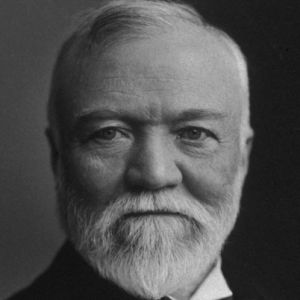
For a man whose mission it was to relinquish his entire fortune before his death, Andrew Carnegie still had plenty of money left when he passed in 1919 at the age of 83. That’s no indictment of a man who built a massively successful business, became the richest man in America, and devoted his later years to giving it all back. It was a noble thing to do. But Carnegie had made so much capital that even he found it difficult to allocate the funds sufficiently.
So he asked for help.
Carnegie grew up poor in Scotland, came to America, and amassed millions in the steel industry. Along the way, he made just as many enemies as dollars. Like many so-called tycoons of his time, Carnegie was accused of cutthroat practices which sacrificed workers’ rights for the bottom line. In protest, workers revolted.
The Homestead Strike of 1892 was due to a dispute between steel workers at Carnegie’s Homestead, Pennsylvania plant and management which refused to raise workers’ pay despite a windfall in profits. The riot that followed is still one of the bloodiest labor confrontations in history. Ten men were killed in the melee and Carnegie who continued production with nonunion workers, was blamed for the uprising.
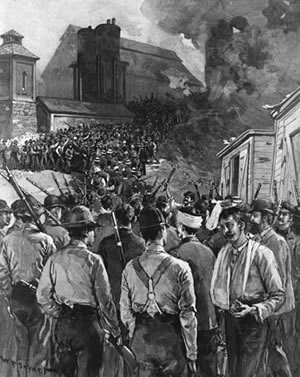
Carnegie viewed it differently than the workers. He believed that reducing production costs meant lower prices to consumers. Therefore, he theorized, the community as a whole profited, not the unions. It was a slippery slope. But, many asked, was it worth men dying for?
Carnegie, of course, thought of himself as a benefactor and did not apologize for becoming a wealthy man. When he retired, however, he made it clear that being rich was only relative: “Man must have no idol and the amassing of wealth is one of the worst species of idolatry! No idol is more debasing than the worship of money! Whatever I engage in I must push inordinately; therefore should I be careful to choose that life which will be the most elevating in its character.”
Carnegie didn’t hand out money haphazardly. He spent it on things and places that moved him. Among other worthy causes, the most prominent were funds for more schools – especially in low income communities – and the building or expansion of public libraries. In each case, he released the money only after specific demands were met, each one designed to make sure none of it went to waste. Carnegie had final approval.
In 1908, at the age of 72, with millions more left to give, Carnegie wrote a letter to people he admired. It was in effect an offer disguised as a question: “If you had say five or ten million dollars (close to 5-billion today) to put to the best possible use, what would you do with it?” Many of the correspondence were business leaders and some were presidents of institutions already bearing the Carnegie name. Most responded in kind that the money should be used to continue fellowships.

The letters were an indication that the burden of giving away a fortune was weighing heavy on Carnegie’s mind.
“The fact is that after spending about $50-million on libraries, the great cities are generally supplied and I am groping for the next field to cultivate,” Carnegie wrote to President Theodore Roosevelt, looking for inspiration. “You have a hard task as present but the distribution of money judiciously is not without its difficulties also and involves harder work than ever acquisition of wealth did.” Carnegie wrapped up the letter by pointing out the absurdity of that last line. “I could play with that and laugh,” he noted.
In the end, of course, Carnegie left enough money behind to take care of his wife and daughter. His loyal servants and caretakers were awarded pensions and his closest friends received substantial annuities.
Carnegie gave away an estimated $350 million dollars, but for the rest, he had one final request. After the will segments were dived up, nearly $20-million remained in stocks and bonds.
He bequeathed that amount to the Carnegie Corporation organization he proudly founded, and which still exists today.

- ← Previous
- 1
- 2
- 3
- …
- 7
- Next →
 UNREMEMBERED